Most companies say they value integrity. It sits on the wall next to “excellence” and “customer obsession,” and nobody can tell you what it would look like to fail at it.
When I had a privilege of managing Yapsody India people and processes, we did something less comfortable. We defined integrity precisely, built our employee tiers around it across every department, and made advancement contingent on demonstrating it – before the promotion, not after.
This is what that looked like, what it cost, and what I’d tell you to do differently.
What was actually broken
Nothing dramatic. That’s the point.
People were late. Deadlines slipped. Commitments made in one meeting quietly didn’t survive to the next. Nobody was incompetent and nobody was malicious – the work was getting done, mostly, eventually, and the shortfall in each individual case was small enough to absorb.
That’s exactly what makes it hard to fix. There’s no crisis to point at. There’s just a persistent gap between what the company said it would do and what arrived, and a lot of energy spent absorbing it: chasing, re-planning, building slack into every estimate to cover the slippage you’d learned to expect.
The instinct in that situation is to reach for motivation, or for tighter tracking. We had a different diagnosis. The problem wasn’t that people didn’t care or weren’t watched closely enough. It was that commitments themselves had become soft, routinely assumed rather than made, routinely missed without anyone saying so, routinely absorbed rather than repaired. The word had stopped meaning anything, so the work built on it couldn’t hold.
If that’s the problem, no amount of motivation fixes it. You have to make the word mean something again.
The definition we used
We didn’t invent our definition. We took it from Werner Erhard, Michael Jensen and Steve Zaffron’s work on integrity as a positive phenomenon – meaning a matter of function rather than virtue.
The distinction matters more than it sounds. In their model, integrity is the state of being whole and complete. A wheel is in integrity when every spoke is intact. It isn’t a good wheel; it’s a working wheel. Break a spoke and the wheel isn’t bad – it’s out of true, and it will not perform as designed until someone trues it.
Applied to a person, integrity means honoring your word. And your word turns out to be much larger than the promises you made out loud. It includes what you said, what you know to do or not do, what others expect of you in relationships you want to keep working, what you assert to be true, what you say you stand for, and the standards of the groups you belong to.
That’s a wide net. But the crucial move is the second one: honoring your word does not mean never breaking it. It means keeping it, or as soon as you know you won’t – saying so to everyone affected and cleaning up the mess your failure caused them.
Without that second clause, the whole thing collapses. A standard nobody can meet doesn’t produce integrity; it produces concealment. People hide what they aren’t allowed to admit.With that clause, the standard becomes achievable by anyone on any day, because it’s no longer about perfect delivery. It’s about nothing going unspoken.
Why we put it in the tier structure
Here’s the argument that convinced me.
Performance problems look like motivation problems, so that’s where leaders reach first – incentives, pep talks, a re-org, someone new. It rarely works, and I think the reason is that motivation is an input, and inputs are subject to the efficiency of the system they enter.
Where integrity is missing, effort leaks. Commitments that were never actually made get assumed. Expectations that were never declined stay live. Broken promises get quietly hoped past instead of disclosed, so the person downstream discovers the problem at the deadline instead of three weeks earlier when it was solvable. Add motivation to that system and you get more effort, not proportionally more output.
A car needs fuel or nothing happens at all. But fuel isn’t what separates a high-performance engine from an ordinary one. That’s the integrity of the parts – tolerances held, every component doing exactly what it was designed to do. Same fuel, very different results.
If that’s true, then integrity isn’t a nice-to-have alongside performance. It’s the thing that determines how much performance you get per unit of effort. And if it’s that, it belongs in how you decide who advances.
How the tiers worked
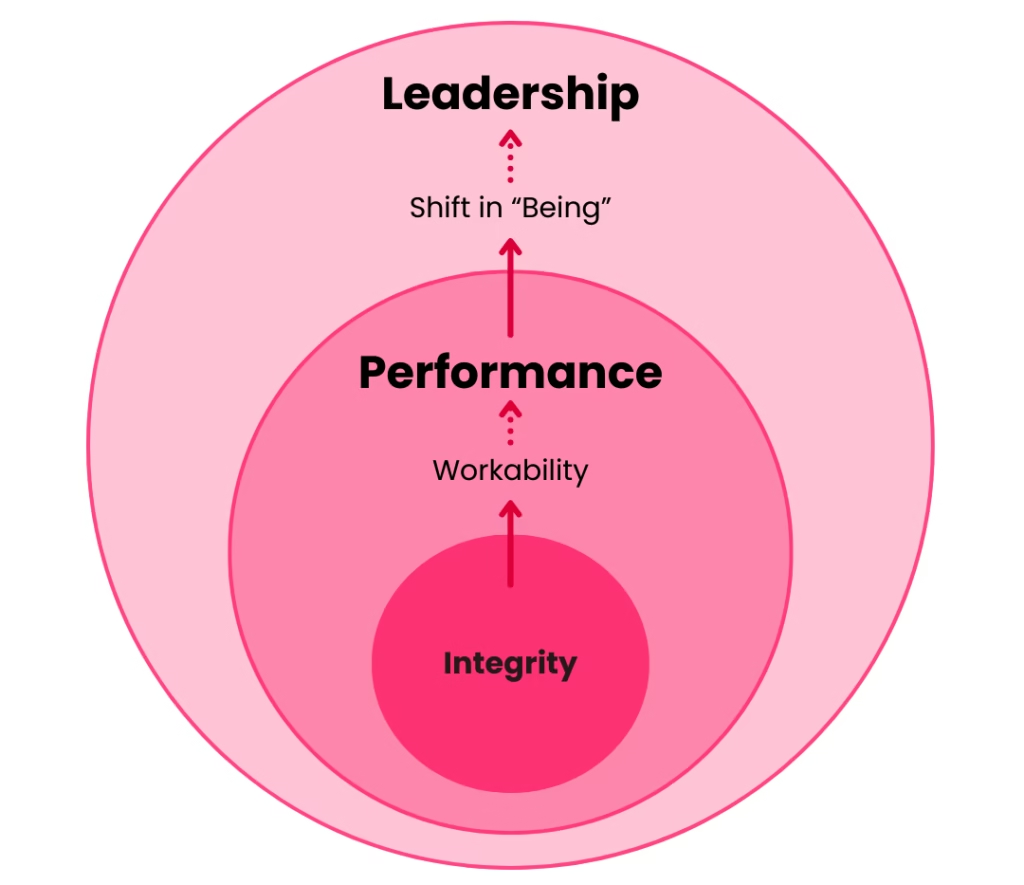
We ran seven tiers across every department. The names were the framework:
I1 → I2 → IP1 → IP2 → IP3 → IPL1 → IPL2
Your tier told you which of the three principles you were accountable for. The letters accumulated – you never stopped being responsible for integrity because you had moved on to leadership.
Most companies use L3, L4, L5. Ask someone at L4 what L4 means and you get a compensation band. Ask someone at IP2 what IP2 means and they can tell you: I have integrity, I generate performance, and I’m starting to demonstrate leadership. The ladder explained itself, which mattered more than I expected – it meant the framework survived without constant re-explanation from me.
The I tier – integrity
At this level people learn from their team and practice completing assigned work as required and on time. Moving up within the tier means becoming proficient at problem-solving.
Two design decisions here are worth stating plainly, because both are contestable.
Integrity was a hiring gate, not a development goal. It had to be present at I1 or we didn’t hire. We were not in the business of teaching adults to keep their word; we were in the business of giving people conditions where keeping it was possible. What people developed at I1 was competence.
I1 had a clock on it. The expectation was one year, and by the end of it a person needed to be capable of I2. This is the most aggressive thing in the structure and I’d expect an argument about it. My defense: the alternative is people sitting for years in a tier with no path, which is a worse thing to do to someone, and quieter about it.
I2 was explicitly a preparation tier – the point was to practice generating performance while still being assessed on integrity, so that the jump to IP1 wasn’t a jump into an unfamiliar standard.
The IP tier – integrity and performance
Here we assumed knowledge of your area. The work shifted to problem-solving and optimizing workflow. Individual contributors were hired directly into IP2, because we expected them to partner with others and act as a mentor or coach – being senior and working alone wasn’t a combination we had a slot for.
The progression through IP is a progression in scope and in fluency:
- IP1 – proven ability to create structures. You optimize your own workflow and plan your own work from provided instructions.
- IP2 – you optimize your team’s workflow, not just your own. You may be accountable for one or more people. Leadership starts being demonstrated, not just performance.
- IP3 – you must be accountable for people. You’re not practicing the optimization any more, you’re fluent in it. And you plan the team’s work from required goals rather than provided instructions.
That last shift is the one that actually separated the tiers. IP1 and IP2 execute against instructions. IP3 executes against goals. The difference is who decides what the work is.
The IPL tier – integrity, performance and leadership
At this tier you are directly accountable for people, a process, or a function. We recognized three kinds, deliberately, so that leadership didn’t collapse into headcount:
People leadership – directly managing a team at I or IP level, with real authority over hiring, promotion, performance management and termination.
Function leadership – owning a project or an area of expertise as a subject matter expert. A player/coach: you have your own work to deliver, and you mentor, train and coach the team, and you take the escalated or complex cases.
Process leadership – owning day-to-day operations and the processes that control them. Measuring how the functions are actually performing, auditing for gaps, and working with team leads to close them.
Keeping all three as legitimate routes mattered. Without it, the only way up is to acquire reports, and you end up promoting your best specialists out of the work they were exceptional at.
The expectation at IPL was that you could create thought leaders around you – and at IPL2, that you could provoke other leaders to change their own behavior, and build structures within which they could demonstrate leadership themselves. Which is the loop closing: leadership at the top of the ladder is the work of creating conditions where the people below you can be in integrity.
How a promotion was actually decided
Three inputs: leadership, HR, and team ratings.
The team ratings mattered more than their weight suggests. Integrity is not visible from above. A manager sees whether you delivered; the people working alongside you see whether you said you’d deliver, whether you told them when you couldn’t, and whether they had to build slack into their own plans to cover you. That information exists only laterally, and if you don’t collect it you are assessing performance and calling it integrity.
What the three inputs were looking for was a sequence, not a checklist:
- Have they demonstrated it? Visibly, in the role they currently hold.
- Have they internalized it? Is this how they operate, or is it something they perform when observed? The tell is what happens under pressure – integrity that survives a bad quarter is internalized, integrity that appears in review season is not.
- Have they started coaching others in it? This was the real threshold. Not whether you keep your word, but whether the people around you keep theirs better because of you.
That third question is why the ladder works as a ladder rather than a set of hurdles. It maps directly onto the framework’s own claim about leadership – that its distinct contribution is creating conditions where other people can be in integrity. Coaching others is that, in its smallest observable form. Someone doing it at IP2 is already doing the thing IPL is named for.
Demonstrated first, promoted second. Not potential. Not a development plan stapled to a new title. The behaviors had to be visible in the role the person already held.
The test case: the high performer who is out of integrity
Every company that says it values integrity eventually meets this person. They produce. The numbers are good, sometimes the best on the team. And their word means nothing – commitments made and dropped without mention, expectations accepted and quietly abandoned, other people’s plans built on assurances that were never going to hold.
Most companies keep them. The results are legible and the damage isn’t.
We gave them the chance to restore integrity. And when it wasn’t restored repeatedly, we let them go – in every case.
The order was never ambiguous: integrity first, performance second. Not integrity and performance, weighted and traded off. Integrity as the precondition, performance as what you do once it’s there. If that ordering only holds when it’s cheap, it isn’t an ordering – it’s a preference, and everyone can tell the difference.
Two things convinced me this was right rather than merely principled.
The output was never worth the input. A person whose word doesn’t hold makes everyone around them slower. Their teammates build private buffers. Plans get made twice. Work gets re-checked because nobody can rely on the first answer. That cost is spread across a dozen people and shows up in none of them individually, while the producer’s own numbers stay pristine. You are looking at a visible gain and an invisible, larger loss.
Nobody wanted to work with them. This turned out to be the clearest signal we had, and it arrived long before anything showed up in a metric. When a team is quietly reorganizing itself to route around someone, that team already knows something the org chart doesn’t.
But isn’t integrity supposed to be restorable?
Fair objection, and it deserves a direct answer, because the framework does say a broken commitment is repairable – disclose it early, clean up what it cost, re-promise, carry on. If that’s true, how does anyone get let go for being out of integrity?
They don’t. Not for that.
Missing a commitment is ordinary and expected. Everyone does it. The framework exists precisely to make that survivable – it’s a bent spoke, and spokes get trued. Nobody was ever let go for a broken promise, however large, that they named and cleaned up.
What we acted on was one level up.
Restoring integrity is itself a promise. When you sit down with someone and they say yes, I see it, here’s how I’ll operate from now – that is their word. They’ve committed to a way of working. So when the same pattern returns, unchanged, unmentioned, the failure isn’t the original one repeating. It’s a new one: they are now out of integrity on the commitment to restore integrity.
Do that once and it’s the ordinary case again – name it, clean it up, go again. We did go again, more than once, with people worth the effort.
But the recursion doesn’t run forever. At some point the pattern has told you what it is: this person will make whatever commitment ends the conversation, including the commitment to stop doing that. And once the repair mechanic is itself the thing being broken, there is nothing left underneath it to appeal to. You’ve reached the bottom of the stack.
That’s what made these decisions clean rather than agonized. We weren’t judging character or deciding who deserved to stay. We were observing that a sequence had completed itself – one the person had been given every opportunity, in the open, to interrupt.
So the rule was never never break your word. It was when you break it, say so and put it right. People who did that kept their jobs regardless of how often they had to do it. People who kept promising to and didn’t, didn’t – regardless of what they produced.
The part that mattered most: shared language
The tier structure was the mechanism. The language was what actually changed the company.
We made “integrity” a working word rather than a value. People said I’m out of integrity on that in ordinary meetings. They said let me restore integrity on this before we go further. It became normal to open a status update by naming a commitment you were going to miss.
I underestimated how much this would do. Three things came from it:
It gave people a way to admit a miss without confessing a character flaw. “I’m out of integrity on the deadline” is a statement about a condition. “I let you down” is a statement about a person. The first one gets said out loud. The second one gets avoided, and the information stays hidden until it’s too late to use.
It made declining legitimate. This is the piece most people miss when they encounter this framework. You are not obligated to accept every expectation placed on you – you’re obligated to respond to it. Saying no, clearly, to the person’s face, is a complete act of integrity. What isn’t available is silence. Once that was understood, the volume of quietly-carried, never-agreed-to obligations dropped sharply, and so did the number of things that failed because nobody had ever actually committed to them.
It relocated the conversation from blame to repair. The question stopped being whose fault and became what’s out, and what would restore it. That’s a faster conversation and it produces a fix.
We got a word wrong, and it was the middle one
The P in IPL did not originally stand for Performance. It stood for Power.
The intent was specific and, I still think, correct: the capacity to produce results, to act effectively, to have your intentions show up in the world. That’s a real thing and it deserves a name.
But that is not what people heard. In a company, with the word printed on a tier that determines who gets promoted, power has an obvious and much louder meaning – authority over other people. And it landed exactly there. Moving up the ladder started to sound like acquiring power over rather than capacity to. Which handed a certain kind of manager a vocabulary they should not have had, and gave everyone else a reason to be suspicious of the whole framework.
So we renamed it. Power became Generating High Performance, and the definition changed with it: the results you actually produce, rather than your ability to direct the behavior of others.
Three things about this are worth taking away.
The abuse potential was in the word, not the people. Nobody set out to misread it. The word had a dominant everyday meaning, that meaning was available for misuse, and in an environment where the word carried consequences, it got used. If you put a term into your promotion criteria, you don’t get to control which of its meanings people apply. You get the loudest one.
The tier labels never changed. Power and Performance both start with P, so I, IP and IPL survived intact. We changed what the framework meant without touching what anyone was called. If you’re going to correct a concept mid-flight, that’s the cheap version.
We were slower to catch it than we should have been. The signal was there early – you could hear it in how people talked about promotions – and it took us a while to recognize that a word we had chosen carefully was doing damage anyway. A framework that claims language shapes behavior should expect to have its own language audited, regularly, by people who aren’t the ones who wrote it.
I’d offer this as the general lesson rather than a footnote about one word: every term you elevate into a formal structure will be interpreted by people who did not attend the meeting where you defined it. Test your vocabulary against its most self-serving reading, not its intended one. Assume someone will find the version of the word that benefits them, and pick the word that has no such version.
Bringing in outside help
We worked with Landmark and Vento Group to build a coaching series for the leadership layer. I’d defend the decision to bring in outside partners, for one reason: this framework is very hard to install top-down by a CEO alone. If it comes only from me, it reads as a management program, and management programs are things people wait out. Having practitioners run the leadership work made it a thing leaders had done themselves rather than a thing they were rolling out.
What I’d warn you about
I’d be doing you no favors if I wrote this as a success story with no edges. Four things to watch.
The vocabulary can become insider language. Every framework carries jargon, and this one carries more than most. Used carelessly, it sorts people into those who talk the way we talk and those who don’t. Watch for the moment when the phrasing starts mattering more than the substance, and translate back into plain English when it does.
It can be weaponized into moralizing. The whole point of a positive model is that being out of integrity is a condition, not a sin. But “you’re out of integrity” is one tone of voice away from an accusation. If managers start using it that way, you have built a more sophisticated instrument for blame and you’re worse off than when you started. The moment a manager uses the phrase to make a report feel small, the model is being used backwards.
This is not hypothetical, and it’s not confined to the word integrity – the Power rename above is the same failure, caught. The vocabulary you attach to advancement is the vocabulary that will get used in the room where advancement is decided. Audit it on that assumption.
The disclosure norm requires a real guarantee. You are asking people to name their misses early. That only works if it is reliably safer than hiding them. The first time someone discloses early and gets punished for it, everyone learns the real rule, and you don’t get told again. This has to be defended personally and visibly, by whoever has the authority to make the promise stick.
Selection effects are not results. A framework like this makes some people thrive and others leave. Both are outcomes, and it’s worth being honest about the second – with yourself and in public.
Would I do it again?
Every time.
I’d rather give you a more qualified answer than that, because unqualified endorsements are easy to write and easy to ignore. So here is the qualification: I’d change how it was specified, not whether we did it. The IPL1 threshold needed to be written properly. “Proven ability” needed observable behaviors attached to every instance of it. And we should have audited our own vocabulary earlier than we did – the Power problem was visible in how people talked about promotions well before we acted on it.
But the decision to put integrity at the base of the ladder, and to hold that ordering when it was expensive, I would make again without hesitation.
The strongest evidence I can offer isn’t my opinion. It’s still in place. It has outlasted my tenure as CEO, which is the only test of an organizational framework that means much. Systems that depend on their author don’t survive their author. This one did – I think because the tier names carried the meaning, so the framework kept explaining itself after the person who introduced it stopped being in the room.
What I’ll say without hesitation is that the sequence matters. Define the word precisely. Make clean-up and declining explicitly safe before you attach anything to advancement. Then tie it to the tiers.
Do it in the other order – consequences first, safety second – and you won’t build integrity. You’ll build a company that has learned a better vocabulary for hiding.