Categories
Articles

We Made Integrity a Promotion Requirement. Here’s What Happened

Most companies say they value integrity. It sits on the wall next to “excellence” and “customer obsession,” and nobody can tell you what it would look like to fail at it.

When I had a privilege of managing Yapsody India people and processes, we did something less comfortable. We defined integrity precisely, built our employee tiers around it across every department, and made advancement contingent on demonstrating it – before the promotion, not after.

This is what that looked like, what it cost, and what I’d tell you to do differently.

What was actually broken

Nothing dramatic. That’s the point.

People were late. Deadlines slipped. Commitments made in one meeting quietly didn’t survive to the next. Nobody was incompetent and nobody was malicious – the work was getting done, mostly, eventually, and the shortfall in each individual case was small enough to absorb.

That’s exactly what makes it hard to fix. There’s no crisis to point at. There’s just a persistent gap between what the company said it would do and what arrived, and a lot of energy spent absorbing it: chasing, re-planning, building slack into every estimate to cover the slippage you’d learned to expect.

The instinct in that situation is to reach for motivation, or for tighter tracking. We had a different diagnosis. The problem wasn’t that people didn’t care or weren’t watched closely enough. It was that commitments themselves had become soft, routinely assumed rather than made, routinely missed without anyone saying so, routinely absorbed rather than repaired. The word had stopped meaning anything, so the work built on it couldn’t hold.

If that’s the problem, no amount of motivation fixes it. You have to make the word mean something again.

The definition we used

We didn’t invent our definition. We took it from Werner Erhard, Michael Jensen and Steve Zaffron’s work on integrity as a positive phenomenon – meaning a matter of function rather than virtue.

The distinction matters more than it sounds. In their model, integrity is the state of being whole and complete. A wheel is in integrity when every spoke is intact. It isn’t a good wheel; it’s a working wheel. Break a spoke and the wheel isn’t bad – it’s out of true, and it will not perform as designed until someone trues it.

Applied to a person, integrity means honoring your word. And your word turns out to be much larger than the promises you made out loud. It includes what you said, what you know to do or not do, what others expect of you in relationships you want to keep working, what you assert to be true, what you say you stand for, and the standards of the groups you belong to.

That’s a wide net. But the crucial move is the second one: honoring your word does not mean never breaking it. It means keeping it, or as soon as you know you won’t – saying so to everyone affected and cleaning up the mess your failure caused them.

Without that second clause, the whole thing collapses. A standard nobody can meet doesn’t produce integrity; it produces concealment. People hide what they aren’t allowed to admit.With that clause, the standard becomes achievable by anyone on any day, because it’s no longer about perfect delivery. It’s about nothing going unspoken.

Why we put it in the tier structure

Here’s the argument that convinced me.

Performance problems look like motivation problems, so that’s where leaders reach first – incentives, pep talks, a re-org, someone new. It rarely works, and I think the reason is that motivation is an input, and inputs are subject to the efficiency of the system they enter.

Where integrity is missing, effort leaks. Commitments that were never actually made get assumed. Expectations that were never declined stay live. Broken promises get quietly hoped past instead of disclosed, so the person downstream discovers the problem at the deadline instead of three weeks earlier when it was solvable. Add motivation to that system and you get more effort, not proportionally more output.

A car needs fuel or nothing happens at all. But fuel isn’t what separates a high-performance engine from an ordinary one. That’s the integrity of the parts – tolerances held, every component doing exactly what it was designed to do. Same fuel, very different results.

If that’s true, then integrity isn’t a nice-to-have alongside performance. It’s the thing that determines how much performance you get per unit of effort. And if it’s that, it belongs in how you decide who advances.

How the tiers worked
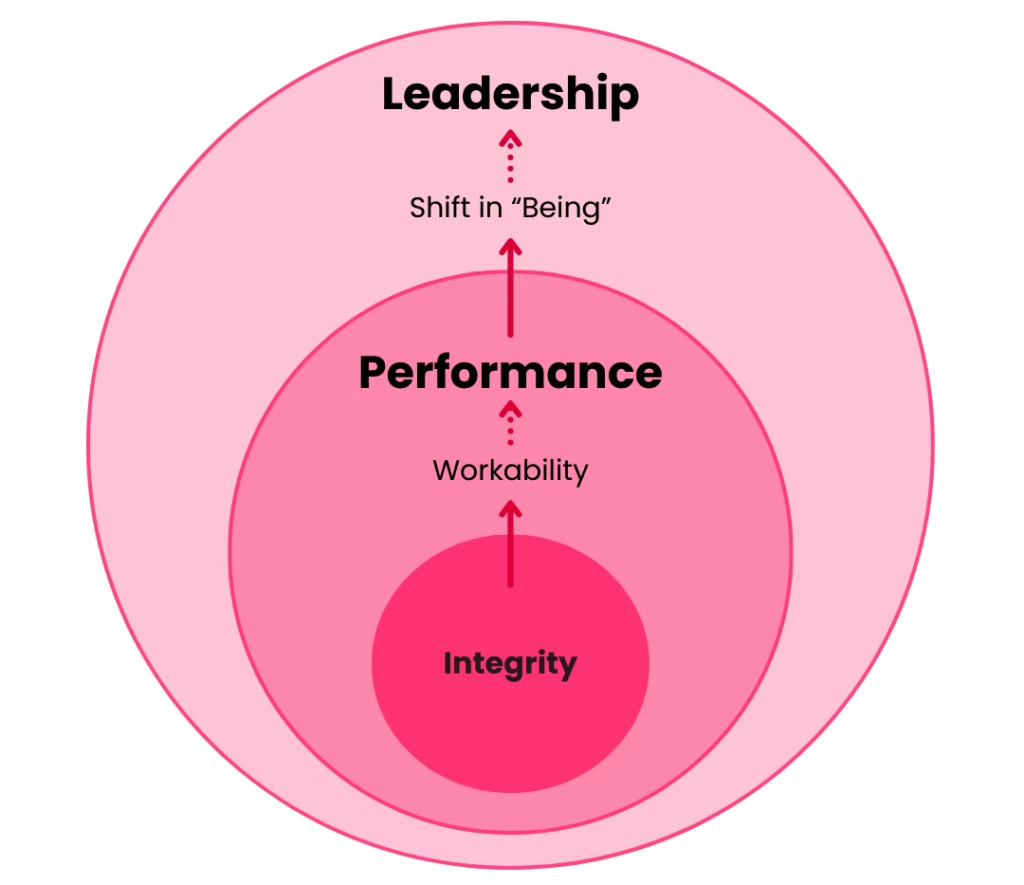
We ran seven tiers across every department. The names were the framework:

I1 → I2 → IP1 → IP2 → IP3 → IPL1 → IPL2

Your tier told you which of the three principles you were accountable for. The letters accumulated – you never stopped being responsible for integrity because you had moved on to leadership.

Most companies use L3, L4, L5. Ask someone at L4 what L4 means and you get a compensation band. Ask someone at IP2 what IP2 means and they can tell you: I have integrity, I generate performance, and I’m starting to demonstrate leadership. The ladder explained itself, which mattered more than I expected – it meant the framework survived without constant re-explanation from me.

The I tier – integrity

At this level people learn from their team and practice completing assigned work as required and on time. Moving up within the tier means becoming proficient at problem-solving.

Two design decisions here are worth stating plainly, because both are contestable.

Integrity was a hiring gate, not a development goal. It had to be present at I1 or we didn’t hire. We were not in the business of teaching adults to keep their word; we were in the business of giving people conditions where keeping it was possible. What people developed at I1 was competence.

I1 had a clock on it. The expectation was one year, and by the end of it a person needed to be capable of I2. This is the most aggressive thing in the structure and I’d expect an argument about it. My defense: the alternative is people sitting for years in a tier with no path, which is a worse thing to do to someone, and quieter about it.

I2 was explicitly a preparation tier – the point was to practice generating performance while still being assessed on integrity, so that the jump to IP1 wasn’t a jump into an unfamiliar standard.

The IP tier – integrity and performance

Here we assumed knowledge of your area. The work shifted to problem-solving and optimizing workflow. Individual contributors were hired directly into IP2, because we expected them to partner with others and act as a mentor or coach – being senior and working alone wasn’t a combination we had a slot for.

The progression through IP is a progression in scope and in fluency:

  • IP1 – proven ability to create structures. You optimize your own workflow and plan your own work from provided instructions.
  • IP2 – you optimize your team’s workflow, not just your own. You may be accountable for one or more people. Leadership starts being demonstrated, not just performance.
  • IP3 – you must be accountable for people. You’re not practicing the optimization any more, you’re fluent in it. And you plan the team’s work from required goals rather than provided instructions.

That last shift is the one that actually separated the tiers. IP1 and IP2 execute against instructions. IP3 executes against goals. The difference is who decides what the work is.

The IPL tier – integrity, performance and leadership

At this tier you are directly accountable for people, a process, or a function. We recognized three kinds, deliberately, so that leadership didn’t collapse into headcount:

People leadership – directly managing a team at I or IP level, with real authority over hiring, promotion, performance management and termination.

Function leadership – owning a project or an area of expertise as a subject matter expert. A player/coach: you have your own work to deliver, and you mentor, train and coach the team, and you take the escalated or complex cases.

Process leadership – owning day-to-day operations and the processes that control them. Measuring how the functions are actually performing, auditing for gaps, and working with team leads to close them.

Keeping all three as legitimate routes mattered. Without it, the only way up is to acquire reports, and you end up promoting your best specialists out of the work they were exceptional at.

The expectation at IPL was that you could create thought leaders around you – and at IPL2, that you could provoke other leaders to change their own behavior, and build structures within which they could demonstrate leadership themselves. Which is the loop closing: leadership at the top of the ladder is the work of creating conditions where the people below you can be in integrity.

How a promotion was actually decided

Three inputs: leadership, HR, and team ratings.

The team ratings mattered more than their weight suggests. Integrity is not visible from above. A manager sees whether you delivered; the people working alongside you see whether you said you’d deliver, whether you told them when you couldn’t, and whether they had to build slack into their own plans to cover you. That information exists only laterally, and if you don’t collect it you are assessing performance and calling it integrity.

What the three inputs were looking for was a sequence, not a checklist:

  1. Have they demonstrated it? Visibly, in the role they currently hold.
  2. Have they internalized it? Is this how they operate, or is it something they perform when observed? The tell is what happens under pressure – integrity that survives a bad quarter is internalized, integrity that appears in review season is not.
  3. Have they started coaching others in it? This was the real threshold. Not whether you keep your word, but whether the people around you keep theirs better because of you.

That third question is why the ladder works as a ladder rather than a set of hurdles. It maps directly onto the framework’s own claim about leadership – that its distinct contribution is creating conditions where other people can be in integrity. Coaching others is that, in its smallest observable form. Someone doing it at IP2 is already doing the thing IPL is named for.

Demonstrated first, promoted second. Not potential. Not a development plan stapled to a new title. The behaviors had to be visible in the role the person already held.

The test case: the high performer who is out of integrity

Every company that says it values integrity eventually meets this person. They produce. The numbers are good, sometimes the best on the team. And their word means nothing – commitments made and dropped without mention, expectations accepted and quietly abandoned, other people’s plans built on assurances that were never going to hold.

Most companies keep them. The results are legible and the damage isn’t.

We gave them the chance to restore integrity. And when it wasn’t restored repeatedly, we let them go – in every case.

The order was never ambiguous: integrity first, performance second. Not integrity and performance, weighted and traded off. Integrity as the precondition, performance as what you do once it’s there. If that ordering only holds when it’s cheap, it isn’t an ordering – it’s a preference, and everyone can tell the difference.

Two things convinced me this was right rather than merely principled.

The output was never worth the input. A person whose word doesn’t hold makes everyone around them slower. Their teammates build private buffers. Plans get made twice. Work gets re-checked because nobody can rely on the first answer. That cost is spread across a dozen people and shows up in none of them individually, while the producer’s own numbers stay pristine. You are looking at a visible gain and an invisible, larger loss.

Nobody wanted to work with them. This turned out to be the clearest signal we had, and it arrived long before anything showed up in a metric. When a team is quietly reorganizing itself to route around someone, that team already knows something the org chart doesn’t.

But isn’t integrity supposed to be restorable?

Fair objection, and it deserves a direct answer, because the framework does say a broken commitment is repairable – disclose it early, clean up what it cost, re-promise, carry on. If that’s true, how does anyone get let go for being out of integrity?

They don’t. Not for that.

Missing a commitment is ordinary and expected. Everyone does it. The framework exists precisely to make that survivable – it’s a bent spoke, and spokes get trued. Nobody was ever let go for a broken promise, however large, that they named and cleaned up.

What we acted on was one level up.

Restoring integrity is itself a promise. When you sit down with someone and they say yes, I see it, here’s how I’ll operate from now – that is their word. They’ve committed to a way of working. So when the same pattern returns, unchanged, unmentioned, the failure isn’t the original one repeating. It’s a new one: they are now out of integrity on the commitment to restore integrity.

Do that once and it’s the ordinary case again – name it, clean it up, go again. We did go again, more than once, with people worth the effort.

But the recursion doesn’t run forever. At some point the pattern has told you what it is: this person will make whatever commitment ends the conversation, including the commitment to stop doing that. And once the repair mechanic is itself the thing being broken, there is nothing left underneath it to appeal to. You’ve reached the bottom of the stack.

That’s what made these decisions clean rather than agonized. We weren’t judging character or deciding who deserved to stay. We were observing that a sequence had completed itself – one the person had been given every opportunity, in the open, to interrupt.

So the rule was never never break your word. It was when you break it, say so and put it right. People who did that kept their jobs regardless of how often they had to do it. People who kept promising to and didn’t, didn’t – regardless of what they produced.

The part that mattered most: shared language

The tier structure was the mechanism. The language was what actually changed the company.

We made “integrity” a working word rather than a value. People said I’m out of integrity on that in ordinary meetings. They said let me restore integrity on this before we go further. It became normal to open a status update by naming a commitment you were going to miss.

I underestimated how much this would do. Three things came from it:

It gave people a way to admit a miss without confessing a character flaw. “I’m out of integrity on the deadline” is a statement about a condition. “I let you down” is a statement about a person. The first one gets said out loud. The second one gets avoided, and the information stays hidden until it’s too late to use.

It made declining legitimate. This is the piece most people miss when they encounter this framework. You are not obligated to accept every expectation placed on you – you’re obligated to respond to it. Saying no, clearly, to the person’s face, is a complete act of integrity. What isn’t available is silence. Once that was understood, the volume of quietly-carried, never-agreed-to obligations dropped sharply, and so did the number of things that failed because nobody had ever actually committed to them.

It relocated the conversation from blame to repair. The question stopped being whose fault and became what’s out, and what would restore it. That’s a faster conversation and it produces a fix.

We got a word wrong, and it was the middle one

The P in IPL did not originally stand for Performance. It stood for Power.

The intent was specific and, I still think, correct: the capacity to produce results, to act effectively, to have your intentions show up in the world. That’s a real thing and it deserves a name.

But that is not what people heard. In a company, with the word printed on a tier that determines who gets promoted, power has an obvious and much louder meaning – authority over other people. And it landed exactly there. Moving up the ladder started to sound like acquiring power over rather than capacity to. Which handed a certain kind of manager a vocabulary they should not have had, and gave everyone else a reason to be suspicious of the whole framework.

So we renamed it. Power became Generating High Performance, and the definition changed with it: the results you actually produce, rather than your ability to direct the behavior of others.

Three things about this are worth taking away.

The abuse potential was in the word, not the people. Nobody set out to misread it. The word had a dominant everyday meaning, that meaning was available for misuse, and in an environment where the word carried consequences, it got used. If you put a term into your promotion criteria, you don’t get to control which of its meanings people apply. You get the loudest one.

The tier labels never changed. Power and Performance both start with P, so I, IP and IPL survived intact. We changed what the framework meant without touching what anyone was called. If you’re going to correct a concept mid-flight, that’s the cheap version.

We were slower to catch it than we should have been. The signal was there early – you could hear it in how people talked about promotions – and it took us a while to recognize that a word we had chosen carefully was doing damage anyway. A framework that claims language shapes behavior should expect to have its own language audited, regularly, by people who aren’t the ones who wrote it.

I’d offer this as the general lesson rather than a footnote about one word: every term you elevate into a formal structure will be interpreted by people who did not attend the meeting where you defined it. Test your vocabulary against its most self-serving reading, not its intended one. Assume someone will find the version of the word that benefits them, and pick the word that has no such version.

Bringing in outside help

We worked with Landmark and Vento Group to build a coaching series for the leadership layer. I’d defend the decision to bring in outside partners, for one reason: this framework is very hard to install top-down by a CEO alone. If it comes only from me, it reads as a management program, and management programs are things people wait out. Having practitioners run the leadership work made it a thing leaders had done themselves rather than a thing they were rolling out.

What I’d warn you about

I’d be doing you no favors if I wrote this as a success story with no edges. Four things to watch.

The vocabulary can become insider language. Every framework carries jargon, and this one carries more than most. Used carelessly, it sorts people into those who talk the way we talk and those who don’t. Watch for the moment when the phrasing starts mattering more than the substance, and translate back into plain English when it does.

It can be weaponized into moralizing. The whole point of a positive model is that being out of integrity is a condition, not a sin. But “you’re out of integrity” is one tone of voice away from an accusation. If managers start using it that way, you have built a more sophisticated instrument for blame and you’re worse off than when you started. The moment a manager uses the phrase to make a report feel small, the model is being used backwards.

This is not hypothetical, and it’s not confined to the word integrity – the Power rename above is the same failure, caught. The vocabulary you attach to advancement is the vocabulary that will get used in the room where advancement is decided. Audit it on that assumption.

The disclosure norm requires a real guarantee. You are asking people to name their misses early. That only works if it is reliably safer than hiding them. The first time someone discloses early and gets punished for it, everyone learns the real rule, and you don’t get told again. This has to be defended personally and visibly, by whoever has the authority to make the promise stick.

Selection effects are not results. A framework like this makes some people thrive and others leave. Both are outcomes, and it’s worth being honest about the second – with yourself and in public.

Would I do it again?

Every time.

I’d rather give you a more qualified answer than that, because unqualified endorsements are easy to write and easy to ignore. So here is the qualification: I’d change how it was specified, not whether we did it. The IPL1 threshold needed to be written properly. “Proven ability” needed observable behaviors attached to every instance of it. And we should have audited our own vocabulary earlier than we did – the Power problem was visible in how people talked about promotions well before we acted on it.

But the decision to put integrity at the base of the ladder, and to hold that ordering when it was expensive, I would make again without hesitation.

The strongest evidence I can offer isn’t my opinion. It’s still in place. It has outlasted my tenure as CEO, which is the only test of an organizational framework that means much. Systems that depend on their author don’t survive their author. This one did – I think because the tier names carried the meaning, so the framework kept explaining itself after the person who introduced it stopped being in the room.

What I’ll say without hesitation is that the sequence matters. Define the word precisely. Make clean-up and declining explicitly safe before you attach anything to advancement. Then tie it to the tiers.

Do it in the other order – consequences first, safety second – and you won’t build integrity. You’ll build a company that has learned a better vocabulary for hiding.
Categories
Articles

Choosing the Right Way to Motivate Your Team

A few years back, I had two engineering teams stalled on the same platform migration. On paper, both wanted the same outcome – get off the legacy system before it started costing us reliability. But one team was arguing about sequencing, and the other was quietly convinced the whole migration was the wrong call to begin with. I made the mistake most leaders make in that moment: I gave both rooms the same pep talk. It worked for one team. It did nothing for the other.

That sent me back to a framework I’d come across years earlier – Clayton Christensen, Matt Marx, and Howard Stevenson’s Tools of Cooperation and Change. The idea is simple but easy to forget in the moment: before you reach for a leadership tool, diagnose what people actually agree on. A technique that works brilliantly in one situation can fail completely in another, and more often than not, the problem isn’t the tool – it’s the diagnosis.

Picture it like planning a climb with your team. Some people are excited about the summit but can’t agree on the route. Others know exactly how to make the climb but aren’t convinced the summit is worth it. A few disagree about both. And every so often, you get a team that shares the same ambition and trusts the same way of getting there.

From a distance, all four situations look identical: the team isn’t moving. But each one calls for a different response from you as the leader. Do you explain the vision? Introduce a process? Offer an incentive? Set a firm boundary? Or step back and let the culture carry the team forward? The answer depends entirely on the kind of agreement that already exists.

Why Good Leadership Tools Often Fail

Leaders have a lot of tools available to them: vision, storytelling, incentives, training, standard operating procedures, measurement, role modeling, negotiation, and formal authority. The common mistake and I’ve made this one myself is picking a favourite tool and reaching for it every time.

A visionary leader assumes a more inspiring presentation will resolve every disagreement. A process-oriented manager responds to uncertainty by adding another checklist. A decisive leader imposes a solution before understanding the resistance. A team with a strong culture keeps repeating familiar rituals even when the environment demands something different.

The problem usually isn’t the tool. It’s the diagnosis.

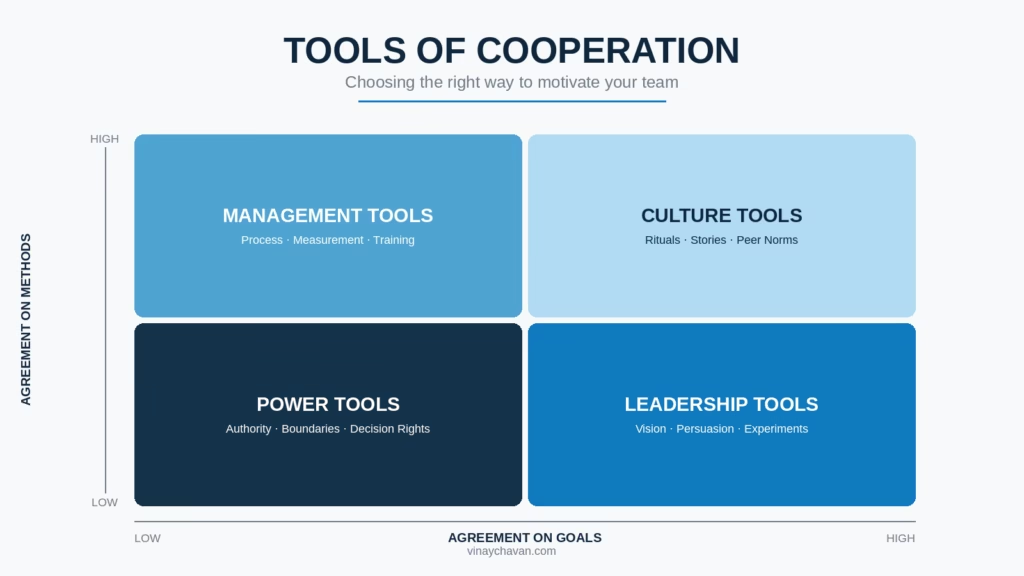
The Tools of Cooperation framework asks you to assess the situation along two dimensions:

  1. Agreement on goals: Do people agree on what they want to achieve?
  2. Agreement on cause and effect: Do people agree on which actions are likely to produce that result?

That second question goes deeper than agreeing on a plan. Two people can sign off on the same project plan while holding very different beliefs about why it will actually work. Cooperation holds together a lot better when the team shares an understanding of how the action leads to the outcome.

Together, these two dimensions give you four leadership situations.

The Four Tools of Cooperation

1. Power Tools: Little Agreement on Either Goals or Methods

When people disagree about both the destination and the way to get there, inspiration and process alone won’t create movement. This is where you need power tools: formal authority, role definition, control systems, firm boundaries.

That doesn’t have to mean authoritarian leadership. In practice, it usually means making a clear executive call, defining a non-negotiable standard, assigning decision ownership, or stopping behaviour that’s creating unacceptable risk.

Example: I’ve seen this play out almost exactly in an engineering org dealing with repeated security incidents. Some teams didn’t believe security work should interrupt feature delivery, and there was no shared agreement on which controls actually mattered. The only way through was leadership setting a mandatory security baseline, assigning accountable owners, and blocking releases that failed critical checks.

The point of authority here is to break dangerous gridlock, not to replace leadership indefinitely. Power creates compliance quickly, but it rarely creates commitment on its own. Lean on it too long and you get silence, dependency, and resistance that just moves underground. Once the immediate risk is under control, the real work is building understanding and moving the team toward genuine agreement.

2. Leadership Tools: Goals Are Shared, Methods Are Disputed

This is the situation I run into most with ambitious teams. Everyone wants the same outcome better reliability, faster delivery, a stronger customer experience — but people disagree about how to get there.

This is where leadership tools do the work: vision, storytelling, persuasion, role modeling, strategic framing, visible experimentation.

Example: Product and engineering agree that releases need to get faster and safer. One group is pushing for trunk-based development, another wants longer stabilization cycles, a third thinks better automated testing is the real fix. Rather than prescribing every step up front, the job is to reconnect the debate to the shared outcome, make room for a controlled pilot, and model genuine curiosity about what the evidence shows.

Your job isn’t to pretend there’s no disagreement. It’s to keep disagreement about methods from destroying commitment to the goal. When people already care about the destination, a credible vision gives them a reason to try a new path and a small experiment turns competing opinions into shared evidence.

3. Management Tools: Methods Are Understood, Goals Differ

Sometimes people broadly agree on how the work gets done but show up for different reasons or optimize for different outcomes. This is where management tools earn their keep: standard operating procedures, measurement systems, training, resource allocation, incentives, clear responsibilities.

Example: Engineering, compliance, and customer support can all value a release-readiness review, just for different reasons. Engineering wants fewer rollbacks, compliance wants traceability, support wants fewer escalations. They don’t share an identical definition of success, but they agree the review reduces preventable failures. A documented process, a shared dashboard, and clear ownership can coordinate all three groups even before their motivations fully line up.

Management tools only work when people trust the relationship between the process and its outcome. If that trust is missing, adding more process just feels like bureaucracy. A checklist can’t fix a disagreement about whether the checklist actually works.

4. Culture Tools: Agreement on Both Goals and Methods

When a team shares both its priorities and its understanding of how to get there, cooperation becomes almost automatic. People make similar calls even when a manager isn’t in the room. This is culture tools: rituals, stories, traditions, peer recognition, shared language, consensus-based decisions.

Example: A mature team that genuinely believes in learning from failure doesn’t need to be told to run a blameless incident review after an outage, it just happens. The ritual is baked into how the team works. Stories from past incidents reinforce the norm, and the senior folks model it for anyone new.

That’s the strength of culture: it scales judgment. It’s also its limitation. A strong culture is excellent at protecting an established direction, but it can resist change that challenges the very beliefs that made it successful in the first place. A ritual that once drove excellence can quietly become an obstacle once circumstances shift. It’s worth asking regularly whether you have a strong culture or a culture suited to the next challenge those aren’t always the same thing.

Quick Reference

SituationAgreement on GoalsAgreement on MethodsReach For
Power ToolsLowLowAuthority, boundaries, decision rights
Leadership ToolsHighLowVision, persuasion, experiments
Management ToolsLowHighProcess, measurement, training, incentives
Culture ToolsHighHighRituals, stories, peer norms

The Team Isn’t Permanently in One Quadrant

This matrix is a snapshot, not a personality test for your organization.

The same team can sit in different quadrants depending on the decision. I’ve had teams with deep agreement on product quality, partial agreement on architecture, and almost no agreement on returning to the office all at the same time. Different stakeholder groups can land in different places too.

Which means the first question isn’t “what kind of team do I have?” It’s:

“For this specific change, where does agreement exist and where does it break down?”

Agreement also shifts over time. Dialogue builds agreement on goals. Experiments and evidence build agreement on cause and effect. Training makes a proven method easier to adopt. Repeated success eventually turns a new behavior into culture. Your job isn’t just picking the right tool for today, it’s helping the team build the shared understanding it’ll need tomorrow.

A Practical Diagnostic

Before you announce the next transformation, roll out a new process, or try to motivate a struggling team, pause and run a short diagnosis first.

Step 1: Define the change clearly. Finish this sentence in plain language: “We want the team to ______ because ______.” If you can’t state the change cleanly, you can’t honestly assess agreement on it.

Step 2: Test agreement on the goal.

  • Do people agree this problem is worth solving?
  • Do they define success the same way?
  • Who benefits from the change, and who carries the cost?
  • Is the agreement real, or are people just quiet in front of authority?

Step 3: Test agreement on cause and effect.

  • Do people believe the proposed actions will actually produce the outcome?
  • Which assumptions are backed by evidence, and which aren’t?
  • Where are we leaning on habit, hierarchy, or opinion instead?
  • What small experiment would reduce the uncertainty?

Step 4: Choose the tool that fits.

  • Low agreement on both: set boundaries, decision rights, and immediate controls.
  • Shared goal, disputed methods: lead with vision, persuasion, role modeling, experiments.
  • Disputed goal, shared methods: coordinate through process, measurement, training.
  • Agreement on both: reinforce it through rituals, stories, recognition, peer norms.

Choose the least forceful tool that will still produce responsible action. Authority may be necessary in an emergency, but it shouldn’t become a shortcut around actually listening.

Step 5: Reassess after you act. Don’t assume one intervention permanently resolves anything. Look for real evidence has behaviour changed, has understanding improved, are people complying or genuinely committed, has the team moved toward more agreement? Cooperation is dynamic. Your diagnosis has to keep up with it.

Psychological Safety Makes the Diagnosis Honest

There’s a condition underneath all of this: people have to feel safe revealing disagreement.

If your team fears embarrassment, punishment, or being frozen out, you’ll see false consensus. Everyone nods along in the meeting while the real resistance moves into side conversations and quiet non-compliance. This is exactly the dynamic Google’s Project Aristotle research pointed to when it named psychological safety as the strongest predictor of team effectiveness and it matters here because the whole framework only works if people will tell you what they actually believe.

Before you try to measure alignment, make disagreement safe first. Ask for the counter-evidence. Invite the quietest people to speak before you share your own conclusion. Separate debating the idea from judging the person who raised it. A team that can disagree openly gives you better information and gives itself a real shot at genuine cooperation, not just the appearance of it.

Mistakes I See Leaders Make With This

Treating silence as agreement. People often go quiet because the decision already feels made. Test alignment privately, invite written input, and ask people to explain the goal and the logic back to you in their own words.

Using vision to solve a goal conflict. An inspiring speech doesn’t land when people fundamentally want different outcomes. Surface the competing interests before you try to rally everyone around a slogan.

Adding process to solve a belief conflict. If people don’t believe a method will work, a detailed procedure just formalizes the disagreement. Use evidence, pilots, and small wins to build confidence in cause and effect instead.

Overusing authority. Power moves fast, especially in a crisis, but leaning on it too often erodes ownership. Use it to protect clear boundaries or break urgent gridlock, then build a path back toward participation.

Assuming a strong culture is automatically an adaptive one. Deep agreement makes execution efficient, but it can also make old assumptions invisible. Every so often, ask which rituals still serve the mission and which ones are just preserving the past.

Diagnosing the whole org as one group. Executives, managers, frontline engineers, customers, and partners can all hold different goals and different beliefs about cause and effect. Map the important stakeholder groups separately before you pick an intervention.

Final Thoughts

Motivating a team was never really about becoming more charismatic, more forceful, or more process-driven. It’s about understanding the situation well enough to know which response it actually calls for.

The Tools of Cooperation framework gives you a disciplined way to make that call. When a team disagrees about both goals and methods, establish clarity and boundaries first. When the goal is shared but the path is uncertain, lead with vision and learning. When the method is trusted but the motivations differ, coordinate through management systems. When both are shared, let culture carry the work and stay alert to the moment it starts protecting the past instead of the mission.

The mountain was never really the problem. The real question is whether people want the same summit, believe in the same route, and trust each other enough to say when they don’t.

So before asking “how do I motivate this team,” ask two better questions: what do we genuinely agree on, and which tool does this specific situation actually call for? The quality of that diagnosis will tell you almost everything about the quality of your leadership.

Categories
Articles

Process Accountability Framework

A while back, I had a candid conversation with a former colleague about a pervasive and frustrating challenge we’d both encountered: how accountability often gets obscured amid complex processes. We noticed that when projects falter—missing deadlines or exceeding budgets—the blame tends to cascade downward through the organization. This downward flow of blame not only impedes progress but also breeds frustration at the top management level, eroding trust and disengaging teams along the way.

From that discussion, we brainstormed ways to fundamentally improve accountability across processes. The result was an idea I call the Process Accountability Framework (PAF). In today’s fast-paced business environment, organizations frequently struggle to create clear connections between where resources are invested, the completion of deliverables, and individual accountability. The PAF introduces a structured approach that embeds transparency, traceability, and responsibility throughout the entire project lifecycle. This ensures that every operational activity is directly aligned with—and actively supports—the organization’s strategic business objectives.

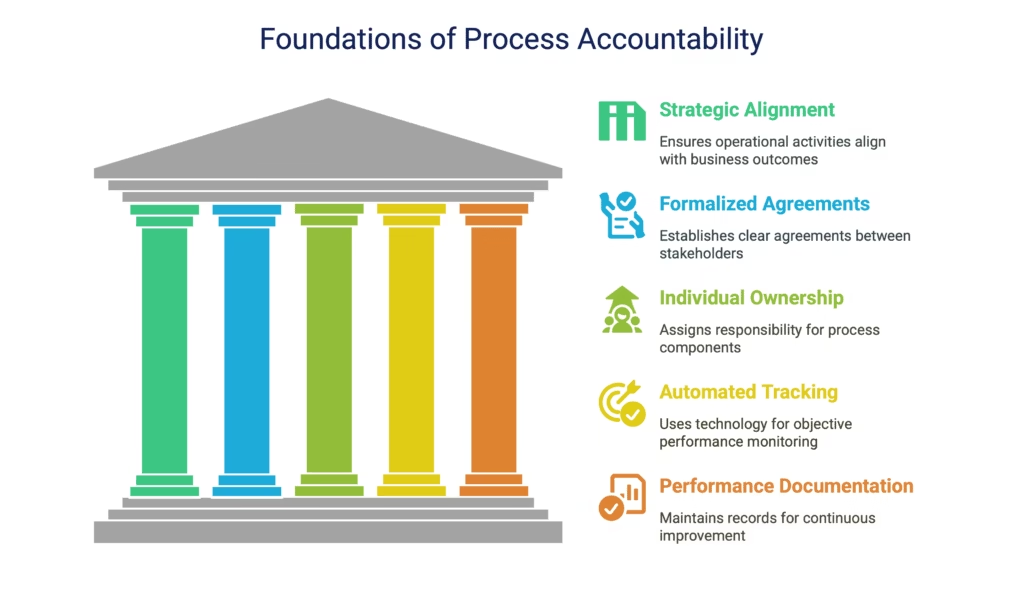
Process Accountability Framework (PAF) Foundations

1. Strategic Alignment of Operations

Every operational activity must directly connect to measurable business outcomes such as cost efficiency, accelerated time-to-market, quality improvement, or risk mitigation. This connection is quantified through:

  • Financial resource allocation and consumption
  • Time investment tracking
  • Clear ownership designation

Without strategic alignment, teams risk expending effort on activities that don’t contribute to organizational goals. This principle ensures that every hour worked and dollar spent has a clear line of sight to business value creation. Organizations can eliminate wasteful processes and prioritize high-impact work by continually validating operational activities against strategic objectives. This alignment also enables leaders to make evidence-based decisions about resource allocation by understanding the direct correlation between investments and business outcomes.

2. Formalized Stakeholder Agreements

Each process phase begins with a documented agreement between relevant stakeholders (e.g., product owners and implementation teams) that specifies:

  • Expected Completion Date
  • Actual Completion Date (recorded upon delivery)
  • Resulting Variance (measured in appropriate time units)

Formalized agreements eliminate ambiguity that often leads to missed expectations and project delays. By documenting commitments explicitly at each stage, all parties maintain a shared understanding of deadlines and deliverables. This practice reduces costly misalignments that typically emerge only after significant time has passed. Moreover, these agreements create a historical record that can be analyzed to improve future estimation accuracy and identify systemic issues in commitment-setting. Organizations with formalized agreements experience fewer disputes over project scope and timeline, as these elements are specified and agreed upon before work begins.

3. Individual Ownership of Outcomes

Every process component has a designated accountable individual responsible for:

  • Delivering within the agreed timeframe
  • Providing transparent reporting on performance
  • Explaining and addressing any variances

Without clear ownership, issues fall into organizational gaps where they remain unaddressed. Individual accountability ensures someone has both the authority and responsibility to drive each process component to completion. This clarity prevents the “diffusion of responsibility” phenomenon where group ownership often results in no ownership at all. When individuals know they are accountable for specific outcomes, they become more proactive in identifying and mitigating risks. This principle also creates natural escalation paths, as accountability designations make it immediately clear who should address emerging issues at each stage of the process.

4. Automated Temporal Tracking

To ensure data integrity and eliminate subjective reporting:

  • Expected and Actual dates must be system-captured
  • Timestamps should be triggered by objective events (e.g., status changes, approvals)
  • All temporal data must be maintained in tamper-resistant systems

Manual tracking introduces human bias and often results in reconstructed timelines that don’t reflect reality. Automated tracking creates an objective, indisputable record of when activities actually occurred. This principle eliminates the common practice of retroactive date adjustment to mask delays or performance issues. Automated systems also reduce the administrative burden on teams, freeing them to focus on value-adding activities rather than status reporting. Most importantly, automation creates reliable data sets that can be used for trend analysis and process improvement, as the organization can trust that the information accurately represents actual performance.

5. Comprehensive Performance Documentation

Each deliverable maintains a digital record containing:

  • Original agreements and success criteria
  • Actual delivery parameters
  • Performance variances with documented explanations

Without comprehensive documentation, organizations lose valuable institutional knowledge and the ability to learn from past experiences. This principle ensures that contextual information about performance is preserved, including the reasoning behind variances. When teams document the causes of delays or accelerations, the organization develops a knowledge base that informs future planning. This documentation also protects against revisionist interpretations of events that can occur when relying solely on memory. Additionally, comprehensive records support fair performance evaluation by providing objective evidence of achievements and challenges, rather than relying on recollections that may be influenced by recency bias.

6. Value-Based Task Mapping

Every activity must demonstrate direct contribution to business value through quantifiable metrics related to cost management, cycle time reduction, revenue enhancement, or quality improvement.

Organizations often engage in activities that consume resources without creating proportional value. Value-based mapping challenges teams to articulate how each task contributes to business outcomes before investing resources. This principle helps eliminate “busy work” that appears productive but doesn’t meaningfully advance business objectives. By requiring explicit connections between tasks and value creation, organizations can better prioritize their efforts and eliminate low-value activities. This practice also enables more sophisticated cost-benefit analysis, as leaders can assess whether the value derived from an activity justifies the resources consumed. Teams that consistently map their work to business value develop a sharper focus on outcomes rather than outputs.

Example: Software Development Lifecycle Implementation

The following example illustrates how the PAF operationalizes accountability throughout a software development lifecycle:

Stage Accountable Person Expected Date of Completion Actual Date of Completion Variance (expected – actual)
Use Case Writing Analyst A 2025-05-01 2025-05-03 -2
Use Case Doubt Resolution Analyst B 2025-05-04 2025-05-04 0
Effort Estimation Tech Lead C 2025-05-05 2025-05-06 -1
Budget & UAT Delivery Estimation PM D 2025-05-07 2025-05-07 0
Development Dev Team Lead E 2025-05-15 2025-05-18 -3
Deployment to QA DevOps F 2025-05-19 2025-05-19 0
Internal Testing QA Lead G 2025-05-20 2025-05-20 0
Deployment to UAT DevOps F 2025-05-21 2025-05-21 0
User Acceptance Testing (UAT) QA Lead G 2025-05-22 2025-05-23 -1
Bug Fixes Dev Team Lead E 2025-05-24 2025-05-26 -2
Production Deployment DevOps F 2025-05-27 2025-05-27 0
Closure PM D 2025-05-28 2025-05-28 0

In this example, we can observe real-world application of the framework principles:

  1. Use Case Documentation (-2 days): Analyst A completed documentation two days later than expected. The variance log indicates this was due to unexpected stakeholder feedback requiring additional use case scenarios. This documentation serves as a reference point for addressing similar scope changes in future projects.
  2. Effort Estimation (-1 day): Tech Lead C required an extra day for estimation because the team discovered integration requirements with a third-party API that weren’t initially considered. This variance prompted the organization to add an “external dependency review” checkpoint to their estimation process.
  3. Development (-3 days): The most significant delay occurred during development. Development Lead E documented that two key contributing factors were:
    • A senior developer’s unexpected absence due to illness
    • Technical debt in the authentication module that required more refactoring than anticipated
    This variance triggered a retrospective that resulted in cross-training developers on critical system components and scheduling targeted technical debt reduction sprints.
  4. Zero Variance Activities: DevOps Engineer F maintained zero variance across all deployment responsibilities. Analysis revealed this was due to:
    • Well-documented deployment procedures
    • Automated deployment pipelines with pre-flight checks
    • Reserved buffer time for unforeseen issues
    These practices were documented and shared as best practices across other teams.
  5. Defect Resolution (-2 days): Development Lead E documented that defect resolution took longer than expected due to:
    • Higher than anticipated defect density in the payment processing module
    • Required coordination with an external payment gateway provider
    This information led to implementation of more thorough unit testing requirements for financial components and establishing dedicated communication channels with external providers.

Performance Analysis

  • Zero Variance Analysis – Process stages with zero variance represent efficiency opportunities. Analysis of these stages can reveal success factors such as:
    • Precise requirement definition
    • Optimal resource allocation
    • Effective dependency management
    • Proactive risk mitigation
  • Negative Variance Analysis – Delays (negative variances) provide valuable insights for process improvement. Root causes typically include:
    • Inadequate initial scoping
    • Unidentified technical dependencies
    • Resource constraints or skill mismatches
    • Communication breakdowns
    • External dependencies or blockers
  • Positive Variance Analysis – Early completions (positive variances) should be examined to identify potential efficiencies:
    • Innovative approaches or automation opportunities
    • Over-estimation that could be refined
    • Effective risk management techniques
    • Resource optimization strategies
    • Successful parallel processing of tasks

Implementation Strategy

1. Define Accountability Matrix

Approach:

  • Conduct stakeholder workshops to identify every discrete phase in your process workflow
  • For each phase, designate a single accountable individual (not a team or committee)
  • Document decision rights and escalation paths for each accountable person
  • Create a RACI (Responsible, Accountable, Consulted, Informed) matrix for all stakeholders

Implementation Steps:

  1. Map your current process flow with all dependencies and handoffs
  2. Identify current ambiguities or areas with shared/unclear ownership
  3. Determine clear criteria for “completion” of each phase
  4. Assign accountability based on authority level and proximity to the work
  5. Document the matrix in your project management or workflow system
  6. Communicate role definitions to all stakeholders and obtain explicit acceptance

2. Establish Formal Agreements

Approach:

  • Create standardized agreement templates for each process phase
  • Include explicit completion criteria and quality standards
  • Document dependencies and prerequisites
  • Specify the expected completion date with clear reasoning
  • Obtain formal acknowledgment from both the accountable individual and stakeholders

Implementation Steps:

  1. Develop digital templates with standard fields for agreements
  2. Integrate these templates into your workflow or project management system
  3. Implement approval workflows that capture acceptance from all parties
  4. Create a time-stamped record of all agreement versions and modifications
  5. Establish a process for agreement revisions when circumstances change

3. Automate Measurement

Approach:

  • Configure your project management or workflow tools to automatically timestamp state transitions
  • Implement webhooks or integration points to capture events from various systems
  • Create a central data repository for all temporal metrics
  • Develop validation mechanisms to ensure data integrity

Implementation Steps:

  1. Audit existing systems to identify where time data is captured
  2. Configure automatic timestamp recording for key events (task creation, assignment, state changes)
  3. Implement data validation to prevent manual overrides of timestamps
  4. Create API connections between disparate systems to consolidate temporal data
  5. Establish data retention policies for historical analysis

4. Develop Visualization Tools

Approach:

  • Create real-time dashboards that display current process status
  • Design variance reports highlighting deviations from agreements
  • Implement trend analysis to identify patterns across projects or time periods
  • Develop role-specific views customized to different stakeholder needs

Implementation Steps:

  1. Identify key metrics and KPIs that reflect process health
  2. Design dashboard layouts with clear visual indicators of performance
  3. Implement automated data refreshes to ensure current information
  4. Create alerting mechanisms for significant variances
  5. Develop drill-down capabilities for detailed analysis

5. Institutionalize Review Cycles

Approach:

  • Establish regular cadence for variance review meetings
  • Create standardized agendas focused on analysis rather than status reporting
  • Implement action tracking for process improvements
  • Develop knowledge base of lessons learned from variance analysis

Implementation Steps:

  1. Schedule recurring variance review meetings with key stakeholders
  2. Define standard agenda items focusing on root cause analysis
  3. Create protocols for capturing action items and improvement initiatives
  4. Implement follow-up mechanisms to track implementation of process changes
  5. Develop a knowledge management system to catalog learnings

Conclusion

This structured approach enables leadership to:

  • Monitor progress against business objectives in real-time
  • Identify and address systemic bottlenecks
  • Enforce accountability at every process level
  • Calculate precise resource-to-output ratios
  • Implement data-driven process improvements

The Process Accountability Framework transforms operational execution by establishing a direct connection between strategic intent and tactical delivery. By implementing automated tracking, formalized agreements, and clear accountability structures, organizations can systematically improve operational efficiency while building a culture of responsibility and continuous improvement.

Categories
Articles

How a Group Becomes a Team

If there is one lesson I have learned in my years of leading engineering teams and product innovation, it is this: nothing gets done without teamwork. As a manager, I’ve seen great ideas falter and projects stall when individuals work in silos, each with their own vision and approach. But when you transform a group of people into a true team, magic happens. Ideas flow seamlessly, challenges are tackled collectively, and goals are not just met—they are exceeded. But how does a group become a team? That’s where Tuckman’s stages of team development come into play.

From a Collection of Individuals to a Unified Force

Imagine you’ve just put together a new team—whether for a product launch, a critical engineering project, or a startup venture. You’ve got talented individuals, each bringing their own strengths and experiences. However, without a shared direction and understanding of how to work together, they remain just that—individuals. The challenge as a leader is to shape them into a cohesive unit working towards a singular goal.

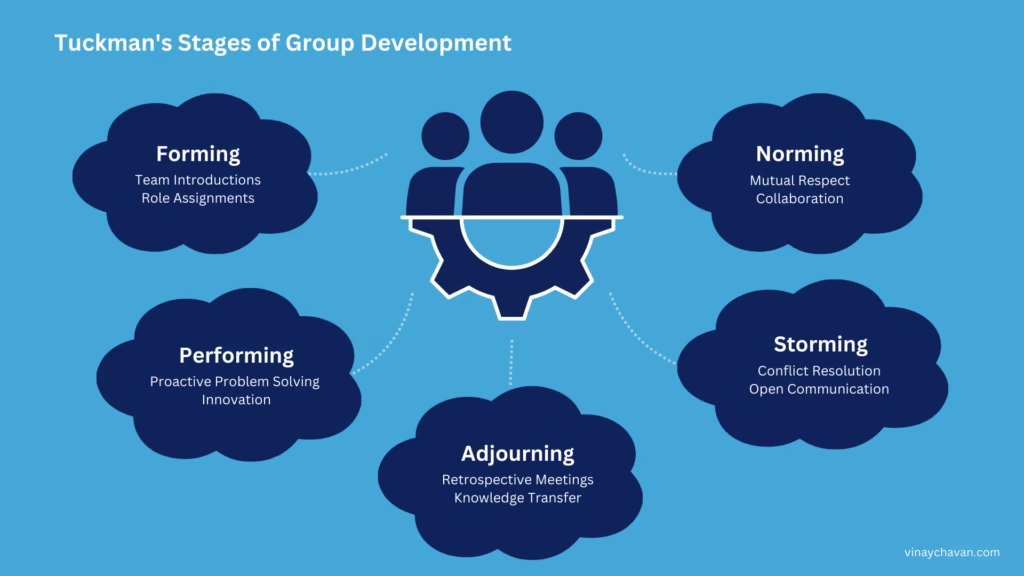
Dr. Bruce Tuckman, a psychologist, identified five key stages that every team goes through in its evolution. Recognizing these stages can help managers and leaders guide their teams effectively and accelerate their growth. Let’s dive in.

Stage 1: Forming – The Excitement of the Unknown

At the forming stage, team members are polite, cautious, and eager to understand their roles. There’s excitement, but also uncertainty. I remember when I took over as CEO of Yapsody India, leading a diverse team across engineering, customer success, marketing, and design. In those early days, everyone was feeling out the new dynamics. My role as a leader was to provide clarity, set expectations, and ensure that everyone felt heard.

What Happens in the Forming Stage?

  • Team introductions and icebreaker activities to build rapport.
  • Setting initial goals, project objectives, and team expectations.
  • Assigning roles and responsibilities while allowing flexibility for adjustments.
  • Establishing communication channels and tools (Open Handbook, Process documents, Google Chat/Email, etc.).

Stage 2: Storming – Where Conflicts Shape Growth

This is the stage where tensions arise. People challenge ideas, struggle for influence, and experience frustration. It’s tempting to avoid conflict, but I’ve learned that healthy debates, when managed correctly, lead to better outcomes.

At Yapsody, we built a culture where challenging the status quo was encouraged, but it had to be done with integrity and respect. The key here is to ensure that conflicts are constructive, not personal. Leaders must act as facilitators, helping the team navigate differences while reinforcing the shared goal.

What Happens in the Storming Stage?

  • Differences in working styles and opinions surface, leading to conflict.
  • Some members may push against leadership or team norms.
  • Leaders step in to mediate disputes and set conflict resolution guidelines.
  • Encouraging open communication and trust-building exercises.
  • Establishing problem-solving frameworks to resolve issues objectively.

Stage 3: Norming – Finding the Rhythm

Once conflicts are addressed, the team starts to find its rhythm. Processes become smoother, collaboration improves, and individuals begin to trust one another. This is the stage where you see alignment—where team members understand not just their own roles, but also how they fit into the bigger picture.

As a leader, this is the time to reinforce positive behaviors and ensure that progress is being made. Acknowledging wins, big or small, fosters a sense of momentum and unity. I always made it a point to celebrate small victories, as they build confidence and reinforce the idea that we are moving forward together.

What Happens in the Norming Stage?

  • Team members develop mutual respect and recognize each other’s strengths.
  • Collaboration improves, and workflows become more efficient.
  • Leaders take a step back, allowing the team to self-organize more effectively.
  • Regular check-ins and retrospectives ensure alignment and continued growth.
  • Social bonding activities help solidify trust and camaraderie.

Stage 4: Performing – The Peak of Efficiency

This is where the real magic happens. A high-performing team is self-sufficient, goal-oriented, and innovative. They don’t just execute; they anticipate challenges, adapt, and push boundaries.

In my years of leading agile teams, I’ve seen the shift when a team moves into this stage. Stand-up meetings become more about problem-solving rather than status updates. Engineers proactively improve code without being asked. Designers collaborate seamlessly with developers. It’s a stage where leadership shifts from directing to empowering.

What Happens in the Performing Stage?

  • The team operates with minimal supervision and high efficiency.
  • Problem-solving is proactive rather than reactive.
  • Team members hold themselves and each other accountable.
  • High levels of innovation and productivity emerge.
  • Focus shifts from managing conflicts to achieving peak performance.

Stage 5: Adjourning – The Transition to What’s Next

Every project has an end, and every team eventually disbands or evolves. This stage, sometimes called the “mourning” phase, is often overlooked, but it’s vital. Reflection, feedback, and knowledge transfer ensure that learnings are carried forward.

I’ve always encouraged my teams to document lessons learned and celebrate the journey before moving on to the next challenge. It provides closure and sets the stage for future success.

What Happens in the Adjourning Stage?

  • Conducting retrospective meetings to reflect on successes and challenges.
  • Recognizing individual contributions and celebrating achievements.
  • Knowledge transfer sessions to document insights for future teams.
  • Emotional closure as team members move on to new projects or roles.
  • Maintaining professional relationships and connections beyond the project.

Why Teamwork is Everything

Building a successful team is not about assembling the smartest individuals; it’s about creating an environment where those individuals can thrive together. The best ideas are rarely the result of one genius mind but rather the culmination of diverse perspectives refining each other.

In my journey, from leading mobile development at Yapsody to overseeing complex engineering infrastructures, I’ve seen firsthand that teamwork is the single most important factor in getting things done. No matter how innovative your technology, how groundbreaking your product, or how ambitious your vision—without a strong, cohesive team, execution falls apart.

So, if you’re a leader, engineer, or entrepreneur, invest in your team. Guide them through the natural ups and downs of team development. Encourage open communication, foster trust, and most importantly, keep them focused on a singular, compelling goal. Because when a group truly becomes a team, there are no limits to what they can achieve.

Categories
Articles

Leading Through Conflict: A Self-Aware Approach

Have you ever found yourself in a situation where a tough decision had to be made, and differing opinions were pulling you in opposite directions? Perhaps a team project was on the verge of missing a deadline because two key stakeholders couldn’t agree on the best approach. Or maybe you’ve had to mediate a disagreement between colleagues, unsure whether to push for a compromise or let one party take the lead. If so, you’re not alone. Conflict is an inevitable part of any organization.

Why Self-Awareness Matters in Conflict Resolution

Understanding one’s default conflict-handling mode is essential for effective leadership. Self-awareness allows leaders to:

  • Recognize their natural tendencies in conflict situations.
  • Assess whether their default approach is appropriate for the given context.
  • Develop the flexibility to adopt different styles as needed.
  • Enhance emotional intelligence, improving communication and team dynamics.

The way leaders manage conflict has a profound impact on organizational health, culture, and performance. To navigate these complexities effectively, leaders must first develop self-awareness before entering a conflict negotiation. One of the most insightful tools for this self-awareness is the Thomas-Kilmann Conflict Mode Instrument (TKI).

Understanding the TKI Framework

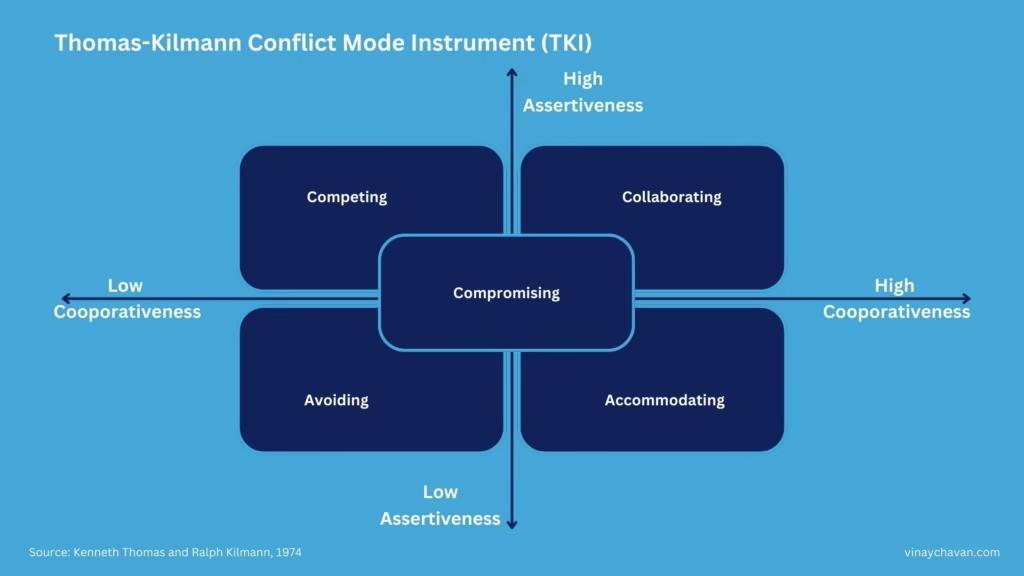
Developed by Kenneth W. Thomas and Ralph H. Kilmann, the TKI identifies five primary conflict-handling modes, each based on two fundamental dimensions:

  1. Assertiveness – The extent to which an individual tries to satisfy their own concerns.
  2. Cooperativeness – The extent to which an individual attempts to satisfy the concerns of others.

These two dimensions create five conflict resolution styles:

1. Competing (High Assertiveness, Low Cooperativeness)

A competing approach is highly assertive and low in cooperation. Leaders using this mode pursue their own interests forcefully, often at the expense of others. This approach is most effective in situations where quick, decisive action is required, such as emergencies, or when protecting non-negotiable principles. However, overuse can damage relationships and create resentment among team members.

Example Statement: “I understand your concerns, but this decision needs to be made now, and we are going with my approach.”

Real-Life Scenario: A project manager insists on meeting a strict deadline despite pushback from team members about workload, prioritizing efficiency over consensus.

2. Collaborating (High Assertiveness, High Cooperativeness)

A collaborative approach seeks win-win outcomes. Leaders employing this style invest time in finding solutions that satisfy all parties. This mode is ideal for complex problems requiring creative solutions and when maintaining strong relationships is crucial. However, it demands patience and open communication, making it impractical for urgent decision-making.

Example Statement: “Let’s brainstorm together and find a way where both of our concerns are addressed.”

Real-Life Scenario: Two department heads with conflicting budget requests work together to identify a solution that supports both their goals without compromising key priorities.

3. Compromising (Moderate Assertiveness, Moderate Cooperativeness)

A compromising leader seeks a middle ground, ensuring that both parties give up something to reach an agreement. This approach is useful when time constraints prevent full collaboration but still require a fair outcome. While effective in many situations, excessive reliance on compromise can lead to suboptimal solutions where neither party is fully satisfied.

Example Statement: “If you’re willing to adjust your deadline by one week, I can allocate more resources to support you.”

Real-Life Scenario: A marketing director and sales manager agree to split the promotional budget evenly instead of one department receiving a majority, ensuring both teams get some level of support.

4. Avoiding (Low Assertiveness, Low Cooperativeness)

Avoidance involves sidestepping conflict altogether. Leaders may use this approach when an issue is trivial, when emotions are too high for productive discussion, or when more information is needed before engaging. However, habitual avoidance can lead to unresolved tensions and a culture of passivity in conflict resolution.

Example Statement: “This isn’t the right time to discuss this. Let’s revisit it after the quarterly review.”

Real-Life Scenario: A team member avoids addressing a minor workplace dispute, hoping the issue will resolve itself over time rather than confronting it immediately.

5. Accommodating (Low Assertiveness, High Cooperativeness)

An accommodating leader prioritizes the needs of others over their own, often yielding to maintain harmony. This approach is beneficial in situations where preserving relationships is more important than immediate personal gain. However, excessive accommodation can lead to a loss of respect and an imbalance in power dynamics.

Example Statement: “I see how important this is to you, so I’ll support your approach even though I had a different perspective.”

Real-Life Scenario: An employee volunteers to cover a coworker’s shift at the last minute despite personal inconvenience, prioritizing teamwork over personal plans.

Steps to Enhance Conflict-Handling Awareness

Good leaders recognize that conflict, when managed constructively, can drive innovation, strengthen teams, and improve decision-making. By integrating TKI into their leadership toolkit, they cultivate a culture of trust, accountability, and open communication.

  1. Self-Assessment: Use the TKI assessment to determine your dominant conflict mode. Take time to reflect on past conflicts—how did you handle them? Were you more assertive or cooperative? Understanding your go-to response provides a foundation for growth.
  2. Situational Analysis: Before engaging in a conflict, evaluate the stakes, relationships involved, and desired outcomes. Ask yourself questions like: What are the long-term implications of this conflict? Is this a one-time disagreement, or does it indicate a deeper issue that needs addressing? Considering these factors will help you choose the most effective conflict-handling mode.
  3. Mindful Adaptation: Develop the ability to shift between conflict modes depending on the context. For example, in high-stakes negotiations, collaboration might be the best approach, while minor disagreements may be resolved through accommodation or compromise. Practicing adaptability ensures that conflicts are managed effectively without damaging relationships.
  4. Feedback Loop: Seek feedback from colleagues and mentors on your conflict management style. Regularly discussing your approach with trusted advisors provides valuable perspectives that help refine your conflict resolution skills. Additionally, observing how others handle conflicts can offer new strategies to incorporate into your own leadership approach.
  5. Skill Development: Invest in training, workshops, or coaching to enhance your conflict resolution skills. Practicing active listening, negotiation techniques, and emotional intelligence can improve how you navigate difficult situations and build stronger relationships with your team.
  6. Post-Conflict Reflection: After a conflict is resolved, take time to reflect on the outcome. What worked well? What could have been handled differently? Continuous learning from each experience helps refine your conflict resolution strategy over time.

Final Thoughts

Effective conflict resolution is not about winning or losing—it’s about fostering understanding, collaboration, and sustainable solutions. By embracing self-awareness and adaptability, leaders can turn conflicts into opportunities for personal and professional growth. The Thomas-Kilmann Conflict Mode Instrument offers a structured approach to navigating difficult conversations with clarity and confidence. As you refine your conflict management skills, remember that every disagreement is a chance to strengthen relationships, build trust, and contribute to a healthier, more resilient organization.

Key Takeaways

  • Conflict is an inevitable part of leadership and can be managed constructively.
  • The Thomas-Kilmann Conflict Mode Instrument (TKI) helps leaders understand their natural conflict resolution tendencies.
  • There are five conflict-handling modes: Competing, Collaborating, Compromising, Avoiding, and Accommodating.
  • Self-awareness is essential for choosing the right conflict resolution approach for different situations.
  • Developing adaptability in conflict resolution fosters stronger relationships and better decision-making.
  • Seeking feedback, engaging in situational analysis, and practicing mindful adaptation enhance conflict-handling skills.
  • Every conflict presents an opportunity to learn, grow, and improve workplace culture.

Categories
Articles

From Microservices to Microteams: Two Pizza Rule in Action

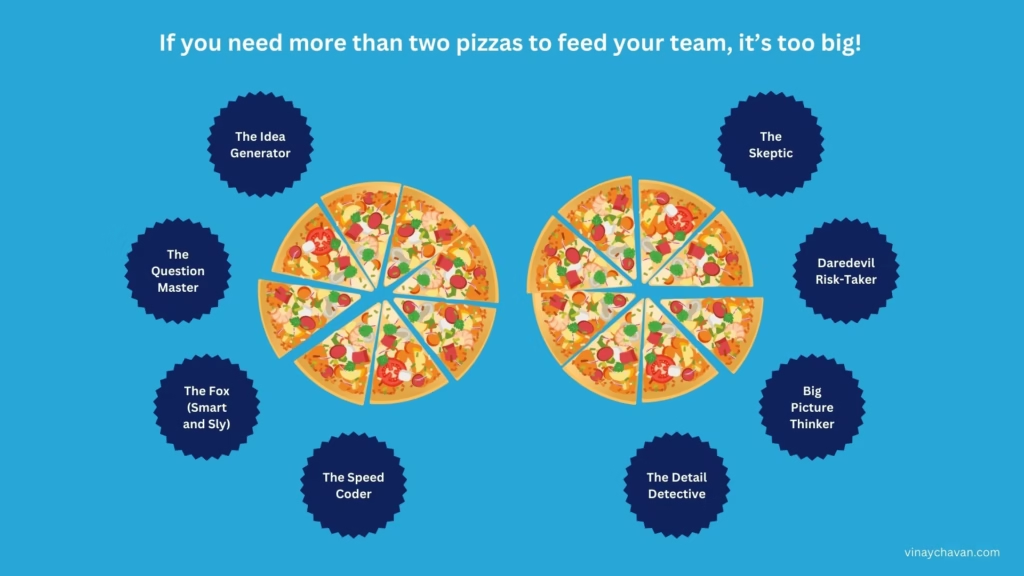
Have you ever looked at the structure of your organization and wondered why some teams seem to work seamlessly while others struggle to get anything done? The answer may lie in a principle you’ve already heard of: the “Two Pizza Rule.” Popularized by Jeff Bezos, it’s the idea that a team should be small enough to be fed by two pizzas. Simple, right? But there’s a profound reason why this works, and it’s tied to something called Conway’s Law.

Let me explain.

Conway’s Law tells us that the systems you build will inevitably reflect the structure of the teams that design them. If your organization is fragmented or overly complex, your software will mirror those flaws. Conversely, if your teams are well-structured, clear, and independent, your systems will thrive. This insight is a game-changer for anyone building software—or, frankly, running any kind of team.

Why Structure Matters More Than You Think

I learned this lesson firsthand while leading the development of integrated event organizers systems suite, an event-driven micro-services architecture. The project was ambitious, with 80+ services working together seamlessly. But as I quickly realized, the success of the system wasn’t just about the technology—it was about the teams building it.

You see, micro-services thrive on autonomy. Each service has a single, clear responsibility, communicates through well-defined APIs, and operates independently. Sound familiar? That’s exactly what the Two Pizza Rule is all about. Small, cross-functional teams mirror the modularity of micro-services. They are independent, agile, and focused—exactly what you need when tackling complex challenges.

The Two Pizza Rule and Conway’s Law

Here’s where it gets really interesting: the Two Pizza Rule is a practical application of Conway’s Law. Think about it. If your organization is made up of small, nimble teams, the systems you design will naturally reflect that structure. They’ll be modular, efficient, and easy to scale.

But the opposite is also true. If your teams are too large or fragmented, your software will end up bloated, full of dependencies, and hard to maintain. I’ve seen it happen more than once—large teams produce systems that look like committee work: disjointed, slow, and overly complicated.

By keeping your teams small, you’re not just setting them up for success—you’re ensuring the systems they build are designed for success, too.

Why Small Teams Work Better

In smaller teams, communication channels are simplified. With fewer people, the number of potential interactions is drastically reduced, making it easier to align on objectives and share ideas. This efficiency accelerates decision-making, eliminates unnecessary noise, and minimizes misunderstandings. Instead of spending time clarifying roles or chasing approvals, team members can focus on meaningful, impactful conversations that drive progress.

1. They Communicate Efficiently

In a small team, every individual’s role is both visible and significant. There’s no room for ambiguity, and contributions—or the lack thereof—are immediately apparent. This clarity fosters a strong sense of ownership among team members, motivating them to deliver their best. When everyone understands their responsibility and its direct impact on the team’s success, it creates a culture of trust and accountability where excellence becomes the norm.

2. They Foster Clear Accountability

In a small team, every individual’s role is both visible and significant. There’s no room for ambiguity, and contributions—or the lack thereof—are immediately apparent. This clarity fosters a strong sense of ownership among team members, motivating them to deliver their best. When everyone understands their responsibility and its direct impact on the team’s success, it creates a culture of trust and accountability where excellence becomes the norm.

3. They Adapt Quickly to Change

Priorities shift—whether it’s due to evolving customer needs, market dynamics, or internal realignments. Small teams are inherently agile. They can pivot quickly without getting bogged down by bureaucracy or lengthy chains of command. This flexibility enables them to seize opportunities, respond to challenges in real-time, and stay ahead in fast-paced environments.

4. They Create Focused, Modular Systems

Small teams naturally align with the principles of modularity. Much like microservices in software design, they focus on specific, well-defined objectives. This reduces overlap, eliminates dependencies, and ensures that every team member is working toward a shared, clear goal. This modular approach not only enhances productivity but also makes it easier to integrate contributions across teams, ensuring seamless collaboration on larger projects.

We embraced these principles wholeheartedly. Each micro-team was given full ownership of a specific service, from initial design to final deployment. This autonomy empowered our teams to take pride in their work and deliver results that exceeded expectations. By clearly defining responsibilities and giving teams the freedom to innovate, we didn’t just improve the quality of our output—we cultivated a culture of commitment, creativity, and accountability.

Small teams aren’t just efficient—they’re transformative. They create an environment where everyone’s voice matters, adaptation is second nature, and excellence is a collective goal. In a world that demands agility and precision, small teams have a unique edge—and we harnessed that to its fullest potential.

How We Build Micro-Teams That Work

Looking back, here are a few key lessons we applied:

1. Defined Clear Roles & Goals

Just as every micro-service had a single responsibility, we ensured every team member knew exactly what they were accountable for. By clearly defining roles, we eliminated overlaps and confusion, which allowed the team to focus entirely on their objectives.

2. Minimized Dependencies

We encouraged our teams to solve problems within their domain before seeking external help. This approach kept projects moving forward without unnecessary delays. When dependencies outside the team arose, we treated them as opportunities to innovate and streamline processes, making teams more self-sufficient over time.

3. Communicated Like APIs

We treated our teams like micro-services, setting up clear communication protocols for how they interacted with one another. Internally, we aimed for communication saturation, ensuring that everyone within the team was fully informed and aligned. Whenever cross-team communication was required, we treated it as a problem statement to solve. This led us to ask questions like, “Why is this dependency here?” and “How can we reduce it in the future?”

4. Encouraged Puzzle-Like Diversity

We deliberately built teams with specific pieces of the puzzle that fit well together. By encouraging diversity in skills and expertise within teams, we reduced external dependencies while fostering autonomy. Each team became a self-contained unit, equipped to make decisions and tackle challenges independently. This diversity also sparked innovation and helped us approach problems from multiple perspectives.

5. Celebrated Autonomy

We gave our teams the freedom to make decisions within their scope. By trusting them, we saw remarkable results. Autonomy not only accelerated decision-making but also boosted morale. Team members took ownership of their work, creating a culture of accountability and pride in the outcomes.

From Micro-services to Micro-Teams

The success of the project wasn’t just about building great software—it was about building great teams. The Two Pizza Rule gave us a framework to align our team structure with the architecture we were designing. By keeping our teams small, we created a system that was agile, scalable, and resilient.

And here’s the best part: this approach doesn’t just apply to software. Whether you’re running a marketing department, managing a product launch, or leading a creative team, the principles are the same. Small, focused teams will always outperform large, unwieldy ones.

Why This Matters to You

If there’s one thing I want you to take away, it’s this: the structure of your teams isn’t just an operational decision—it’s a strategic one. By adopting the Two Pizza Rule, you’re not just making life easier for your teams; you’re setting your entire organization up for long-term success.

So, the next time you’re assembling a team, think like a micro-services architect. Keep it small. Keep it focused. And remember: just like a well-designed system, a well-designed team is one that works seamlessly, scales effortlessly, and delivers consistently.

Because in the end, great teams build great things. And sometimes, all it takes is two pizzas to get started.

Categories
Articles

Enhancing Engineering Teams with a Competency Matrix

In the ever-evolving field of software engineering, it’s essential to keep teams performing at their best and continuously improving. One effective strategy to achieve this is through the use of a competency matrix. In this article we’ll discuss the challenges of objectively assessing individual skills, the benefits of standardizing roles, and how a competency matrix can help identify and bridge skill gaps through strategic hiring and development programs. Additionally, we’ll discuss how integrating this matrix into Objectives and Key Results (OKRs) for engineering managers can boost overall team performance.

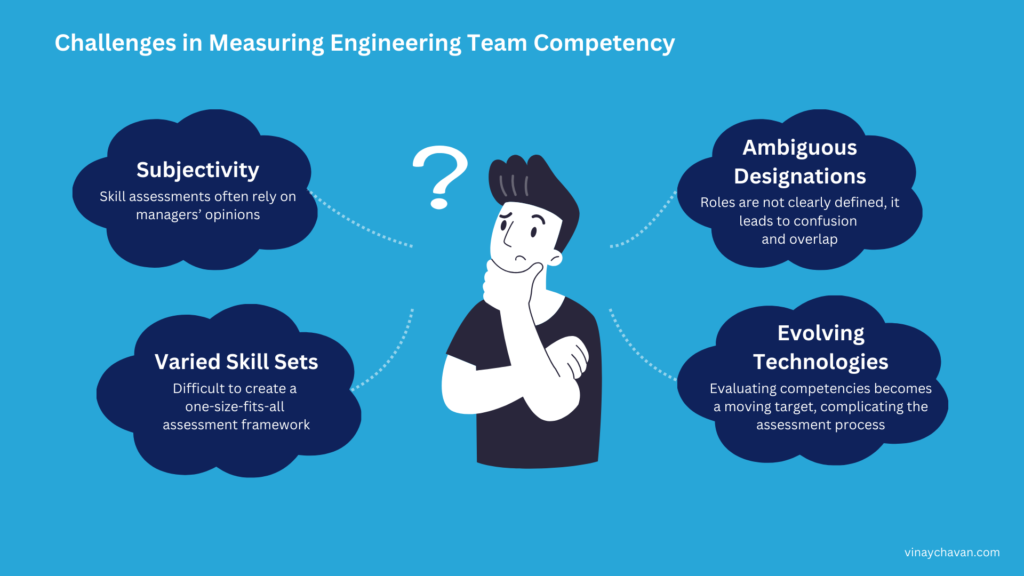
Challenges in Measuring Team Competency

Challenges in Measuring Engineering Team Competency

Measuring individual competency within a diverse engineering team is fraught with challenges. One of the primary issues is subjectivity. Performance reviews and skill assessments often rely on managers’ opinions, which can vary widely. This subjectivity can lead to inconsistencies, as different managers might have different criteria for what constitutes proficiency in a particular skill.

Another significant challenge arises from ambiguous designations given based on age instead of skills. When roles and responsibilities are not clearly defined, it leads to confusion and overlap. For instance, if the distinction between a “software engineer” and a “senior software engineer” is not clear, it becomes difficult to set appropriate expectations and evaluate performance accurately. This ambiguity can cause frustration among team members who are unsure of their specific duties and career progression paths.

The varied skill sets present within a team add another layer of complexity. Engineering teams comprise individuals with different roles and areas of expertise, making it difficult to create a one-size-fits-all assessment framework. For instance, the competencies required for a front-end developer are vastly different from those needed for a back-end engineer or a DevOps specialist. This diversity necessitates a flexible yet standardized approach to competency measurement.

Furthermore, the rapid evolution of technology adds another layer of complexity. Technologies and best practices in software engineering are continually advancing, requiring engineers to engage in continuous learning and adaptation. As new tools and methodologies emerge, evaluating competencies becomes a moving target, complicating the assessment process.

Building Competency Matrix

1. Standardize Designations and Roles

To effectively create a competency matrix, it’s essential to standardize job designations within the team. This begins with defining roles and responsibilities. Clearly outlining what is expected from each role helps in setting precise performance benchmarks. A huge shoutout to Sarah Drasner (@sarah_edo) for her career ladders! This framework is an excellent foundation for standardizing team designations based on roles rather than technology-specific titles as follows,

  1. Engineer I
  2. Engineer II
  3. Senior Engineer
  4. Staff Engineer
  5. Principal Engineer
  6. Distinguished Engineer

2. Identify Key Competencies

Next, it’s crucial to create skill categories. Skills can be broadly divided into technical and non-technical areas. Technical skills might include proficiency in programming languages, familiarity with development tools, and knowledge of specific frameworks. Non-technical skills, on the other hand, encompass abilities like effective communication, problem-solving, and teamwork. By categorizing skills, organizations can ensure a holistic approach to competency evaluation. Example,

General SkillsWeb FrontendBackendMobileQA AutomationTesting Areas
Attention to DetailTypescriptTypescriptTypescriptSeleniumDatabase/SQL
CommunicationReact JSNodeJSReactNativeAppiumAPI Testing
Problem-SolvingReduxExpressExpoCypressPerformance Testing
Time ManagementJest/MochaJest/MochaApp StoreTestCompleteSecurity Testing
QC StandardsSQLPlay StoreKatalon Studio
TeamworkMongoDB
Agile and ScrumDynamoDB
Documentation
Key Competencies

3. Establish Proficiency Levels

Lastly, establishing proficiency levels is key to standardization. Proficiency levels such as novice, intermediate, and expert provide a clear progression path for skill development. For instance, a novice in cloud computing might understand basic concepts, an intermediate might be able to deploy applications, and an expert might design and manage complex cloud architectures. These levels help in setting clear expectations and growth paths for team members.

Skill LevelDescriptionLevel
Not applicable / missing0
NoviceRequires hand holding and supervision1
Intermediatedoes not require hand-holding but requires supervision for complex problems2
Expertno supervision required, can teach others3
Proficiency Levels

Implementing a Competency Matrix

1. Set Up the Excel Sheet

  1. Open Excel: Start by opening a new Excel workbook.
  2. Label Rows and Columns: In the first row, list the key competencies across the columns (e.g., A1: Programming Languages, B1: Database Management, C1: Problem-Solving). In the first column, list the names of the team members down the rows (e.g., A2: John Doe, A3: Jane Smith).
  3. Define Proficiency Levels: Determine the proficiency levels you will use (e.g., 1 for novice, 2 for intermediate, 3 for expert). You can add a legend or key to explain these levels, perhaps in a cell near the top of the sheet.

Here’s a simple example to illustrate how your matrix might look:

Programming
Languages
Database
Management
Problem-SolvingCommunication
John Doe
Jane Smith
Alice Johnson
Bob Brown
Simple Competency Matrix

2. Populate the Matrix

  1. Assess Competencies: Once key competencies are identified, the next step is to assess current skill levels within the team. This can be done through self-assessments, peer reviews, and practical evaluations. Standardized tests or coding challenges can also be used to validate these assessments. For instance, team members might rate their proficiency in different areas, followed by peer reviews to cross-verify these ratings. This multi-faceted approach helps in creating an accurate picture of the team’s current skill set.
  2. Add Team and Employee Versatility: Apply the formula such that the individual team member gets a single score in percentage for the overall competencies defined as well as for each competency column for the team. In the table below those are shown as Individual Versatility and Team Versatility respectively.
Team
Coverage: 100%
Skills ▶︎JavascriptTypescriptReactReact
Native
Node
Team
Versatility ▶︎
100%75%75%75%100%
NameDesignationEmployee
Versatility
John DoeStaff
Engineer
100%33333
Jane SmithSenior Engineer93%32333
Alice JohnsonEngineer II80%32223
Bob BrownEngineer I67%32113
Completed Team Competency Matrix

Leveraging the Competency Matrix

With the establishment of the competency matrix, you now have a clear, objective perspective on the team’s skill levels and proficiencies. This tool allows you to accurately gauge the distribution of competencies across various roles and designations within the team. By utilizing the competency matrix, you can identify existing skill gaps and assess the overall efficiency and utilization of your team’s capabilities. This comprehensive overview offers invaluable insights for targeted skill development and strategic resourcing, ensuring that each team member is positioned to contribute effectively to the organization’s goals.

  1. Analyze Skill Gaps – With the current competencies assessed, the next step is to analyze skill gaps. By comparing current skill levels with the required competencies, organizations can identify areas where team members need improvement or where new skills are necessary. For example, if the team lacks expertise in a new technology that the organization plans to adopt, this gap can be highlighted for targeted development.
  2. Develop Learning and Development Programs – To address identified skill gaps, it’s crucial to develop targeted learning and development programs. These programs might include workshops, online courses, and mentorship initiatives. Encouraging continuous learning is key to keeping the team updated with the latest technological advancements. For instance, organizing regular coding boot camp or subscribing to online learning platforms can help team members enhance their skills.
  3. Hiring to Fill Gaps – When internal development isn’t sufficient to address all skill gaps, it’s essential to hire new team members with the required competencies. The competency matrix can guide the hiring process by pinpointing specific skills that are lacking within the team. For example, if there’s a gap in cybersecurity expertise, the recruitment process can focus on candidates with strong backgrounds in this area, ensuring a balanced and well-rounded skill set within the team.
  4. Cutting the Weeds – A crucial yet often uncomfortable aspect of leveraging a competency matrix is identifying team members who may be slowing down the team’s progress. By objectively assessing each individual’s skills and performance, the matrix can reveal those who consistently fall short of the required competencies. This transparency allows engineering managers to make informed decisions about whether to provide additional support and training to these individuals or, in some cases, to consider more drastic measures such as reassigning roles or even termination. The ultimate goal is to ensure that every team member contributes effectively to the team’s success and that underperformance is addressed promptly to maintain overall productivity and morale.

Integrating Competency Matrix into OKRs

To ensure that the competency matrix makes a tangible impact, it should be integrated into the OKRs for engineering managers. This integration involves several steps:

  1. Setting Clear Objectives – First, define specific objectives related to skill development and competency improvement. These objectives should be clear and measurable. For instance, an objective could be to “Increase the team’s proficiency in cloud technologies by 20% over the next quarter.” Such objectives provide a clear direction for skill enhancement efforts.
  2. Tracking Key Results – Next, measure progress through key results. Key results could include the number of completed training sessions, improvements in competency assessments, or the successful implementation of new technologies. Regularly reviewing and adjusting OKRs based on the team’s evolving needs and achievements helps in maintaining focus and momentum. For example, tracking the number of team members who have completed advanced cloud certification courses can provide tangible evidence of progress.
  3. Continuous Update and Feedback – Finally, it’s important to regularly update the competency matrix to reflect new skills and technologies. Encouraging feedback from team members helps in refining the matrix and training programs continuously. For instance, as new technologies become relevant, the competency matrix should be updated to include these skills. Regular feedback sessions can also help in identifying any gaps or areas for improvement in the training programs.

Benefits of a Competency Matrix to an Organization

Implementing a competency matrix offers several advantages across the organization on how other departments such as HR function because of this:

  1. Objective Measurement – A competency matrix provides a clear and objective framework for evaluating skills and competencies. By standardizing assessments, organizations can minimize subjectivity and ensure consistent evaluations across the team. This objectivity helps in making fair and informed decisions about promotions, role assignments, and development needs.
  2. Targeted Development – With a competency matrix, organizations can implement focused training and development initiatives. By identifying specific skill gaps, resources can be allocated efficiently to areas that need the most attention. This targeted approach ensures that training programs are relevant and impactful, leading to a more skilled and capable team.
  3. Improved Performance – Addressing skill gaps through targeted development leads to improved team performance. Teams become more proficient and capable of handling complex projects, resulting in higher-quality deliverables and increased productivity. For instance, a team with enhanced cloud computing skills can more effectively leverage cloud technologies, leading to better project outcomes.
  4. Enhanced Hiring – A competency matrix guides the hiring process by highlighting specific skills that are lacking within the team. This helps in bringing in new team members with the required competencies, ensuring a balanced and well-rounded skill set. By aligning hiring decisions with the competency matrix, organizations can build a team that is better equipped to meet current and future challenges.

Conclusion

A competency matrix is a powerful tool for enhancing the performance of engineering teams. By standardizing designations, identifying skill gaps, and implementing targeted learning and development programs, organizations can foster a culture of continuous improvement. Integrating this matrix into the OKRs for engineering managers ensures that competency development aligns with overall team performance goals. This alignment leads to a more skilled, adaptable, and successful engineering team, capable of meeting the dynamic demands of the software engineering landscape.

Categories
Reposts

Bootstrapping a Fresh Mac Setup in Minutes

Like many developers, I enjoy doing a clean install of macOS from time to time. It keeps the system lean, removes accumulated clutter, and gives me a fresh development environment.

However, the biggest pain after a clean install is reinstalling all the tools, apps, and configurations required for development. Over the years, I’ve tried different approaches — manual installs, Homebrew bundles — but recently I created a neat utility that simplifies the process.

The tool is mac-bootstrap, available on GitHub here:

Mac bootstrap
https://github.com/davinc/mac-bootstrap

https://github.com/davinc/mac-bootstrap

What It Does

This utility helps bootstrap a new Mac environment automatically. Instead of manually installing everything after a fresh OS install, you can run a script that installs and configures the tools you need.

Typically, Mac bootstrap scripts automate tasks such as:

  • Installing development tools
  • Installing applications via package managers like Homebrew
  • Setting up shell environments and dotfiles
  • Applying system preferences and developer defaults

These scripts are commonly used to provision a brand-new machine quickly, turning hours of setup work into a repeatable automated process. 

Why I Like This Approach

When I do a clean macOS install, I want to reach a fully working development environment quickly. With a bootstrap script:

  • Setup becomes repeatable
  • Configuration stays documented in code
  • A new machine can be ready in minutes instead of hours

It also acts as a living checklist of everything I consider essential on my Mac.

A Small Tip

If you frequently reinstall macOS or move between machines, maintaining a bootstrap script like this is extremely useful. Over time, you can customize it with:

  • Your favorite tools
  • Development frameworks
  • System tweaks
  • CLI utilities

Eventually, setting up a new Mac becomes as simple as cloning a repo and running one command.

Categories
Articles

Healing The Hidden Wounds: Transforming Gossip Into Growth

In every corner of your organization lies the potential for greatness, powered by clear and open communication. Yet, when whispers and backchannel chatter begin to weave through the corridors, consider this not as mere office politics, but as a beacon highlighting deeper, more systemic challenges within your communication landscape. Your role as a leader stretches far beyond the realms of task delegation and project oversight; you are the steward of your team’s culture, the architect of an environment where trust and clarity can thrive.

Seeing these hidden conversations not as problems but as symptoms is your first step on a journey of transformation. It’s a call to action, inviting you to delve beneath the surface, to understand and address the roots of these whispers. In Sarah Drasner’s words, “As you move up the leadership chain, the further you will be from the actual metal of the problems, and thus, you need to rely on your staff and others to tell you the truth of the problem space.”

This is your moment to turn potential discord into powerful growth opportunities, to stitch together any rifts with threads of transparency and unity. Let’s understand why this happens and how we can tackle it effectively.

Understanding Why Backchannel Communication Happens

Backchannel communication typically emerges from a perceived lack of efficacy, safety, or accessibility in official communication channels. This can stem from various factors:

  1. Lack of Trust: If employees believe that their inputs are undervalued or ignored in formal settings, they may seek alternative routes to voice their concerns or suggestions.
  2. Perceived Inefficiency: The official channels may exist, but if they’re seen as slow or unresponsive, employees will naturally look for a faster way to convey information.
  3. Fear of Reprisal: Concerns over potential negative repercussions for speaking up can push employees towards more covert means of communication.
  4. Cultural Norms: An organizational culture that inadvertently favors informal over formal communication can encourage back channeling as a norm.
  5. Lack of Awareness or Training: Without proper knowledge or skills on effective communication practices, employees might not utilize official channels effectively.

Edgar Schein’s Organizational Culture Model offers a profound lens through which to examine and address these undercurrents. Originally published in 1985, Schein’s book “Organizational Culture and Leadership” proposed that organization culture can be analyzed on three levels: Artifacts, Espoused Values, and Basic Underlying Assumptions, guiding you in identifying and remedying the disconnects that often lead to indirect communication paths.

Artifacts as Indicators: If you notice a prevalence of gossip and backchannel chatter, these behaviors can be considered artifacts – visible indicators of deeper cultural dynamics. They suggest a misalignment within the team’s culture, pointing towards gaps between public endorsements and private practices or beliefs.

Espoused Values and Reality Check: When there’s a noticeable gap between what your organization claims to value (such as open communication) and what your team members experience, it creates fertile ground for back channeling. Your team might be bypassing official channels not out of malice, but because those channels are perceived as ineffective or, worse, punitive.

Core Beliefs Influencing Behavior: The most profound layer, the basic underlying assumptions about trust, safety, and the effectiveness of open communication, ultimately shapes your team’s communication habits. If the tacit understanding is that speaking up openly is discouraged or risky, backchannel communication becomes a natural response.

Strategies You Can Implement to Address Root Causes

1. Introducing Direct Communication Channels

  • Create a 1:1 Communication Channel: Establish a dedicated channel for 1:1 meetings with team members, using a meeting agenda checklist that’s only shared between you two. Regularly address each item in these meetings, listening to feedback without judgment to ensure team members feel heard in a safe space.
  • Report to Your Team: Make it a practice to report back to your team about the actions you’ve taken based on their feedback, mirroring the accountability you expect from them. This demonstrates your commitment to their concerns and the steps you’re taking to address them.

2. Normalize Seeking Help

  • Demonstrate Vulnerability: Share your own experiences of seeking help, highlighting that it’s normal and safe. By sharing moments when you were vulnerable and how asking for help benefited you, you lead by example, normalizing help-seeking behavior among your team.

3. Harmonizing Artifacts with Values

  • Lead by Example: Mirror the organization’s espoused values in your actions. Transparent communication and decision-making from you set a behavioral benchmark for your team.
  • Implement Visible Changes: Actively support and promote open dialogue and feedback channels, like open forums and transparent policy updates, demonstrating your commitment to these values.
  • Be at Service: Position yourself as a service provider to your team, focusing on facilitating their success and addressing their needs proactively.

4. Closing the Gap Between Stated Values and Practices

  • Reinforce Values Through Actions: Ensure that your team’s policies and your managerial conduct consistently mirror the organization’s stated values, emphasizing the significance of these values through your actions and communication.
  • Establish Effective Feedback Mechanisms: Set up channels for your team to voice their experiences and views on the congruence between espoused values and actual practices, and act on this feedback.

5. Shifting Basic Underlying Assumptions

  • Cultivate a Safe Environment: Strive to create a psychologically safe space where team members feel secure in sharing their views and feedback without fear of repercussions.
  • Engage in Open Dialogues: Encourage discussions that enable your team to collectively examine and potentially alter the underlying assumptions that influence their behavior, especially concerning communication and trust.

6. Maintain Continuous Evaluation and Adaptation

  • Regularly Assess Cultural Alignment: Employ surveys, focus groups, or informal check-ins to evaluate the coherence between the visible culture of your team, the values you advocate for, and the foundational assumptions.
  • Be Ready to Pivot: Stay flexible and ready to modify your strategies based on feedback, ensuring your initiatives to foster open communication align with your team’s evolving requirements.

These strategies, rooted in understanding and actively shaping the organizational culture, represent a comprehensive approach to addressing and mitigating backchannel communication and gossip. As you implement these strategies, remember that fostering a culture of openness and trust is an ongoing process that requires persistence, empathy, and adaptability.

Wrapping Up: Cultivating a Culture of Openness

As we’ve explored the depths of Schein’s Organizational Culture Model and its application in addressing backchannel communication and gossip, it’s clear that fostering a culture of transparency and trust is both a challenge and an opportunity for leadership. By implementing the strategies discussed, you embark on a journey towards realigning your team’s artifacts, espoused values, and basic underlying assumptions, paving the way for a more open, communicative, and cohesive work environment.

However, the journey doesn’t end here. The complexity and dynamism of organizational culture mean that there’s always more to learn, more strategies to try, and more adjustments to make. That’s where you come in. Your experiences, challenges, and successes in navigating and shaping your team’s culture are invaluable. They not only enrich your own understanding but can also light the way for others facing similar challenges.

I invite you to share your stories, strategies, and questions. Have you found effective ways to improve your organization’s culture? Are there persistent challenges that you’re grappling with? Let’s continue the conversation. Connect with me on LinkedIn. Together, we can build a community of practice, sharing insights and solutions that help us all grow as leaders and culture shapers.

Your insights and experiences are crucial to broadening our collective understanding of organizational culture and the practical steps we can take to nurture environments where everyone feels heard, valued, and motivated. Let’s collaborate to uncover new strategies, solve challenges, and contribute to creating workplaces where transparency, trust, and open communication flourish.

Looking forward to connecting, sharing, and learning together.

Categories
Articles

You Need a Clear Ownership for Better Project Management

Imagine this (or maybe you don’t need to), a team is sitting in front of their computers, ready for a Zoom meeting. As they look at their screens with a latest numbers in a presentation, figures glaringly short of the set targets. Right away – a room is filled with silence, few cameras turning off and others just frozen. As a minute passes, one brave soul declares, “That part wasn’t my responsibility”, their voice echoing through the speakers, “I was held up because I didn’t get the information I needed from sales” another counters. Soon the virtual space is filled with a excuses and finger-pointing. This back-and-forth blame keeps going, making it hard for anyone to figure out how to fix the problem. No one wants to say it’s their fault. It’s a situation many of us have seen before during online meetings. Have you ever found yourself in a similar situation, wondering how things could have been different with clear ownership?

This scenario underscores a pervasive issue in project management—the lack of clear ownership. When outcomes are murky, and responsibilities blurred, projects often veer off course, culminating in a mire of blame rather than productive resolution. This highlights the necessity of establishing unequivocal ownership in project management, moving away from the blame game towards a culture of accountability and success.

Why Clear Ownership Matters

The cornerstone of any successful project is clarity in ownership. When individuals are designated as directly responsible for specific tasks or outcomes—known as Directly Responsible Individuals (DRIs)—it engenders a sense of accountability and dedication to the project’s success. This clear allocation of ownership ensures that every team member knows precisely what is expected of them, reducing ambiguities that often lead to the blame game.

Apple’s introduction of the DRI model was a game-changer in project management. As detailed in Fortune’s article on Apple’s operational strategies, the DRI is the person with whom “the buck stops” regarding any given project. This clear delineation of responsibility ensures that every project has a singular point of accountability, which simplifies decision-making and problem-solving processes.

At the core of the DRI model is a commitment to results and efficiency. The assignment of a DRI to a project removes ambiguity about decision-making authority, streamlining the project’s progression. Contrary to the belief that a single point of responsibility might hinder collaboration, the DRI model actually fosters a more cooperative environment. DRIs are encouraged to be fully invested in their projects and to seek input and collaboration actively. They hold the final decision-making power but are also expected to leverage the expertise and judgment of their team members.

This approach aligns with the foundational values of accountability and dedication, following are just some of the clear benefits to this approach,

  1. Enhances Accountability: When a DRI is assigned, they become the point person for that task or outcome, fostering a deep sense of responsibility and personal investment in the project’s success.
  2. Streamlines Communication: Clear ownership simplifies communication channels. Team members know whom to approach for updates or to address issues, thereby reducing misunderstandings and inefficiencies.
  3. Improved Collaboration: By knowing who is responsible for what, team members can collaborate more effectively, with a clear understanding of how their contributions fit into the larger project goals.
  4. Facilitates Decision-Making: DRIs have the authority to make decisions related to their areas of responsibility, which accelerates the decision-making process and ensures agile project progression.
  5. Improves Problem-Solving: With clear ownership, DRIs are more attuned to the intricacies of their tasks, enabling them to identify and address problems more swiftly and effectively.
  6. Boosts Team Morale: Assigning DRIs can lead to a more engaged and motivated team. Individuals take pride in ownership, which can enhance overall team morale and productivity.

How to Implement Effective Ownership Allocation

To cultivate an environment where ownership is clearly defined and embraced, organizations must:

  • Define Roles and Responsibilities: From the outset of the project, explicitly outline who is responsible for what.
  • Empower DRIs: Ensure that DRIs have the resources, authority, and support needed to fulfill their responsibilities effectively.
  • Foster a Culture of Accountability: Encourage an organizational culture where accountability is valued and recognized. This includes celebrating successes and constructively addressing challenges.
  • Regular Check-ins: Implement regular status updates and check-ins to monitor progress, address any obstacles DRIs may face, and realign on objectives as necessary.

Implementing effective ownership allocation in project management is essential for ensuring clarity, accountability, and success. Here’s how three distinct frameworks—DACI, RACI, and RAPID—can be effectively employed to delineate responsibilities and empower Directly Responsible Individuals (DRIs) within any organization:

RACI Model: Streamlining Project Responsibilities

https://zapier.com/blog/raci/

RACI is an acronym for Responsible, Accountable, Consulted, and Informed, focusing on task assignment and project roles.

  • Responsible: Individuals or teams tasked with performing the work. There can be multiple people responsible, but tasks are clearer when fewer hands are involved.
  • Accountable: The single DRI who ultimately answers for the task’s completion. This person delegates tasks and ensures they’re completed satisfactorily.
  • Consulted: Those whose opinions are sought typically subject matter experts with two-way communication.
  • Informed: People who are kept updated on progress but do not contribute directly to the task execution.

When to Use:

  • Project Management: Essential for projects that involve multiple tasks and teams, where it’s crucial to define who is responsible for what.
  • Clarifying Roles and Responsibilities: Best used in scenarios where there is confusion about task ownership, and there’s a need to clarify who does what.
  • Cross-Functional Collaboration: Ideal for projects that require cooperation across different departments, ensuring everyone understands their specific roles without overstepping.

RACI is most beneficial in environments where detailed task management and clear communication channels are necessary to prevent overlap and ensure that all aspects of a project are covered without ambiguity. It ensures everyone knows who is doing what, who needs to be consulted, and who should be informed, reducing the risk of miscommunication and overlooked responsibilities.

Further reading:

  1. The RACI matrix: Your blueprint for project success
  2. RACI model: A map for team structure

DACI Framework: Enhancing Decision-Making Clarity

https://www.capterra.com/resources/what-is-a-daci-matrix/

DACI stands for Decision Maker, Accountable, Contributors, and Informed. It is specifically designed to clarify decision-making roles within projects.

  • Decision Maker: Identifies the single individual responsible for making a decision, ensuring decisions are made swiftly and effectively.
  • Accountable: Points to the person who is accountable for the overall success or failure of the decision, ensuring there’s always someone who owns the outcome.
  • Contributors: Are those who provide input or information necessary for the decision. Their role is crucial in supplying the decision-maker with all relevant data.
  • Informed: Consists of stakeholders who need to be kept in the loop about the decision but are not directly involved in making it.

When to Use:

  • Complex Decision-Making: Ideal for projects where decisions require input from various contributors but still need a clear, single decision-maker.
  • High-Level Projects: Useful in situations where strategic decisions impact multiple departments or the entire organization, necessitating a broad range of inputs.
  • Innovation-Driven Initiatives: When projects are highly innovative, requiring creative input and a clear path to decision-making to explore new ideas effectively.

DACI is particularly effective when a project’s success hinges on critical decisions that must be made efficiently, with input from a diverse set of contributors. This framework ensures that every decision has a clear owner (the DRI), supported by a structured team that contributes to and is informed about outcomes. By defining these roles, DACI prevents ambiguity in decision-making processes, ensuring all members know their exact responsibilities.

Further reading:

  1. What is DACI: An Explainer

RAPID Framework: Facilitating Agile Decision-Making

https://www.bain.com/insights/rapid-decision-making

RAPID is a framework aimed at clarifying who is involved in decisions within an organization, consisting of Recommend, Agree, Perform, Input, and Decide roles.

  • Recommend: Individuals who recommend actions or propose decisions based on their knowledge or analysis.
  • Agree: Stakeholders who must agree to a decision before it moves forward, ensuring that all necessary approvals are obtained.
  • Perform: The people who carry out the decision once it’s made, similar to the Responsible role in RACI.
  • Input: Those who provide input based on expertise or stakeholder needs, contributing to the information that leads to a decision.
  • Decide: The single individual, the DRI, who has the final say in the decision, ensuring accountability and clarity in who makes the call.

When to Use:

  • Agile Decision-Making: Suited for dynamic environments where decisions need to be made quickly to adapt to changing conditions.
  • Leadership and Strategic Planning: Useful in settings where leadership needs to make swift, strategic decisions with input from key stakeholders.
  • Streamlining Processes: When the goal is to reduce bottlenecks in decision-making processes, particularly in larger organizations or complex projects.

RAPID excels in scenarios where speed and clarity in decision-making are paramount. It delineates who needs to be involved at each stage of the decision. It streamlines the decision-making process by explicitly defining the roles involved, thereby facilitating faster, more coherent, and accountable project management.

Selecting the right framework—DACI, RACI, or RAPID—depends on the specific challenges and goals of your organization or project. DACI is excellent for complex decision-making with many contributors; RACI shines in projects needing clear task ownership across teams; and RAPID is best for fast-paced environments requiring quick, decisive action. Understanding the strengths and applications of each can help managers and leaders effectively implement the most suitable framework, thereby enhancing project outcomes, team collaboration, and overall organizational efficiency.

Further reading:

  1. RAPID Decision Making

Final Thoughts: Embracing the Power of Defined Ownership

The establishment of clear ownership through the assignment of Directly Responsible Individuals (DRIs) is not just beneficial but essential for the triumphant execution of projects. It instills a profound sense of accountability and dedication, transforming how tasks are approached and completed. This deliberate delineation of duties not only curtails the propensity for finger-pointing but also ensures that every team member is precisely informed of their expected contributions. Through the DRI framework, project management becomes an endeavor marked by precision in decision-making and a collaborative spirit that is both purposeful and results-driven.

What you, as a leader, must do is recognize the transformative potential of implementing the DRI model within your organizational or project framework. It’s about leveraging the power of individual responsibility and collective teamwork to create an environment where ownership is clearly defined, and success is a shared objective. The model is a beacon for navigating the complexities that today’s project management landscapes present, proving itself as an indispensable strategy for achieving outstanding results, optimizing operational efficiency, and nurturing an ethos of mutual respect and collaboration.

Incorporating the DRI model, along with frameworks like DACI, RACI, and RAPID, depending on the specific needs of your project or organization, will not only streamline workflows but also enhance the quality of outcomes achieved. This approach is your stepping stone towards fostering a culture where clarity, accountability, and excellence are not just envisioned but actively realized. As you move forward, let the principles of clear ownership and responsibility guide your strategies, enabling you and your team to reach new heights of project success and organizational growth.

Categories
Articles

Navigating the Path to High Performance

Talent wins games, but teamwork and intelligence win championships.

Michael Jordan

This rings true in the business world, too. It’s not just the smartest people or the standout stars who push a company to the top; it’s teams that work well together. Understanding and fixing team problems can be tricky. Patrick Lencioni’s model of the “Five Dysfunctions of a Team” offers a profound lens through which we can scrutinize and elevate our teams. Here’s how we can stride from dysfunction to high performance.

As a leader, envisioning yourself as the doctor for your team is pivotal. Your primary responsibility is not just to direct but to diagnose and heal the underlying ailments that may hinder your team’s performance. Recognizing the symptoms of dysfunctions early on is crucial to maintaining a healthy, high-performing team. Here’s a summary of what to watch for and how to act as your team’s caretaker:

Symptoms of Dysfunctions

  1. Lack of Trust: If you notice team members hesitating to share ideas, admit mistakes, or seek help, it indicates a foundational crack in trust. This environment stifles open communication and vulnerability, essential ingredients for strong teamwork.
  2. Fear of Conflict: When discussions become superficial or disagreements are avoided to maintain artificial harmony, it’s a sign that your team is not engaging in healthy, constructive debates necessary for innovation and problem-solving.
  3. Lack of Commitment: Watch for ambiguity in decisions and plans. If team members seem disengaged or indifferent towards team goals, it reflects a lack of commitment and clarity.
  4. Avoidance of Accountability: A clear red flag is when poor performance is not addressed, deadlines are consistently missed, and there’s an absence of constructive feedback. This avoidance can create an environment of resentment and lower overall team standards.
  5. Inattention to Results: If team members prioritize their individual goals or departmental targets over the team’s collective objectives, it can derail the team from its primary mission.

Acting as Your Team’s Doctor

Your leadership role extends beyond management to include diagnosis and remedy. By staying vigilant to these symptoms and addressing them with targeted strategies, you can ensure your team not only recovers but thrives.

1. Cultivate Trust: The Foundation of High-Performing Teams

Building a high-performing team is akin to crafting a masterpiece; it requires patience, skill, and a foundation that will stand the test of time. Trust is that foundation. It’s about nurturing an environment where openness is valued over pretense, where team members feel secure enough to reveal their true selves, including their uncertainties and aspirations. When trust is present, a team is not just a collection of individuals working together, but a unified entity with a shared vision.

Trust is the glue that holds a team together through thick and thin. It’s the assurance that everyone has each other’s backs. When you trust your team, and they trust you, magic happens. Here’s how you can lay this crucial groundwork:

Fostering Open Dialogue:

Start by promoting honest and open dialogue. This doesn’t just mean encouraging team members to speak their minds about work issues; it means creating an atmosphere where personal expressions are also welcomed. When people share their thoughts and feelings without fear, they’re not just communicating – they’re connecting.

Know Each Member’s Core Value System:

Understanding and respecting your team members’ core values is crucial. Take the time to discover what drives each person, what they stand for, and start by sharing your own values. This mutual understanding fosters a deeper respect and a stronger bond among team members.

Public Praise, Private Feedback:

Recognition and feedback are two sides of the same coin. When your team does well, shout it from the rooftops. Praise them publicly to show you don’t just notice their hard work, you appreciate it. But when it comes to feedback, especially if it’s constructive, do it privately. This shows respect for their feelings and dignity.

Career Laddering:

Talk about their careers – not just jobs. Invest time in understanding where your team members see themselves in the future and help them map out a path to get there. This shows that you’re not just their leader for the current project, but a mentor for their professional journey.

Get to know their personal goals as well, thats a bonus. What do they aspire to achieve outside of work? When you take interest in their life beyond office walls, you show that you value them as complete individuals, not just as cogs in the machine.

2. Embrace Conflict: The Crucible of Creativity

Conflict isn’t just inevitable; it’s invaluable. Far from being a sign of dysfunction, the clash of differing opinions reveals a team’s dedication to excellence. It’s within these heated exchanges that creativity thrives, transforming potential discord into groundbreaking ideas. This dynamic is not about contention but about the passionate pursuit of innovation, with every team member daring to question the status quo in search of something extraordinary.

Confront Problems:

Procrastination can turn a small spark into a wildfire. This includes engineering problems and people behavior both. Addressing problems promptly shows the team that issues are opportunities for growth, not roadblocks. When you tackle challenges head-on, you set the stage for innovation, turning potential conflicts into catalysts for team development and creative solutions. Let the team know you have their back and not afraid to lead them with example when problems arise.

Practical Solutions Development:

Developing practical solutions in the face of conflict is an exceptional teaching moment for the team. It’s an opportunity to demonstrate that from the crucible of opposing views can emerge the strongest, most innovative outcomes. Use these moments to encourage critical thinking and problem-solving skills within your team.

Inclusion & Minimum Politics:

Make it a point to solicit input from all team members, as groundbreaking ideas can emerge from the most unexpected sources. By valuing each team member’s contribution equally, you ensure a diverse range of perspectives are considered. This inclusivity not only enriches the solution pool but also strengthens team cohesion.

Strive to maintain an environment where team politics are kept to a minimum. Bias and favoritism can stifle open dialogue and hinder the team’s creative potential. By treating everyone’s ideas with equal consideration, you foster a culture of mutual respect and collaboration. In such a setting, team members feel valued and motivated to contribute their best, knowing that their voices will be heard and their ideas given fair consideration.

3. Strengthen Commitment: The Drive of Unwavering Dedication

Commitment isn’t just about agreeing to do something; it’s about truly aligning with the team’s goals, understanding the direction, and dedicating yourself to it. This deep sense of commitment comes when every person on the team understands the why behind what they’re doing and fully buys into it. It’s a powerful force that moves everyone in the same direction with a shared sense of purpose. When there’s clarity around the objectives and a collective agreement on the path forward, the journey isn’t just easier—it’s propelled by a shared drive that can overcome any obstacle.

Clear Buy-In on Objectives:

The journey towards unwavering dedication starts with achieving a unanimous nod on the objectives at hand. Imagine a scenario where each team member feels personally connected to the goals set before them. It’s not merely about dictating these goals from a position of authority but fostering a sense of ownership and participation in crafting them. When individuals understand how their contributions fit into the larger picture, their investment in the outcome deepens. This process of garnering buy-in is more than a procedural step; it’s the cultivation of a collective determination to succeed. It’s about transforming the “I” into “we,” where goals become shared ambitions rather than imposed targets.

Bring Clarity with Open Dialogue:

Achieving this level of commitment requires open dialogue, transparency in decision-making, and a genuine effort to incorporate feedback from across the team. It means laying out the strategy, the why behind it, and the role each person plays in navigating towards success. When team members see their fingerprints on the plan, their commitment to its execution is natural and profound. This approach not only propels the team forward with a shared sense of purpose but also minimizes the friction often encountered when direction feels imposed rather than adopted.

Conclusive One Time Discussions:

To truly foster a spirit of commitment, it’s critical that every discussion, meeting, or brainstorming session concludes with a clear and decisive plan of action. This level of conclusiveness is only achievable when every member of the team is equally committed. It’s about making sure that by the time everyone stands up from the table, there’s a shared understanding of the path forward, and an eagerness to tackle the tasks at hand. Having these conclusive discussions means that the team not only identifies what needs to be done but also leaves no room for ambiguity about who is responsible for what and by when. This clarity and commitment ensure that the team’s energy is directed towards making strides in their shared journey, rather than getting caught in a loop of uncertainty and indecision. It’s this collective dedication to moving forward, with every member pulling in the same direction, that transforms plans into action and visions into reality.

4. Enforce Accountability: The Backbone of Execution

Accountability stands as the unwavering pillar upon which the integrity and success of a team rest. It’s the bold commitment to not just aim for excellence but to consistently uphold it, creating an environment where everyone knows what’s expected of them and strives to meet those expectations without fail. In the realm of high-performing teams, accountability means more than just individual responsibility; it’s about fostering a culture where everyone feels responsible for the collective outcome. It’s where constructive feedback flows freely, and underperformance is tackled head-on, not swept under the rug.

Solidifying Accountability with Clear Roles and Expectations:

The first step toward genuine accountability is ensuring that every team member has a crystal-clear understanding of their role. This clarity is paramount for individuals to function at their peak. When roles are defined, and expectations are set from the outset, it removes ambiguity, allowing team members to channel their efforts effectively. It’s about laying out a roadmap for success for each member, ensuring they know not just their destination but the path to get there.

Maintaining High Standards Across the Board:

Accountability also hinges on the maintenance of uniformly high standards. This means addressing poor performance head-on, without bias. Failing to do so can foster an environment of resentment and hopelessness, eroding the team’s morale. It’s crucial that the same standards apply to everyone, regardless of their position or closeness to leadership. This equality in accountability ensures that all team members are pulling in the same direction, committed to the team’s success.

Deadlines Are Sacred:

In the culture of accountability, missing deadlines should never become the norm. It’s essential to do whatever it takes to adhere to timelines, as consistent delays can undermine the team’s objectives. This may require extra support for some team members or reallocating resources, but the ultimate goal remains clear: meet your deadlines, and keep the team’s momentum going strong.

Addressing Underperformance Without Bias:

When it comes to holding team members accountable, it’s vital to approach the task without bias. This unbiased stance ensures that performance issues are addressed fairly, fostering a sense of justice and respect within the team. When everyone is held to the same standard, and accountability is enforced equitably, it reinforces the team’s foundation, making it stronger and more cohesive.

5. Focus on Results: The Pinnacle of Team Achievement

The true measure of a team’s effectiveness is its ability to deliver results. This means setting aside personal ambitions and focusing on what the team can achieve together. It’s about defining success in tangible outcomes, not just the effort put in. For high-performing teams, the end goal is always in sight, and every action is aimed at reaching that goal.

Clearly Defined Results:

Start by making sure everyone knows exactly what success looks like. This isn’t about vague objectives or feel-good statements; it’s about concrete, measurable outcomes. Numbers speak louder than words, so quantify your goals. Whether it’s hitting a sales target, reducing operational costs by a certain percentage, or achieving a project milestone on time, make it specific. This clarity ensures that every team member understands what they’re working towards and can see the direct impact of their efforts.

Numbers Over Feelings:

It’s crucial to prioritize data and metrics over subjective feelings. While intuition and experience play roles in decision-making, they must be grounded in empirical evidence. If you can’t measure something, you can’t know if you’re truly succeeding. This approach might seem cold to some, but it’s about ensuring accountability and enabling the team to make informed decisions. It’s not about dismissing individual contributions but about aligning those contributions with the team’s overall objectives.

Agility in Course Correction:

Being results-focused means being prepared to pivot when necessary. High-performing teams monitor their progress closely, ready to make adjustments based on what the data tells them. This agility allows them to stay on track towards their goals, even when unexpected challenges arise. It’s about being committed to the outcome, not to a particular path. If the numbers show that a change in strategy is needed, then that change must be made, without hesitation.

Reward Results:

Finally, it’s important to celebrate and reward the results. Recognizing achievements reinforces the importance of focusing on outcomes and motivates the team to continue pushing for excellence. Rewards can take many forms, from public acknowledgment in a team meeting to bonuses or other incentives. What matters is that the reward is tied directly to the achievement of specific results, sending a clear message that high performance is noticed and valued.


References

  1. Patrick Lencioni (2002), The Five Dysfunctions of a Team: A Leadership Fable

TL;DR for Leaders: The Diagnostic Lens for Team Health

As leaders, it’s our prerogative to act as the guardians of our team’s health, much like a doctor would for their patient. Recognizing the symptoms of dysfunction within your team is paramount to maintaining its well-being and steering it back to its optimal state. Be vigilant for signs of eroding trust, such as team members hesitating to share their true thoughts or feelings. Notice when conflict is avoided rather than leveraged as a tool for creativity and innovation. Observe the levels of commitment; a lack of clear direction or wavering dedication can signal misalignment. Accountability, or the lack thereof, often manifests as missed deadlines or subpar performance becoming the norm. Lastly, a shift from collective to individual focus, where team goals are overshadowed by personal achievements, can indicate a loss of result-oriented drive.

Your role as the team’s guide is not just to identify these symptoms but to prescribe and administer the necessary interventions to address them. This involves fostering an environment where trust can flourish, encouraging open and constructive conflict, ensuring commitment through clarity and buy-in, upholding accountability with impartiality, and maintaining a laser focus on results over personal gain.

The journey towards overcoming team dysfunctions is a shared endeavor, one that benefits immensely from the collective wisdom of leaders across various fields. I invite my fellow leaders to share their strategies for identifying and remedying team dysfunctions. How do you foster an environment where trust is the foundation, conflict becomes a source of innovation, commitment is unwavering, accountability is embraced, and a singular focus on results drives your team forward? Your experiences, strategies, and accomplishments in navigating these challenges can serve as invaluable lessons for us all.

I invite you to reflect on these principles and share your insights. How do you navigate these dysfunctions in your teams?

Categories
Articles

The Daily Discipline of Excellence: Nietzsche’s Path to Leadership and Fulfillment

No Small Art Is It To Sleep; It Is Necessary For That Purpose To Keep Awake All Day.

Ten Times A Day Must Thou Overcome Thyself: That Causeth Wholesome Weariness, And Is Poppy To The Soul.

Ten Times Must Thou Reconcile Again With Thyself; For Overcoming Is Bitterness, And Badly Sleep The Unreconciled.

Ten Truths Must Thou Find During The Day; Otherwise Wilt Thou Seek Truth During The Night, And Thy Soul Will Have Been Hungry.

Friedrich Nietzsche

As leaders, we navigate through the complexities of decision-making, influencing others, and driving change, all while striving to maintain our inner equilibrium. Friedrich Nietzsche, with his penetrating insight into the human spirit, offers us a profound blueprint for cultivating excellence in leadership. His counsel, although articulated over a century ago, resonates with timeless relevance for today’s leaders. Let’s check into Nietzsche’s wisdom and explore how it can guide us on a path to excellence and fulfillment.

In the light of Friedrich Nietzsche’s profound wisdom, I invite you, as a leader, to embark on a journey of self-mastery and personal excellence. Nietzsche’s words are not merely philosophical musings but a call to action for those who lead. To sleep well at night, to be at peace with oneself, requires a day filled with conscious effort, overcoming, and reconciliation. Let’s explore this path together, as I speak directly to you, a leader seeking not just to lead but to inspire.

The Art of Staying Awake

To truly master the art of sleep, one must remain vigilant throughout the day. This doesn’t imply a physical wakefulness but a mental and emotional alertness. You, as a leader, are tasked with staying awake to the needs of your team, the vision of your organization, and most importantly, to your own inner compass. It’s about keeping your eyes open to the realities around you and within you, ensuring that you’re not merely going through the motions but actively engaging with every moment.

Overcoming Yourself

Nietzsche challenges us to overcome ourselves ten times a day. This is no small feat. Each instance of overcoming is an act of leadership courage. It’s about facing the uncomfortable truths, admitting mistakes, pushing beyond your perceived limits, and making the tough decisions that no one else wants to make. Overcoming yourself is a testament to your strength, not just as a leader but as a person committed to growth. It’s in these moments of self-conquest that you find the energy that fuels progress and innovation.

The Necessity of Reconciliation

With every act of overcoming comes the need for reconciliation. This is where many leaders stumble, finding it difficult to reconcile with their actions, decisions, and their consequences. But Nietzsche reminds us that reconciliation with oneself is essential. It’s about making peace with the choices you’ve made throughout the day, understanding that each decision, whether right or wrong, was made with the information and intention you had at the moment. This self-forgiveness is crucial for moving forward without the weight of past regrets.

Seeking Truths

The pursuit of ten truths during the day is a powerful reminder of the importance of continuous learning and reflection. As a leader, your quest for truth should be insatiable. These truths are the insights you gain from your experiences, the feedback you receive, the successes you celebrate, and the failures you endure. They are the lessons learned from the front lines of leadership, from the heart of your team, and from the depths of your own leadership journey.

The Reward of Wholesome Weariness

Nietzsche speaks of “wholesome weariness” as the reward for a day spent in overcoming and reconciling. This weariness is a sign of a day well-lived, of efforts expended towards something meaningful. It’s the kind of tiredness that feels fulfilling, knowing that you’ve pushed yourself, that you’ve grown, and that you’ve made a difference. This weariness is what makes the sleep of the reconciled so sweet, the rest of the warrior who knows they’ve given their all.

In embracing Nietzsche’s wisdom, you, as a leader, are invited to a higher standard of living and leading. It’s a path that demands vigilance, courage, humility, and an unwavering commitment to growth. But the rewards are immense, not just in the peace it brings to your nights but in the impact it allows you to make each day. Lead not just with your mind but with your heart, not just with strength but with wisdom, and watch as your leadership transforms not just your team, but yourself.

Categories
Reposts

Productivity in software development: the lean perspective

In a long tradition of consultants imposing cookie-cutter solutions, McKinsey introduced a framework to measure developer productivity, which has triggered strong reactions in the software community (from Dan NorthKent Beck, or Gergely Orosz).

The problem with productivity is not measuring it, but why we measure it in the first place. When we decide to measure something, it is because we have recognized a gap of knowledge we need to fill to improve our chances of making the business numbers. Halve the bad, double the good, the lean mantra goes. Reduce the number of bugs by half, reduce the delivery lead time by half, double the number of zero bug features, double the number of experts in the team, double the positive customer feedback, and so on. Productivity only measures how fast and efficient we are at learning and improving to reach those ambitious goals.

Flavian Hautbois

https://blog.buildtosell.org/productivity-in-software-development-the-lean-perspective/

Flavian discusses the topic of productivity in software development from a lean perspective. He criticizes McKinsey’s approach of measuring productivity and introduces three key insights from lean thinking that can lead to developing exceptional software developers.

The first insight emphasizes that measuring productivity should focus on the team’s learning curve and improvement, rather than using it as a reporting or command-and-control tool. Lean productivity measurement considers the number of value units delivered to clients per full-time equivalent per day.

The second insight highlights the importance of team productivity over individual productivity. Lean thinking values teamwork, collaboration, and continuous improvement fostered by a team leader. It discourages measuring individual productivity, which can create a culture of competition and hinder teamwork.

The third insight focuses on the role of managers as coaches to team leaders. The lean approach believes that improving team performance involves working on product quality and creating favorable work conditions. Managers should trust individuals and teams, provide support, and encourage them to suggest and implement process improvements.

Categories
Reposts

DORA Metrics: Measuring Engineering Team Performance

DORA Metrics: the Right Answer to measuring engineering team performance

“What metrics should I use to measure my engineering team’s performance?”

I get asked this question often enough to be worth an FAQ.

You might expect my answer to be “it depends” but no: I believe there’s a single right answer! More precisely, there’s an established set of metrics that are so good, so widely applicable, that they should be your starting point.

Jacob aka @jacobian

The DORA metrics mentioned in the article – Deployment Frequency (DF), Lead Time For Changes (LT), Change Failure Rate (CFR), and Mean Time To Recovery (MTTR) – are indeed a great starting point for measuring the performance of an engineering team. These metrics have been extensively researched and found to correlate with successful, high-performing teams.

However, it is important to note that these metrics should not be treated as rigid targets from the outset. It is suggested to measure and monitor these metrics for a period of time before deciding what is considered “good” for your specific team. Prematurely setting targets can lead to Goodhart’s Law, where the measure becomes a target and loses its effectiveness as a measure.

Furthermore, it is crucial to carefully define ancillary terms associated with these metrics. Terms such as “failure,” “recovery,” “change,” and others should be clearly defined to ensure consistency in measurement. Take the time to define how these values will be measured within your team.

The article also provides real examples of how different types of teams can apply the DORA metrics. For example, a feature team may measure DF by counting deploys per day, LT by measuring the time from when an issue is moved to “In Progress” to when it is closed, CFR by determining the percentage of deploys causing a failure, and MTTR by calculating the time to resolve incidents or bugs.

Similarly, a security engineering team may measure DF indirectly by looking at the teams they are embedded in, LT by monitoring their own changes, CFR by tracking security issues introduced during their involvement, and MTTR by measuring the time between initial discovery and final remediation.

An SRE team, on the other hand, may monitor DF and CFR for each component team they support and measure MTTR on an organization-wide basis.

Are you an Elite DevOps performer? Find out with the Four Keys Project explores the four key metrics that organizations can use to evaluate their DevOps practices and drive continuous improvement. I found it to be a valuable resource for anyone interested in enhancing their DevOps performance.

Overall, adopting the DORA metrics requires skill and understanding of the subtleties involved. While these metrics provide a solid foundation, it is also essential to consider additional metrics specific to your team’s goals and objectives. Regular monitoring, root cause analysis, and adjustment based on the relative change in performance can contribute to continuous improvement and align team efforts towards success.

Categories
Articles

Mastering Scrum: Avoiding Common Pitfalls in Agile Project Management

In the dynamic world of project management, embracing agile methodologies like Scrum has become increasingly popular. Scrum, with its focus on collaboration, adaptability, and iterative development, offers a robust framework for achieving project success. However, despite its effectiveness, many project managers make common mistakes in Scrum team implementations that can hinder progress and diminish the framework’s potential.

In this article, we will explore five prevalent mistakes made by project managers when implementing Scrum. Each of these missteps, from prioritizing process over people to neglecting the importance of a well-maintained project backlog, can significantly impact a project’s outcome. By understanding these pitfalls and how to avoid them, project managers can enhance their Scrum practices and lead their teams to greater success.

Pitfalls In Agile Project Management

Pitfall 1 – Putting Process Over People

Scrum is often viewed as a set of rules and ceremonies that must be strictly followed. While adherence to the Scrum framework is crucial, it should never come at the expense of the people involved. One common mistake project managers make is placing too much emphasis on process and too little on the individuals who make up the Scrum team.

Scrum is inherently people-centric, promoting collaboration, self-organization, and continuous improvement. Every process is a waste by definition, and Scrum aims to keep waste to a minimum by focusing on what adds value. When project managers become overly rigid in their approach, team members may feel stifled and disengaged. It’s essential to remember that Scrum is a guide, not a rulebook, and it should be adapted to fit the unique needs and dynamics of the team.

To avoid this mistake, project managers should encourage open communication, active participation, and a culture of trust within the team. Everyone in the Scrum team is considered a leader, and there are no designations like team lead. By prioritizing the people over the process and embracing the idea that everyone is a leader, project managers can create a more motivated and productive Scrum team.

Pitfall 2 – Making Team Size Too Big

Scrum advocates for small, cross-functional teams that can work collaboratively to deliver value quickly. However, some project managers make the error of assembling teams that are too large. Large teams can lead to communication challenges, increased complexity, and difficulties in reaching consensus.

The ideal Scrum team size typically ranges from five to nine members, allowing for efficient collaboration and effective decision-making. Larger teams may struggle to coordinate efforts, resulting in delays and reduced productivity. To address this mistake, project managers should carefully consider the skills and expertise needed for the project and aim to keep teams within the recommended size range. Smaller teams tend to be more agile and adaptable, which aligns with the core principles of Scrum.

Pitfall 3 – Not Having Cross-Department Expertise

Scrum teams are expected to be self-sufficient and possess the necessary expertise to complete a project independently. However, some project managers make the mistake of creating teams with a limited skill set, leading to dependencies on other departments or specialists.

This can result in bottlenecks and delays as teams wait for external support or information. To avoid this pitfall, project managers should strive to assemble cross-functional teams with diverse skills and expertise. When team members come from different backgrounds and possess a range of skills, they can tackle challenges more effectively and make informed decisions without relying on external resources.

Encouraging cross-training and knowledge sharing among team members can also help build a more versatile and self-reliant Scrum team, aligning with the agile principles of adaptability and flexibility.

Pitfall 4 – Not Being Diligent About Daily Standup

The daily standup, or daily Scrum meeting, is a vital component of the Scrum framework. It serves as a brief, daily check-in where team members discuss progress, challenges, and plans. Every day standup is like a heartbeat of the team, keeping it synchronized and informed.

When the daily standup is not given proper attention, it can hinder progress tracking, issue identification, and timely problem-solving. To avoid this mistake, project managers should ensure that daily standups are held consistently and follow a structured agenda. During these meetings, team members should share updates, impediments, and their plans for the day.

Creating a culture of transparency and open communication during daily standups can enhance collaboration and keep the team aligned with the project’s goals. Project managers should actively participate in these meetings, facilitating discussions and removing obstacles to keep the team’s progress on track.

Pitfall 5 – Not Having a Good Project Backlog

A well-maintained and prioritized project backlog is the foundation of effective Scrum planning and execution. Unfortunately, some project managers make the mistake of not dedicating enough time and effort to keep the backlog refined and up-to-date.

Without a clear and well-prioritized backlog, teams can lose focus, and it becomes challenging to determine what to work on next. To avoid this mistake, project managers should regularly conduct backlog grooming sessions. During these sessions, the team reviews and prioritizes backlog items, ensuring that they align with the project’s goals and objectives.

Maintaining a good project backlog not only helps the team stay organized but also enables them to deliver value consistently and respond to changing priorities effectively.

In conclusion, Scrum is a powerful framework for agile project management, but its success depends on how well it is implemented. Project managers must be mindful of these common mistakes and take proactive steps to address them. By prioritizing people over process, optimizing team size, fostering cross-departmental expertise, conducting effective daily standups (the heartbeat of the team), and maintaining a well-organized project backlog, project managers can set their Scrum teams up for success and deliver outstanding results. In Scrum, everyone is a leader, and there are no single leaders or team leads, emphasizing the importance of collaboration and shared responsibility.

Categories
Articles

Feeling Committed vs Being Committed to Cause the Result

In our lives and workplaces, the term “commitment” is often used to indicate dedication and loyalty. But have we taken the time to dig deeper into what it means to be committed versus simply feeling committed? Though the distinction might seem minor, it carries significant implications for our ability to generate tangible results.

Feeling committed often refers to a state of aspiration or obligation, typically based on emotional attachment. In contrast, being committed implies an active state of engagement, determination, and readiness to act to achieve a particular goal, regardless of feelings or circumstances.

The Impact of True Commitment

Let’s consider the example of someone who aspires to lose weight and voices their commitment to a healthier lifestyle. If they merely feel committed, they may only stick to their diet and exercise regimen when motivated or when it’s convenient. But if they are truly committed, they adhere to their plan even during holidays, stressful periods, or times when motivation wanes. This illustrates that while feeling committed is a start, being committed is what drives real, sustainable change.

The importance of understanding this distinction extends across every sphere of our lives – personal, professional, health, fitness, and more. Being committed, rather than just feeling committed, significantly influences the outcomes we achieve and the success we experience.

Holding Ourselves Accountable

A crucial aspect of being committed involves holding ourselves accountable. This accountability must be measurable and objectively defined; without a quantifiable standard, commitment can easily fall back into the realm of feeling rather than being.

Consider someone committed to losing weight; they don’t simply rely on subjective feelings of fitness or wellbeing but rather track progress using scales, measurement tapes, or body fat percentages. This measurement offers tangible proof of their commitment, serving as a motivator and a reminder of their progress.

But what about non-physical or intangible commitments, such as love or company culture? Even in these realms, measurement is not only possible but essential. A person committed to their partner might gauge their commitment by tracking the quality time spent together, the frequency of saying ‘I love you,’ or the number of selfless acts performed for their partner.

In a professional setting, if a leader is committed to improving company culture, they could use regular employee surveys to monitor morale, engagement levels, and overall satisfaction. This ongoing evaluation allows them to track progress, address concerns, and make data-driven decisions to improve their organization’s culture.

By giving thought to how we measure our commitments, we can make them tangible and real. This evidence not only reaffirms our commitment but also fuels our motivation to continue on our chosen path, especially when faced with obstacles or adversity.

Navigating the Journey from Feeling Committed to Being Committed

Transitioning from feeling committed to being committed requires a shift in mindset and attitude. It begins with a deep understanding of our values and the alignment of those values with our actions. We need to embrace consistency, resilience, and determination, even in the face of adversity.

However, this transformation doesn’t come without challenges. Obstacles like self-doubt, wavering motivation, societal pressure, or lack of support can hinder progress. Despite these difficulties, it’s these very tests that refine the authenticity of our commitment and catalyze growth.

In the professional sphere, leaders and managers play a vital role in fostering commitment. They can encourage team members to transition from feeling committed to being committed by nurturing a culture of transparency, accountability, and support.

One essential task of a leader is to bring clarity to thoughts and the language that team members use. Leaders must “see” the path that each person would take to fulfill what they’ve promised, breaking down the promise into a series of specific action items that are required to achieve the goal.

When leaders bring such clarity, they can anticipate and manage the potential fallout that might occur as a part of fulfilling promises. These oversights often lead to missed project deadlines and other issues. Therefore, as a leader, it’s crucial to create a space of clarity when working with team members, which in turn empowers them to effectively keep their promises and stay committed to their tasks.

By being committed to each teams members growth, setting clear expectations and providing regular feedback for improvement, sometimes even taking a step back, leaders can help individuals align their actions with their commitments. Through their leadership, they can guide their teams from the realm of feeling committed to truly being committed, resulting in a more engaged, motivated, and productive workforce.

Embracing the Journey

While being committed tends to yield superior results, feeling committed shouldn’t be disregarded entirely. It’s the initial spark that can ignite the flame of dedication. However, to keep that flame alight and translate it into concrete results, we must strive to move beyond feelings and fully embrace commitment.

Being committed surpasses feeling committed in its power to cause results and reach goals. It’s a testament to our resilience, strength, and determination. As we navigate the journey from feeling committed to being committed, we must remember that it’s this very path that shapes us, fuels our growth, and brings our goals within reach. Let’s embrace the challenges, hold ourselves accountable, and rise to the challenge of true commitment – that’s where the magic happens.

Categories
Articles

Dear Yapsody Team

As I write this, I am filled with a mix of emotions. It’s not easy to say goodbye to such a dedicated and dynamic team.

However, as I step away from my role at Yapsody, I want to leave you with some thoughts that have guided me and, I hope, will continue to inspire you.

Message for Everyone

  1. Be Curious, Not Judgmental: Embrace curiosity in your daily work. Let it guide your problem-solving, learning, and interactions.
  2. Be Great, Being Good Enough is Not OK: Push beyond the boundaries of good enough. Strive for excellence in everything you do.
  3. Communication is Hard – Take More Efforts: Invest in your communication skills. It’s the foundation of effective teamwork and understanding.
  4. Assume Positive Intent When Things Go Wrong, Because They Will: Challenges and misunderstandings will happen. Approach them with a mindset of positive intent.

Message to Managers and Leaders

  1. Focus on 3Ps – People, Process, Product Remember, your first duty is to focus on your people. Then streamline your processes, which in turn, will enhance our products.
  2. Career Pathing for Each Individual: It’s your responsibility to develop a clear career path for every team member. Their growth and progression are in your hands.
  3. Intentional Listening and Safe Space Creation: Actively listen to your team. Take the effort to understand their perspectives and create an environment where they feel safe to express themselves.
  4. Lead by Example: Never ask your team to undertake a task you are not willing to do yourself. Your actions should reflect the standards you set.
  5. Flexibility in Processes: Processes are crucial, but they are not rigid Know when to adapt processes to the needs of your people.
  6. Envision the Future: Your role is to foresee the future function of our people, processes, and products. Live in that future and guide your team towards it.

The time I’ve spent at Yapsody has been a journey of growth and learning, shaped not just by the tasks and projects, but more importantly, by the people I’ve worked with. You are the real product of my time here, a product that I am incredibly proud of.

Now, as I bid farewell, I am entrusting this responsibility to the new leaders and managers. I have complete faith in your ability to steer our team towards a future filled with innovation, success, and fulfillment.

The journey ahead is as exciting as it is challenging. I encourage you to embrace it with the same passion, dedication, and spirit of collaboration that has always been our hallmark at Yapsody.

Thank you for the incredible experiences, the shared successes, and even the challenges we navigated together. Each has contributed to an enriching journey, not just for the company, but for each one of us

As I move on to new challenges, I take with me the lessons learned and memories made here. I look forward to hearing about your continued success and achievements. Remember, the best is yet to come!

Wishing you all the very best,

Vinay Chavan
CEO, Yapsody India

Categories
Articles

The Power of Language: Shaping Organization, one conversation at a time

I spend much of my time mulling over strategies to cultivate a thriving work culture, one that is conducive to innovation, growth, and shared success. In my quest for creating an effective ecosystem, I have discovered an incredibly powerful tool — one that is often overlooked, yet omnipresent. The tool is language.

Language, by its very nature, is transformative. Beyond the realm of basic communication, it serves as a conduit for ideas, aspirations, and visions. In my experience, I have repeatedly witnessed the magic of language — how the act of verbalizing a thought, a vision, can quite literally speak it into existence. When we dare to voice what seems unreasonable or unattainable, we sow the seeds of extraordinary possibilities.

The Unreasonable Team

It is often said that the strength of a company lies in its team. At Yapsody, we take this a step further. We believe in the concept of an ‘unreasonable team’ — a group of individuals who are driven by their shared vision and unrestrained by conventional thought. We are an unreasonable team because we dare to challenge the status quo, and more importantly, because we dare to voice our challenges.

The act of articulating our aspirations, as audacious as they may be, gives them life. It steers the team toward achieving the extraordinary. By speaking the unreasonable into existence, we generate a transformative force that propels our team and our organization forward.

The Organization as a Network of Conversations

Imagine the organization as a vast spiderweb, its countless strands representing the myriad conversations that crisscross through the office corridors every day. These conversations — be they formal or informal, casual or intense — are the individual threads that weave together the fabric of the organization’s culture, set the course for its direction, and underscore its success.

At Yapsody, we embrace this perspective wholeheartedly. We view each conversation, no matter how seemingly insignificant, as a crucial building block in our organizational structure. That friendly banter by the coffee machine? It’s not just idle chitchat. It helps foster connections, building the bedrock of trust and camaraderie that fuels effective teamwork. The lightbulb moments during a lunchtime discussion? They’re spontaneous sparks of creativity that can ignite the next big idea.

In essence, an organization is not just a collection of individuals but a network of conversations. The power of these conversations, when harnessed effectively, can propel the organization towards new horizons of success and achievement. At Yapsody, we believe in the transformative power of conversation, and we strive to create an environment that fosters open, meaningful, and productive dialogues. Because when we engage in the art of conversation, we’re not just talking — we’re building the future of our organization, one conversation at a time.

People as Conversations

An intriguing perspective to consider is that ‘people themselves are conversations.’ To unpack this statement, we must venture into the realm of human interactions, narratives, and dialogues. We are, in essence, the sum of these aspects, shaped by our internal and external conversations. But what do we mean by internal and external conversations? Let’s dive deeper into this concept.

Our ‘internal conversation’ is the dialogue we maintain with ourselves. It shapes our perceptions, beliefs, and attitudes. Each of us holds an ongoing discussion with our own mind — a discourse that outlines our self-concept and worldview. What we say to ourselves significantly impacts who we are and how we behave. Our internal monologue creates our reality. If we constantly tell ourselves that we are confident, resilient, and capable, we embody these traits in our actions and interactions. In essence, we become the person we speak of in our minds.

Equally as important are our ‘external conversations.’ These are the dialogues we engage in with the world around us — the interactions, narratives, and discourses we share with others. We are not isolated beings but part of a vibrant, dynamic network of conversations. Our exchanges with others, from casual chats to profound discussions, all contribute to shaping our identities. These conversations influence our understanding, attitudes, and behaviours, and even shape how we view others.

Each person we encounter in life — from family members and friends to colleagues and strangers — exists within our minds as a ‘conversation.’ We build a mental narrative about each individual based on our interactions with them. These narratives, shaped by our perception, influence how we view and interact with these individuals.

Moreover, we also exist as ‘conversations’ within the minds of others. The impressions we leave, the words we speak, and the actions we take — these become the threads of the narrative others build about us. We live, in a way, within the conversations happening around us.

This perspective shifts the focus from seeing individuals as mere physical entities to recognising them as vibrant ‘conversations’ — intricate tapestries of thoughts, feelings, and experiences woven through dialogues, both internal and external. This understanding underscores the profound impact that our mental dialogues and interpersonal interactions can have on shaping our identities and our relationships with others.

In essence, we are all participants in a vast, intricate web of conversations, continually evolving, influencing, and being influenced. Recognising this can guide us towards more mindful, intentional, and effective communication — with ourselves and with others.

The Role of Team Leads in Speaking Unreasonable Teams into Existence

Creating an ‘unreasonable’ team isn’t about setting unrealistic expectations or promoting a workaholic culture. It’s about cultivating an environment that embraces challenges, values creativity, and celebrates curiosity. It’s about pushing boundaries, taking risks, and most importantly, believing in the power of ‘what if.’

Team leads can establish this culture by voicing their belief in their team’s potential and abilities. They can foster a sense of trust and confidence within their teams that motivates individuals to step outside their comfort zones and reach for the extraordinary.

One of the most potent tools at a team lead’s disposal is affirmative language. Affirmative language focuses on possibilities, strengths, and solutions, rather than problems or obstacles. It promotes a positive and proactive mindset that can energize a team and propel it towards its goals.

A team lead who regularly uses affirmative language in their conversations can shape their team’s perception of their work and their abilities. This can motivate team members to embrace challenges and strive for excellence, creating a positive cycle of achievement and affirmation that drives the team forward.

The role of team leads in generating ‘unreasonable’ teams is crucial. By leveraging the power of language and communication, they can inspire their teams to embrace challenges, push boundaries, and strive for the extraordinary. The seemingly simple act of ‘speaking’ a team into existence can spark a transformative force that propels the team and the entire organization towards success. Through visionary leadership, the establishment of an ‘unreasonable’ culture, and the use of affirmative language, team leads can turn the unreasonable into reality.

Conclusion: The Transformative Power of Language

In conclusion, language, in all its facets, holds immense power. It’s not just a medium to express and communicate; it’s a catalyst for change, a vehicle for vision. In the seemingly simple act of speaking, we hold the power to create an unreasonable team, to shape our organization, and to transform ourselves.

Let’s harness this power. Let’s dare to voice the unreasonable, to articulate our wildest dreams and aspirations. Let’s embrace the magic of language and reshape our world, one conversation at a time. After all, when we change our words, we change our world.

Categories
Articles

Unreasonable Leadership – Harnessing the Power of Unconventionality

In the realms of leadership and management, the conventional wisdom has often painted an image of the “ideal” leader as someone who is level-headed, predictable, and reasonable. Although these qualities are undoubtedly important, I wish to champion an often overlooked, yet potentially transformative kind of leader – the ‘unreasonable’ one.

Unreasonable, in this context, does not denote an irrational or tyrannical figure. Instead, it symbolizes a leader who is willing to challenge established norms, push boundaries, and drive their teams towards audacious goals that others might deem impossible. They are the dreamers, the visionaries, and the trailblazers who dare to disrupt the status quo.

The Power of Being Unreasonable

Being unreasonable, in its most productive sense, stems from an unyielding belief in the potential for change and progress. Such leaders often defy the confines of what is considered “possible” or “practical” in favor of bold, innovative approaches. They’re not afraid to question the way things have always been done or to encourage others to do the same. This audacious mindset can inspire teams to push the envelope and reach new heights.

Think of leaders like Steve Jobs or Elon Musk, who were often seen as unreasonable in their time. Their visions for the future were considered outlandish, yet their conviction led to revolutionary products and services that have significantly impacted society.

The Unreasonable Leader’s Toolkit

There are key traits and skills that unreasonable leaders often exhibit, and these can be cultivated with conscious effort:

1. Vision: Unreasonable leaders have a compelling, often unconventional, vision for the future. They can see possibilities where others only see obstacles. This vision provides a roadmap for innovation and motivates their teams to strive for greatness.

2. Resilience: With their bold visions often comes resistance from those who prefer the status quo. Unreasonable leaders possess an unwavering resilience, helping them overcome obstacles and maintain their course, even when faced with adversity.

3. Empathy: While they might push their teams hard, unreasonable leaders also understand the importance of empathy. They recognize that their teams are their most valuable resource, and they work to cultivate an environment where everyone feels valued and heard.

4. Courage: Unreasonable leaders are not afraid to take risks. They understand that breakthroughs often come from daring to venture into the unknown. Their courage can inspire their teams to also take calculated risks.

Creating a Culture of Unreasonableness

Unreasonable leaders create cultures where audacity, innovation, and resilience are celebrated. They foster an environment that encourages questioning, experimentation, and learning from failure. They understand that to innovate, one must be willing to take risks and potentially fail.

This kind of culture can lead to groundbreaking ideas, products, and services. It also tends to attract employees who are creative, ambitious, and resilient – the very people who can help bring the leader’s visionary ideas to life.

In Conclusion

While reasonableness and predictability are valuable traits in many situations, there’s also a place for the unreasonable leader – the one who dares to dream big, push boundaries, and inspire their teams to do the same. This style of leadership might not be for everyone, but in the right context, it can lead to extraordinary results.

In the end, the unreasonable leader is a catalyst for change, pushing us all to rethink what’s possible and strive for a future that’s brighter, bolder, and beyond what we currently perceive as our limits. They remind us that progress often requires a touch of unreasonableness. After all, as George Bernard Shaw famously said, “The reasonable man adapts himself to the world: the unreasonable one persists in trying to adapt the world to himself. Therefore all progress depends on the unreasonable man.”

This quote encapsulates the essence of the unreasonable leader: someone who refuses to accept the world as it is and instead strives to shape it according to a bold, transformative vision. Their unyielding belief in the potential for change, progress, and innovation sets them apart from their more conventional counterparts.

The unreasonable leader’s journey is often fraught with challenges and resistance, but their resilience, empathy, and courage enable them to navigate these obstacles and inspire their teams to do the same. It’s a journey that requires a delicate balance of audacity and understanding, risk-taking and thoughtful deliberation, pushing hard and nurturing carefully.

Being an unreasonable leader isn’t about being difficult or arbitrary; it’s about breaking free from the constraints of convention and daring to envision and pursue a future that’s better than what currently exists. It’s about fostering a culture that values innovation, resilience, and audacity, a culture that’s equipped to turn visionary ideas into reality.

So, here’s to the unreasonable leaders, the visionaries, the trailblazers, and the dreamers. Here’s to those who dare to challenge the status quo, push boundaries, and lead their teams toward audacious goals. Here’s to those who remind us that sometimes, being unreasonable is exactly what’s needed to make extraordinary things happen.

After all, as we navigate an ever-changing, increasingly complex world, perhaps what we need most are leaders who are willing to be unreasonable in their pursuit of a better, more innovative, and more sustainable future.

Categories
Reviews

7 Awesome Books to Increase Your Productivity

Are you feeling overwhelmed by the amount of work you have to do? Do you struggle to find enough time in the day to get everything done? If so, you are not alone. Many people struggle with time management and find it difficult to be productive. However, there are time management techniques that you can use to increase your productivity and get more done in less time.

The 10x Rule

The first step in managing your time effectively is to set goals. Setting clear and specific goals helps you stay focused and motivated. Write down your goals and break them down into smaller, more manageable tasks. The 10X Rule by Grant Cardone is a great book for setting ambitious goals and taking massive action towards achieving them.

Amazon

Eat That Frog!

Once you have set your goals, prioritize your tasks. Identify the tasks that are most important and urgent and work on them first. This will help you avoid getting overwhelmed and ensure that you are making progress on the most critical tasks. Eat That Frog! by Brian Tracy is a classic book on time management that provides practical tips on how to prioritize tasks and avoid procrastination.

Amazon

The One Thing

Creating a schedule helps you manage your time effectively. Block out time for your tasks and make sure you stick to your schedule. Use tools like calendars and to-do lists to keep yourself organized and on track. The One Thing by Gary Keller and Jay Papasan is a great book on productivity that emphasizes the importance of focusing on one thing at a time and creating a schedule that aligns with your goals.

Amazon

Digital Minimalism

Distractions can be a significant hindrance to productivity. Identify the things that distract you and eliminate them. For example, if social media is a distraction, consider using apps that limit your social media use during work hours. Digital Minimalism by Cal Newport is an excellent book that provides insights on how to reduce digital distractions and optimize your use of technology.

Amazon

The Power of Full Engagement

Taking breaks is essential for maintaining productivity. It’s essential to take short breaks throughout the day to recharge your energy and refocus your mind. Try taking a five-minute break every hour or two, or taking a longer break every two to three hours. The Power of Full Engagement by Jim Loehr and Tony Schwartz is a great book on how to manage your energy and achieve peak performance through strategic breaks and recovery.

Amazon

The 7 Habits of Highly Effective People

Delegating tasks is an effective time management technique. Identify the tasks that can be delegated and assign them to others. This will free up your time to focus on more critical tasks and increase your productivity. For more resources on delegation and time management, you can check out the Harvard Business Review’s guide on Delegation, or read Stephen Covey’s book, The 7 Habits of Highly Effective People.

Amazon

The Art of Saying No

Learning to say no is essential for managing your time effectively. If someone asks you to take on a task that is not important or urgent, politely decline. This will help you avoid taking on too much and ensure that you can focus on your priorities. The Art of Saying No by Damon Zahariades is a great book that provides practical tips on how to set boundaries, say no to requests that don’t align with your goals, and prioritize your time effectively.

Amazon

In conclusion, time management is essential for increasing your productivity. By setting goals, prioritizing your tasks, creating a schedule, eliminating distractions, taking breaks, delegating tasks, and learning to say no, you can manage your time effectively and get more done in less time. Remember, managing your time is a skill, and like any skill, it takes practice to master. Start implementing these techniques today and watch your productivity soar.