Categories
Articles

Choosing the Right Way to Motivate Your Team

A few years back, I had two engineering teams stalled on the same platform migration. On paper, both wanted the same outcome – get off the legacy system before it started costing us reliability. But one team was arguing about sequencing, and the other was quietly convinced the whole migration was the wrong call to begin with. I made the mistake most leaders make in that moment: I gave both rooms the same pep talk. It worked for one team. It did nothing for the other.

That sent me back to a framework I’d come across years earlier – Clayton Christensen, Matt Marx, and Howard Stevenson’s Tools of Cooperation and Change. The idea is simple but easy to forget in the moment: before you reach for a leadership tool, diagnose what people actually agree on. A technique that works brilliantly in one situation can fail completely in another, and more often than not, the problem isn’t the tool – it’s the diagnosis.

Picture it like planning a climb with your team. Some people are excited about the summit but can’t agree on the route. Others know exactly how to make the climb but aren’t convinced the summit is worth it. A few disagree about both. And every so often, you get a team that shares the same ambition and trusts the same way of getting there.

From a distance, all four situations look identical: the team isn’t moving. But each one calls for a different response from you as the leader. Do you explain the vision? Introduce a process? Offer an incentive? Set a firm boundary? Or step back and let the culture carry the team forward? The answer depends entirely on the kind of agreement that already exists.

Why Good Leadership Tools Often Fail

Leaders have a lot of tools available to them: vision, storytelling, incentives, training, standard operating procedures, measurement, role modeling, negotiation, and formal authority. The common mistake and I’ve made this one myself is picking a favourite tool and reaching for it every time.

A visionary leader assumes a more inspiring presentation will resolve every disagreement. A process-oriented manager responds to uncertainty by adding another checklist. A decisive leader imposes a solution before understanding the resistance. A team with a strong culture keeps repeating familiar rituals even when the environment demands something different.

The problem usually isn’t the tool. It’s the diagnosis.

The Tools of Cooperation framework asks you to assess the situation along two dimensions:

  1. Agreement on goals: Do people agree on what they want to achieve?
  2. Agreement on cause and effect: Do people agree on which actions are likely to produce that result?

That second question goes deeper than agreeing on a plan. Two people can sign off on the same project plan while holding very different beliefs about why it will actually work. Cooperation holds together a lot better when the team shares an understanding of how the action leads to the outcome.

Together, these two dimensions give you four leadership situations.

The Four Tools of Cooperation
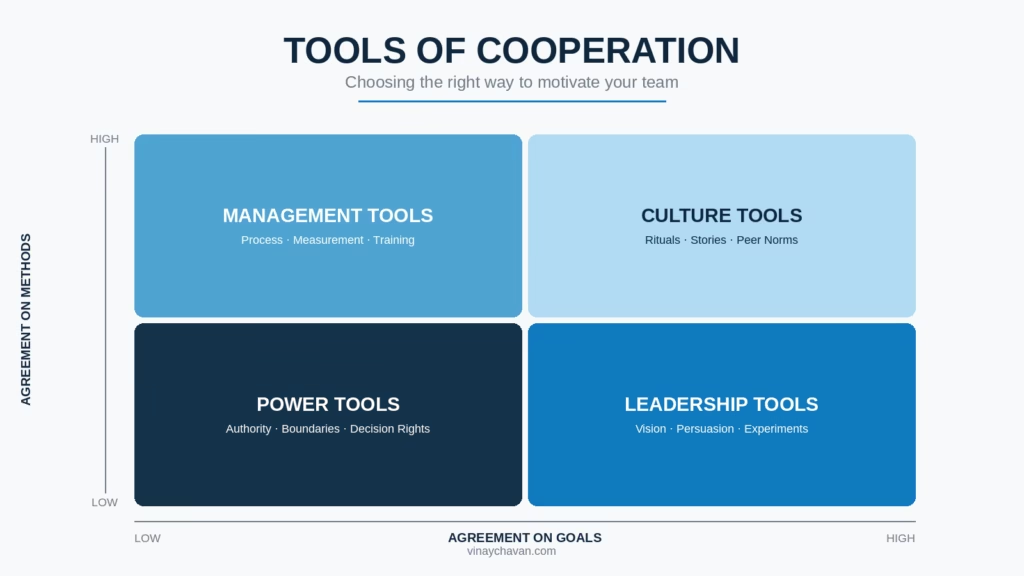
1. Power Tools: Little Agreement on Either Goals or Methods

When people disagree about both the destination and the way to get there, inspiration and process alone won’t create movement. This is where you need power tools: formal authority, role definition, control systems, firm boundaries.

That doesn’t have to mean authoritarian leadership. In practice, it usually means making a clear executive call, defining a non-negotiable standard, assigning decision ownership, or stopping behaviour that’s creating unacceptable risk.

Example: I’ve seen this play out almost exactly in an engineering org dealing with repeated security incidents. Some teams didn’t believe security work should interrupt feature delivery, and there was no shared agreement on which controls actually mattered. The only way through was leadership setting a mandatory security baseline, assigning accountable owners, and blocking releases that failed critical checks.

The point of authority here is to break dangerous gridlock, not to replace leadership indefinitely. Power creates compliance quickly, but it rarely creates commitment on its own. Lean on it too long and you get silence, dependency, and resistance that just moves underground. Once the immediate risk is under control, the real work is building understanding and moving the team toward genuine agreement.

2. Leadership Tools: Goals Are Shared, Methods Are Disputed

This is the situation I run into most with ambitious teams. Everyone wants the same outcome better reliability, faster delivery, a stronger customer experience — but people disagree about how to get there.

This is where leadership tools do the work: vision, storytelling, persuasion, role modeling, strategic framing, visible experimentation.

Example: Product and engineering agree that releases need to get faster and safer. One group is pushing for trunk-based development, another wants longer stabilization cycles, a third thinks better automated testing is the real fix. Rather than prescribing every step up front, the job is to reconnect the debate to the shared outcome, make room for a controlled pilot, and model genuine curiosity about what the evidence shows.

Your job isn’t to pretend there’s no disagreement. It’s to keep disagreement about methods from destroying commitment to the goal. When people already care about the destination, a credible vision gives them a reason to try a new path and a small experiment turns competing opinions into shared evidence.

3. Management Tools: Methods Are Understood, Goals Differ

Sometimes people broadly agree on how the work gets done but show up for different reasons or optimize for different outcomes. This is where management tools earn their keep: standard operating procedures, measurement systems, training, resource allocation, incentives, clear responsibilities.

Example: Engineering, compliance, and customer support can all value a release-readiness review, just for different reasons. Engineering wants fewer rollbacks, compliance wants traceability, support wants fewer escalations. They don’t share an identical definition of success, but they agree the review reduces preventable failures. A documented process, a shared dashboard, and clear ownership can coordinate all three groups even before their motivations fully line up.

Management tools only work when people trust the relationship between the process and its outcome. If that trust is missing, adding more process just feels like bureaucracy. A checklist can’t fix a disagreement about whether the checklist actually works.

4. Culture Tools: Agreement on Both Goals and Methods

When a team shares both its priorities and its understanding of how to get there, cooperation becomes almost automatic. People make similar calls even when a manager isn’t in the room. This is culture tools: rituals, stories, traditions, peer recognition, shared language, consensus-based decisions.

Example: A mature team that genuinely believes in learning from failure doesn’t need to be told to run a blameless incident review after an outage, it just happens. The ritual is baked into how the team works. Stories from past incidents reinforce the norm, and the senior folks model it for anyone new.

That’s the strength of culture: it scales judgment. It’s also its limitation. A strong culture is excellent at protecting an established direction, but it can resist change that challenges the very beliefs that made it successful in the first place. A ritual that once drove excellence can quietly become an obstacle once circumstances shift. It’s worth asking regularly whether you have a strong culture or a culture suited to the next challenge those aren’t always the same thing.

Quick Reference

SituationAgreement on GoalsAgreement on MethodsReach For
Power ToolsLowLowAuthority, boundaries, decision rights
Leadership ToolsHighLowVision, persuasion, experiments
Management ToolsLowHighProcess, measurement, training, incentives
Culture ToolsHighHighRituals, stories, peer norms

The Team Isn’t Permanently in One Quadrant

This matrix is a snapshot, not a personality test for your organization.

The same team can sit in different quadrants depending on the decision. I’ve had teams with deep agreement on product quality, partial agreement on architecture, and almost no agreement on returning to the office all at the same time. Different stakeholder groups can land in different places too.

Which means the first question isn’t “what kind of team do I have?” It’s:

“For this specific change, where does agreement exist and where does it break down?”

Agreement also shifts over time. Dialogue builds agreement on goals. Experiments and evidence build agreement on cause and effect. Training makes a proven method easier to adopt. Repeated success eventually turns a new behavior into culture. Your job isn’t just picking the right tool for today, it’s helping the team build the shared understanding it’ll need tomorrow.

A Practical Diagnostic

Before you announce the next transformation, roll out a new process, or try to motivate a struggling team, pause and run a short diagnosis first.

Step 1: Define the change clearly. Finish this sentence in plain language: “We want the team to ______ because ______.” If you can’t state the change cleanly, you can’t honestly assess agreement on it.

Step 2: Test agreement on the goal.

  • Do people agree this problem is worth solving?
  • Do they define success the same way?
  • Who benefits from the change, and who carries the cost?
  • Is the agreement real, or are people just quiet in front of authority?

Step 3: Test agreement on cause and effect.

  • Do people believe the proposed actions will actually produce the outcome?
  • Which assumptions are backed by evidence, and which aren’t?
  • Where are we leaning on habit, hierarchy, or opinion instead?
  • What small experiment would reduce the uncertainty?

Step 4: Choose the tool that fits.

  • Low agreement on both: set boundaries, decision rights, and immediate controls.
  • Shared goal, disputed methods: lead with vision, persuasion, role modeling, experiments.
  • Disputed goal, shared methods: coordinate through process, measurement, training.
  • Agreement on both: reinforce it through rituals, stories, recognition, peer norms.

Choose the least forceful tool that will still produce responsible action. Authority may be necessary in an emergency, but it shouldn’t become a shortcut around actually listening.

Step 5: Reassess after you act. Don’t assume one intervention permanently resolves anything. Look for real evidence has behaviour changed, has understanding improved, are people complying or genuinely committed, has the team moved toward more agreement? Cooperation is dynamic. Your diagnosis has to keep up with it.

Psychological Safety Makes the Diagnosis Honest

There’s a condition underneath all of this: people have to feel safe revealing disagreement.

If your team fears embarrassment, punishment, or being frozen out, you’ll see false consensus. Everyone nods along in the meeting while the real resistance moves into side conversations and quiet non-compliance. This is exactly the dynamic Google’s Project Aristotle research pointed to when it named psychological safety as the strongest predictor of team effectiveness and it matters here because the whole framework only works if people will tell you what they actually believe.

Before you try to measure alignment, make disagreement safe first. Ask for the counter-evidence. Invite the quietest people to speak before you share your own conclusion. Separate debating the idea from judging the person who raised it. A team that can disagree openly gives you better information and gives itself a real shot at genuine cooperation, not just the appearance of it.

Mistakes I See Leaders Make With This

Treating silence as agreement. People often go quiet because the decision already feels made. Test alignment privately, invite written input, and ask people to explain the goal and the logic back to you in their own words.

Using vision to solve a goal conflict. An inspiring speech doesn’t land when people fundamentally want different outcomes. Surface the competing interests before you try to rally everyone around a slogan.

Adding process to solve a belief conflict. If people don’t believe a method will work, a detailed procedure just formalizes the disagreement. Use evidence, pilots, and small wins to build confidence in cause and effect instead.

Overusing authority. Power moves fast, especially in a crisis, but leaning on it too often erodes ownership. Use it to protect clear boundaries or break urgent gridlock, then build a path back toward participation.

Assuming a strong culture is automatically an adaptive one. Deep agreement makes execution efficient, but it can also make old assumptions invisible. Every so often, ask which rituals still serve the mission and which ones are just preserving the past.

Diagnosing the whole org as one group. Executives, managers, frontline engineers, customers, and partners can all hold different goals and different beliefs about cause and effect. Map the important stakeholder groups separately before you pick an intervention.

Final Thoughts

Motivating a team was never really about becoming more charismatic, more forceful, or more process-driven. It’s about understanding the situation well enough to know which response it actually calls for.

The Tools of Cooperation framework gives you a disciplined way to make that call. When a team disagrees about both goals and methods, establish clarity and boundaries first. When the goal is shared but the path is uncertain, lead with vision and learning. When the method is trusted but the motivations differ, coordinate through management systems. When both are shared, let culture carry the work and stay alert to the moment it starts protecting the past instead of the mission.

The mountain was never really the problem. The real question is whether people want the same summit, believe in the same route, and trust each other enough to say when they don’t.

So before asking “how do I motivate this team,” ask two better questions: what do we genuinely agree on, and which tool does this specific situation actually call for? The quality of that diagnosis will tell you almost everything about the quality of your leadership.
Categories
Articles

Leading Through Conflict: A Self-Aware Approach

Have you ever found yourself in a situation where a tough decision had to be made, and differing opinions were pulling you in opposite directions? Perhaps a team project was on the verge of missing a deadline because two key stakeholders couldn’t agree on the best approach. Or maybe you’ve had to mediate a disagreement between colleagues, unsure whether to push for a compromise or let one party take the lead. If so, you’re not alone. Conflict is an inevitable part of any organization.

Why Self-Awareness Matters in Conflict Resolution

Understanding one’s default conflict-handling mode is essential for effective leadership. Self-awareness allows leaders to:

  • Recognize their natural tendencies in conflict situations.
  • Assess whether their default approach is appropriate for the given context.
  • Develop the flexibility to adopt different styles as needed.
  • Enhance emotional intelligence, improving communication and team dynamics.

The way leaders manage conflict has a profound impact on organizational health, culture, and performance. To navigate these complexities effectively, leaders must first develop self-awareness before entering a conflict negotiation. One of the most insightful tools for this self-awareness is the Thomas-Kilmann Conflict Mode Instrument (TKI).

Understanding the TKI Framework

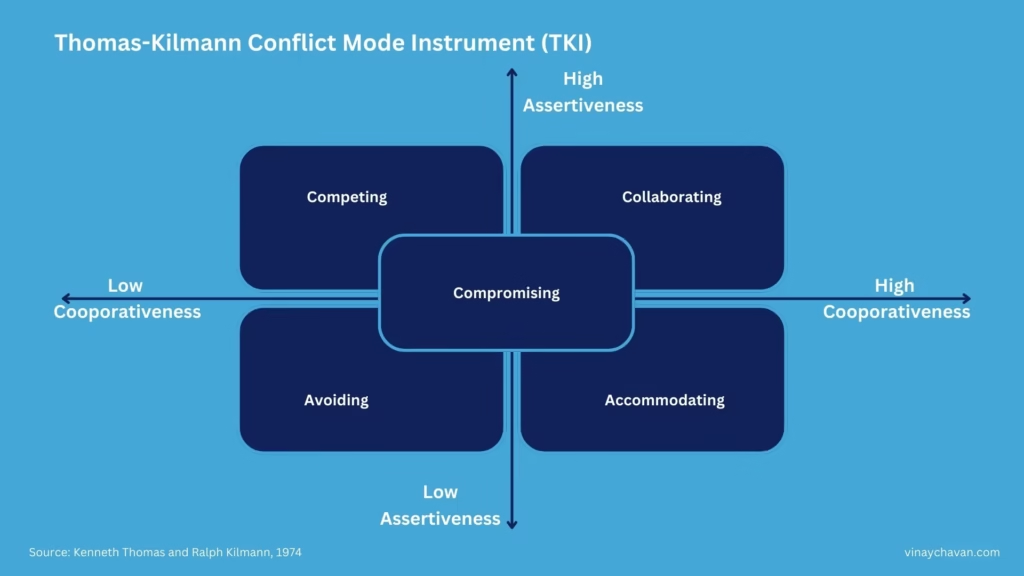
Developed by Kenneth W. Thomas and Ralph H. Kilmann, the TKI identifies five primary conflict-handling modes, each based on two fundamental dimensions:

  1. Assertiveness – The extent to which an individual tries to satisfy their own concerns.
  2. Cooperativeness – The extent to which an individual attempts to satisfy the concerns of others.

These two dimensions create five conflict resolution styles:

1. Competing (High Assertiveness, Low Cooperativeness)

A competing approach is highly assertive and low in cooperation. Leaders using this mode pursue their own interests forcefully, often at the expense of others. This approach is most effective in situations where quick, decisive action is required, such as emergencies, or when protecting non-negotiable principles. However, overuse can damage relationships and create resentment among team members.

Example Statement: “I understand your concerns, but this decision needs to be made now, and we are going with my approach.”

Real-Life Scenario: A project manager insists on meeting a strict deadline despite pushback from team members about workload, prioritizing efficiency over consensus.

2. Collaborating (High Assertiveness, High Cooperativeness)

A collaborative approach seeks win-win outcomes. Leaders employing this style invest time in finding solutions that satisfy all parties. This mode is ideal for complex problems requiring creative solutions and when maintaining strong relationships is crucial. However, it demands patience and open communication, making it impractical for urgent decision-making.

Example Statement: “Let’s brainstorm together and find a way where both of our concerns are addressed.”

Real-Life Scenario: Two department heads with conflicting budget requests work together to identify a solution that supports both their goals without compromising key priorities.

3. Compromising (Moderate Assertiveness, Moderate Cooperativeness)

A compromising leader seeks a middle ground, ensuring that both parties give up something to reach an agreement. This approach is useful when time constraints prevent full collaboration but still require a fair outcome. While effective in many situations, excessive reliance on compromise can lead to suboptimal solutions where neither party is fully satisfied.

Example Statement: “If you’re willing to adjust your deadline by one week, I can allocate more resources to support you.”

Real-Life Scenario: A marketing director and sales manager agree to split the promotional budget evenly instead of one department receiving a majority, ensuring both teams get some level of support.

4. Avoiding (Low Assertiveness, Low Cooperativeness)

Avoidance involves sidestepping conflict altogether. Leaders may use this approach when an issue is trivial, when emotions are too high for productive discussion, or when more information is needed before engaging. However, habitual avoidance can lead to unresolved tensions and a culture of passivity in conflict resolution.

Example Statement: “This isn’t the right time to discuss this. Let’s revisit it after the quarterly review.”

Real-Life Scenario: A team member avoids addressing a minor workplace dispute, hoping the issue will resolve itself over time rather than confronting it immediately.

5. Accommodating (Low Assertiveness, High Cooperativeness)

An accommodating leader prioritizes the needs of others over their own, often yielding to maintain harmony. This approach is beneficial in situations where preserving relationships is more important than immediate personal gain. However, excessive accommodation can lead to a loss of respect and an imbalance in power dynamics.

Example Statement: “I see how important this is to you, so I’ll support your approach even though I had a different perspective.”

Real-Life Scenario: An employee volunteers to cover a coworker’s shift at the last minute despite personal inconvenience, prioritizing teamwork over personal plans.

Steps to Enhance Conflict-Handling Awareness

Good leaders recognize that conflict, when managed constructively, can drive innovation, strengthen teams, and improve decision-making. By integrating TKI into their leadership toolkit, they cultivate a culture of trust, accountability, and open communication.

  1. Self-Assessment: Use the TKI assessment to determine your dominant conflict mode. Take time to reflect on past conflicts—how did you handle them? Were you more assertive or cooperative? Understanding your go-to response provides a foundation for growth.
  2. Situational Analysis: Before engaging in a conflict, evaluate the stakes, relationships involved, and desired outcomes. Ask yourself questions like: What are the long-term implications of this conflict? Is this a one-time disagreement, or does it indicate a deeper issue that needs addressing? Considering these factors will help you choose the most effective conflict-handling mode.
  3. Mindful Adaptation: Develop the ability to shift between conflict modes depending on the context. For example, in high-stakes negotiations, collaboration might be the best approach, while minor disagreements may be resolved through accommodation or compromise. Practicing adaptability ensures that conflicts are managed effectively without damaging relationships.
  4. Feedback Loop: Seek feedback from colleagues and mentors on your conflict management style. Regularly discussing your approach with trusted advisors provides valuable perspectives that help refine your conflict resolution skills. Additionally, observing how others handle conflicts can offer new strategies to incorporate into your own leadership approach.
  5. Skill Development: Invest in training, workshops, or coaching to enhance your conflict resolution skills. Practicing active listening, negotiation techniques, and emotional intelligence can improve how you navigate difficult situations and build stronger relationships with your team.
  6. Post-Conflict Reflection: After a conflict is resolved, take time to reflect on the outcome. What worked well? What could have been handled differently? Continuous learning from each experience helps refine your conflict resolution strategy over time.

Final Thoughts

Effective conflict resolution is not about winning or losing—it’s about fostering understanding, collaboration, and sustainable solutions. By embracing self-awareness and adaptability, leaders can turn conflicts into opportunities for personal and professional growth. The Thomas-Kilmann Conflict Mode Instrument offers a structured approach to navigating difficult conversations with clarity and confidence. As you refine your conflict management skills, remember that every disagreement is a chance to strengthen relationships, build trust, and contribute to a healthier, more resilient organization.

Key Takeaways

  • Conflict is an inevitable part of leadership and can be managed constructively.
  • The Thomas-Kilmann Conflict Mode Instrument (TKI) helps leaders understand their natural conflict resolution tendencies.
  • There are five conflict-handling modes: Competing, Collaborating, Compromising, Avoiding, and Accommodating.
  • Self-awareness is essential for choosing the right conflict resolution approach for different situations.
  • Developing adaptability in conflict resolution fosters stronger relationships and better decision-making.
  • Seeking feedback, engaging in situational analysis, and practicing mindful adaptation enhance conflict-handling skills.
  • Every conflict presents an opportunity to learn, grow, and improve workplace culture.

Categories
Articles

Healing The Hidden Wounds: Transforming Gossip Into Growth

In every corner of your organization lies the potential for greatness, powered by clear and open communication. Yet, when whispers and backchannel chatter begin to weave through the corridors, consider this not as mere office politics, but as a beacon highlighting deeper, more systemic challenges within your communication landscape. Your role as a leader stretches far beyond the realms of task delegation and project oversight; you are the steward of your team’s culture, the architect of an environment where trust and clarity can thrive.

Seeing these hidden conversations not as problems but as symptoms is your first step on a journey of transformation. It’s a call to action, inviting you to delve beneath the surface, to understand and address the roots of these whispers. In Sarah Drasner’s words, “As you move up the leadership chain, the further you will be from the actual metal of the problems, and thus, you need to rely on your staff and others to tell you the truth of the problem space.”

This is your moment to turn potential discord into powerful growth opportunities, to stitch together any rifts with threads of transparency and unity. Let’s understand why this happens and how we can tackle it effectively.

Understanding Why Backchannel Communication Happens

Backchannel communication typically emerges from a perceived lack of efficacy, safety, or accessibility in official communication channels. This can stem from various factors:

  1. Lack of Trust: If employees believe that their inputs are undervalued or ignored in formal settings, they may seek alternative routes to voice their concerns or suggestions.
  2. Perceived Inefficiency: The official channels may exist, but if they’re seen as slow or unresponsive, employees will naturally look for a faster way to convey information.
  3. Fear of Reprisal: Concerns over potential negative repercussions for speaking up can push employees towards more covert means of communication.
  4. Cultural Norms: An organizational culture that inadvertently favors informal over formal communication can encourage back channeling as a norm.
  5. Lack of Awareness or Training: Without proper knowledge or skills on effective communication practices, employees might not utilize official channels effectively.

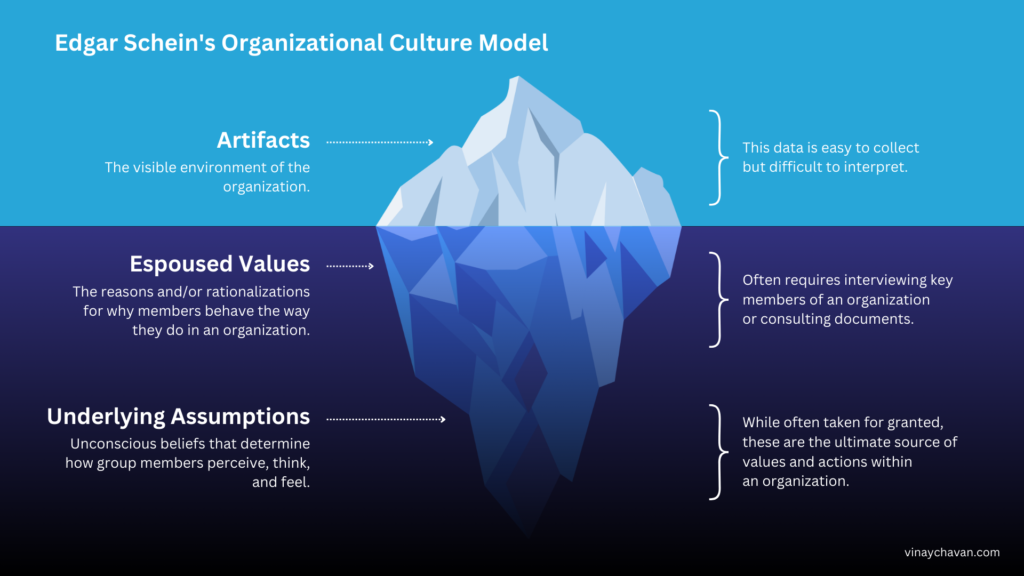
Edgar Schein’s Organizational Culture Model offers a profound lens through which to examine and address these undercurrents. Originally published in 1985, Schein’s book “Organizational Culture and Leadership” proposed that organization culture can be analyzed on three levels: Artifacts, Espoused Values, and Basic Underlying Assumptions, guiding you in identifying and remedying the disconnects that often lead to indirect communication paths.

Artifacts as Indicators: If you notice a prevalence of gossip and backchannel chatter, these behaviors can be considered artifacts – visible indicators of deeper cultural dynamics. They suggest a misalignment within the team’s culture, pointing towards gaps between public endorsements and private practices or beliefs.

Espoused Values and Reality Check: When there’s a noticeable gap between what your organization claims to value (such as open communication) and what your team members experience, it creates fertile ground for back channeling. Your team might be bypassing official channels not out of malice, but because those channels are perceived as ineffective or, worse, punitive.

Core Beliefs Influencing Behavior: The most profound layer, the basic underlying assumptions about trust, safety, and the effectiveness of open communication, ultimately shapes your team’s communication habits. If the tacit understanding is that speaking up openly is discouraged or risky, backchannel communication becomes a natural response.

Strategies You Can Implement to Address Root Causes

1. Introducing Direct Communication Channels

  • Create a 1:1 Communication Channel: Establish a dedicated channel for 1:1 meetings with team members, using a meeting agenda checklist that’s only shared between you two. Regularly address each item in these meetings, listening to feedback without judgment to ensure team members feel heard in a safe space.
  • Report to Your Team: Make it a practice to report back to your team about the actions you’ve taken based on their feedback, mirroring the accountability you expect from them. This demonstrates your commitment to their concerns and the steps you’re taking to address them.

2. Normalize Seeking Help

  • Demonstrate Vulnerability: Share your own experiences of seeking help, highlighting that it’s normal and safe. By sharing moments when you were vulnerable and how asking for help benefited you, you lead by example, normalizing help-seeking behavior among your team.

3. Harmonizing Artifacts with Values

  • Lead by Example: Mirror the organization’s espoused values in your actions. Transparent communication and decision-making from you set a behavioral benchmark for your team.
  • Implement Visible Changes: Actively support and promote open dialogue and feedback channels, like open forums and transparent policy updates, demonstrating your commitment to these values.
  • Be at Service: Position yourself as a service provider to your team, focusing on facilitating their success and addressing their needs proactively.

4. Closing the Gap Between Stated Values and Practices

  • Reinforce Values Through Actions: Ensure that your team’s policies and your managerial conduct consistently mirror the organization’s stated values, emphasizing the significance of these values through your actions and communication.
  • Establish Effective Feedback Mechanisms: Set up channels for your team to voice their experiences and views on the congruence between espoused values and actual practices, and act on this feedback.

5. Shifting Basic Underlying Assumptions

  • Cultivate a Safe Environment: Strive to create a psychologically safe space where team members feel secure in sharing their views and feedback without fear of repercussions.
  • Engage in Open Dialogues: Encourage discussions that enable your team to collectively examine and potentially alter the underlying assumptions that influence their behavior, especially concerning communication and trust.

6. Maintain Continuous Evaluation and Adaptation

  • Regularly Assess Cultural Alignment: Employ surveys, focus groups, or informal check-ins to evaluate the coherence between the visible culture of your team, the values you advocate for, and the foundational assumptions.
  • Be Ready to Pivot: Stay flexible and ready to modify your strategies based on feedback, ensuring your initiatives to foster open communication align with your team’s evolving requirements.

These strategies, rooted in understanding and actively shaping the organizational culture, represent a comprehensive approach to addressing and mitigating backchannel communication and gossip. As you implement these strategies, remember that fostering a culture of openness and trust is an ongoing process that requires persistence, empathy, and adaptability.

Wrapping Up: Cultivating a Culture of Openness

As we’ve explored the depths of Schein’s Organizational Culture Model and its application in addressing backchannel communication and gossip, it’s clear that fostering a culture of transparency and trust is both a challenge and an opportunity for leadership. By implementing the strategies discussed, you embark on a journey towards realigning your team’s artifacts, espoused values, and basic underlying assumptions, paving the way for a more open, communicative, and cohesive work environment.

However, the journey doesn’t end here. The complexity and dynamism of organizational culture mean that there’s always more to learn, more strategies to try, and more adjustments to make. That’s where you come in. Your experiences, challenges, and successes in navigating and shaping your team’s culture are invaluable. They not only enrich your own understanding but can also light the way for others facing similar challenges.

I invite you to share your stories, strategies, and questions. Have you found effective ways to improve your organization’s culture? Are there persistent challenges that you’re grappling with? Let’s continue the conversation. Connect with me on LinkedIn. Together, we can build a community of practice, sharing insights and solutions that help us all grow as leaders and culture shapers.

Your insights and experiences are crucial to broadening our collective understanding of organizational culture and the practical steps we can take to nurture environments where everyone feels heard, valued, and motivated. Let’s collaborate to uncover new strategies, solve challenges, and contribute to creating workplaces where transparency, trust, and open communication flourish.

Looking forward to connecting, sharing, and learning together.