Categories
Articles

Choosing the Right Way to Motivate Your Team

A few years back, I had two engineering teams stalled on the same platform migration. On paper, both wanted the same outcome – get off the legacy system before it started costing us reliability. But one team was arguing about sequencing, and the other was quietly convinced the whole migration was the wrong call to begin with. I made the mistake most leaders make in that moment: I gave both rooms the same pep talk. It worked for one team. It did nothing for the other.

That sent me back to a framework I’d come across years earlier – Clayton Christensen, Matt Marx, and Howard Stevenson’s Tools of Cooperation and Change. The idea is simple but easy to forget in the moment: before you reach for a leadership tool, diagnose what people actually agree on. A technique that works brilliantly in one situation can fail completely in another, and more often than not, the problem isn’t the tool – it’s the diagnosis.

Picture it like planning a climb with your team. Some people are excited about the summit but can’t agree on the route. Others know exactly how to make the climb but aren’t convinced the summit is worth it. A few disagree about both. And every so often, you get a team that shares the same ambition and trusts the same way of getting there.

From a distance, all four situations look identical: the team isn’t moving. But each one calls for a different response from you as the leader. Do you explain the vision? Introduce a process? Offer an incentive? Set a firm boundary? Or step back and let the culture carry the team forward? The answer depends entirely on the kind of agreement that already exists.

Why Good Leadership Tools Often Fail

Leaders have a lot of tools available to them: vision, storytelling, incentives, training, standard operating procedures, measurement, role modeling, negotiation, and formal authority. The common mistake and I’ve made this one myself is picking a favourite tool and reaching for it every time.

A visionary leader assumes a more inspiring presentation will resolve every disagreement. A process-oriented manager responds to uncertainty by adding another checklist. A decisive leader imposes a solution before understanding the resistance. A team with a strong culture keeps repeating familiar rituals even when the environment demands something different.

The problem usually isn’t the tool. It’s the diagnosis.

The Tools of Cooperation framework asks you to assess the situation along two dimensions:

  1. Agreement on goals: Do people agree on what they want to achieve?
  2. Agreement on cause and effect: Do people agree on which actions are likely to produce that result?

That second question goes deeper than agreeing on a plan. Two people can sign off on the same project plan while holding very different beliefs about why it will actually work. Cooperation holds together a lot better when the team shares an understanding of how the action leads to the outcome.

Together, these two dimensions give you four leadership situations.

The Four Tools of Cooperation
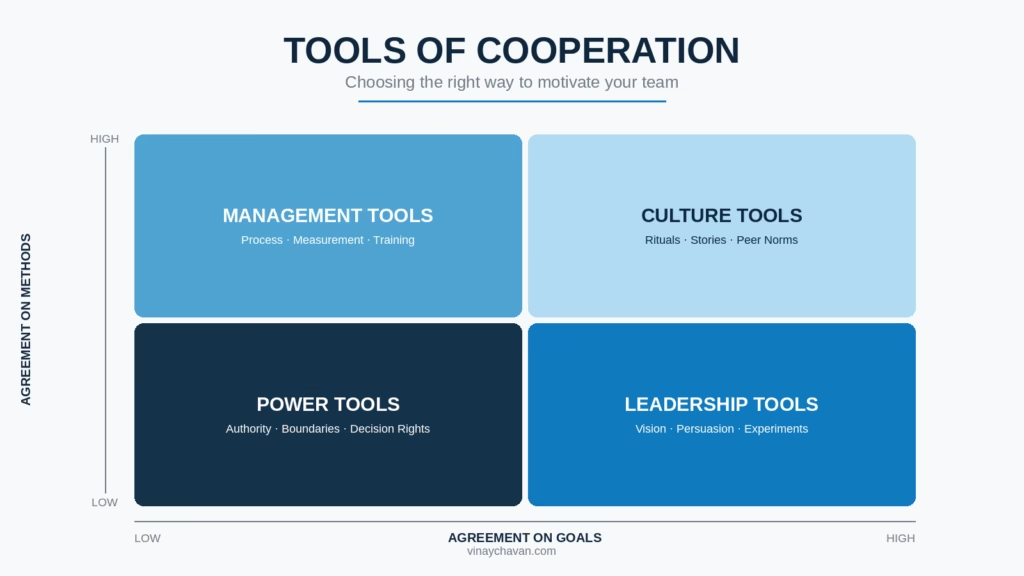
1. Power Tools: Little Agreement on Either Goals or Methods

When people disagree about both the destination and the way to get there, inspiration and process alone won’t create movement. This is where you need power tools: formal authority, role definition, control systems, firm boundaries.

That doesn’t have to mean authoritarian leadership. In practice, it usually means making a clear executive call, defining a non-negotiable standard, assigning decision ownership, or stopping behaviour that’s creating unacceptable risk.

Example: I’ve seen this play out almost exactly in an engineering org dealing with repeated security incidents. Some teams didn’t believe security work should interrupt feature delivery, and there was no shared agreement on which controls actually mattered. The only way through was leadership setting a mandatory security baseline, assigning accountable owners, and blocking releases that failed critical checks.

The point of authority here is to break dangerous gridlock, not to replace leadership indefinitely. Power creates compliance quickly, but it rarely creates commitment on its own. Lean on it too long and you get silence, dependency, and resistance that just moves underground. Once the immediate risk is under control, the real work is building understanding and moving the team toward genuine agreement.

2. Leadership Tools: Goals Are Shared, Methods Are Disputed

This is the situation I run into most with ambitious teams. Everyone wants the same outcome better reliability, faster delivery, a stronger customer experience — but people disagree about how to get there.

This is where leadership tools do the work: vision, storytelling, persuasion, role modeling, strategic framing, visible experimentation.

Example: Product and engineering agree that releases need to get faster and safer. One group is pushing for trunk-based development, another wants longer stabilization cycles, a third thinks better automated testing is the real fix. Rather than prescribing every step up front, the job is to reconnect the debate to the shared outcome, make room for a controlled pilot, and model genuine curiosity about what the evidence shows.

Your job isn’t to pretend there’s no disagreement. It’s to keep disagreement about methods from destroying commitment to the goal. When people already care about the destination, a credible vision gives them a reason to try a new path and a small experiment turns competing opinions into shared evidence.

3. Management Tools: Methods Are Understood, Goals Differ

Sometimes people broadly agree on how the work gets done but show up for different reasons or optimize for different outcomes. This is where management tools earn their keep: standard operating procedures, measurement systems, training, resource allocation, incentives, clear responsibilities.

Example: Engineering, compliance, and customer support can all value a release-readiness review, just for different reasons. Engineering wants fewer rollbacks, compliance wants traceability, support wants fewer escalations. They don’t share an identical definition of success, but they agree the review reduces preventable failures. A documented process, a shared dashboard, and clear ownership can coordinate all three groups even before their motivations fully line up.

Management tools only work when people trust the relationship between the process and its outcome. If that trust is missing, adding more process just feels like bureaucracy. A checklist can’t fix a disagreement about whether the checklist actually works.

4. Culture Tools: Agreement on Both Goals and Methods

When a team shares both its priorities and its understanding of how to get there, cooperation becomes almost automatic. People make similar calls even when a manager isn’t in the room. This is culture tools: rituals, stories, traditions, peer recognition, shared language, consensus-based decisions.

Example: A mature team that genuinely believes in learning from failure doesn’t need to be told to run a blameless incident review after an outage, it just happens. The ritual is baked into how the team works. Stories from past incidents reinforce the norm, and the senior folks model it for anyone new.

That’s the strength of culture: it scales judgment. It’s also its limitation. A strong culture is excellent at protecting an established direction, but it can resist change that challenges the very beliefs that made it successful in the first place. A ritual that once drove excellence can quietly become an obstacle once circumstances shift. It’s worth asking regularly whether you have a strong culture or a culture suited to the next challenge those aren’t always the same thing.

Quick Reference

SituationAgreement on GoalsAgreement on MethodsReach For
Power ToolsLowLowAuthority, boundaries, decision rights
Leadership ToolsHighLowVision, persuasion, experiments
Management ToolsLowHighProcess, measurement, training, incentives
Culture ToolsHighHighRituals, stories, peer norms

The Team Isn’t Permanently in One Quadrant

This matrix is a snapshot, not a personality test for your organization.

The same team can sit in different quadrants depending on the decision. I’ve had teams with deep agreement on product quality, partial agreement on architecture, and almost no agreement on returning to the office all at the same time. Different stakeholder groups can land in different places too.

Which means the first question isn’t “what kind of team do I have?” It’s:

“For this specific change, where does agreement exist and where does it break down?”

Agreement also shifts over time. Dialogue builds agreement on goals. Experiments and evidence build agreement on cause and effect. Training makes a proven method easier to adopt. Repeated success eventually turns a new behavior into culture. Your job isn’t just picking the right tool for today, it’s helping the team build the shared understanding it’ll need tomorrow.

A Practical Diagnostic

Before you announce the next transformation, roll out a new process, or try to motivate a struggling team, pause and run a short diagnosis first.

Step 1: Define the change clearly. Finish this sentence in plain language: “We want the team to ______ because ______.” If you can’t state the change cleanly, you can’t honestly assess agreement on it.

Step 2: Test agreement on the goal.

  • Do people agree this problem is worth solving?
  • Do they define success the same way?
  • Who benefits from the change, and who carries the cost?
  • Is the agreement real, or are people just quiet in front of authority?

Step 3: Test agreement on cause and effect.

  • Do people believe the proposed actions will actually produce the outcome?
  • Which assumptions are backed by evidence, and which aren’t?
  • Where are we leaning on habit, hierarchy, or opinion instead?
  • What small experiment would reduce the uncertainty?

Step 4: Choose the tool that fits.

  • Low agreement on both: set boundaries, decision rights, and immediate controls.
  • Shared goal, disputed methods: lead with vision, persuasion, role modeling, experiments.
  • Disputed goal, shared methods: coordinate through process, measurement, training.
  • Agreement on both: reinforce it through rituals, stories, recognition, peer norms.

Choose the least forceful tool that will still produce responsible action. Authority may be necessary in an emergency, but it shouldn’t become a shortcut around actually listening.

Step 5: Reassess after you act. Don’t assume one intervention permanently resolves anything. Look for real evidence has behaviour changed, has understanding improved, are people complying or genuinely committed, has the team moved toward more agreement? Cooperation is dynamic. Your diagnosis has to keep up with it.

Psychological Safety Makes the Diagnosis Honest

There’s a condition underneath all of this: people have to feel safe revealing disagreement.

If your team fears embarrassment, punishment, or being frozen out, you’ll see false consensus. Everyone nods along in the meeting while the real resistance moves into side conversations and quiet non-compliance. This is exactly the dynamic Google’s Project Aristotle research pointed to when it named psychological safety as the strongest predictor of team effectiveness and it matters here because the whole framework only works if people will tell you what they actually believe.

Before you try to measure alignment, make disagreement safe first. Ask for the counter-evidence. Invite the quietest people to speak before you share your own conclusion. Separate debating the idea from judging the person who raised it. A team that can disagree openly gives you better information and gives itself a real shot at genuine cooperation, not just the appearance of it.

Mistakes I See Leaders Make With This

Treating silence as agreement. People often go quiet because the decision already feels made. Test alignment privately, invite written input, and ask people to explain the goal and the logic back to you in their own words.

Using vision to solve a goal conflict. An inspiring speech doesn’t land when people fundamentally want different outcomes. Surface the competing interests before you try to rally everyone around a slogan.

Adding process to solve a belief conflict. If people don’t believe a method will work, a detailed procedure just formalizes the disagreement. Use evidence, pilots, and small wins to build confidence in cause and effect instead.

Overusing authority. Power moves fast, especially in a crisis, but leaning on it too often erodes ownership. Use it to protect clear boundaries or break urgent gridlock, then build a path back toward participation.

Assuming a strong culture is automatically an adaptive one. Deep agreement makes execution efficient, but it can also make old assumptions invisible. Every so often, ask which rituals still serve the mission and which ones are just preserving the past.

Diagnosing the whole org as one group. Executives, managers, frontline engineers, customers, and partners can all hold different goals and different beliefs about cause and effect. Map the important stakeholder groups separately before you pick an intervention.

Final Thoughts

Motivating a team was never really about becoming more charismatic, more forceful, or more process-driven. It’s about understanding the situation well enough to know which response it actually calls for.

The Tools of Cooperation framework gives you a disciplined way to make that call. When a team disagrees about both goals and methods, establish clarity and boundaries first. When the goal is shared but the path is uncertain, lead with vision and learning. When the method is trusted but the motivations differ, coordinate through management systems. When both are shared, let culture carry the work and stay alert to the moment it starts protecting the past instead of the mission.

The mountain was never really the problem. The real question is whether people want the same summit, believe in the same route, and trust each other enough to say when they don’t.

So before asking “how do I motivate this team,” ask two better questions: what do we genuinely agree on, and which tool does this specific situation actually call for? The quality of that diagnosis will tell you almost everything about the quality of your leadership.
Categories
Articles

Navigating the Path to High Performance

Talent wins games, but teamwork and intelligence win championships.

Michael Jordan

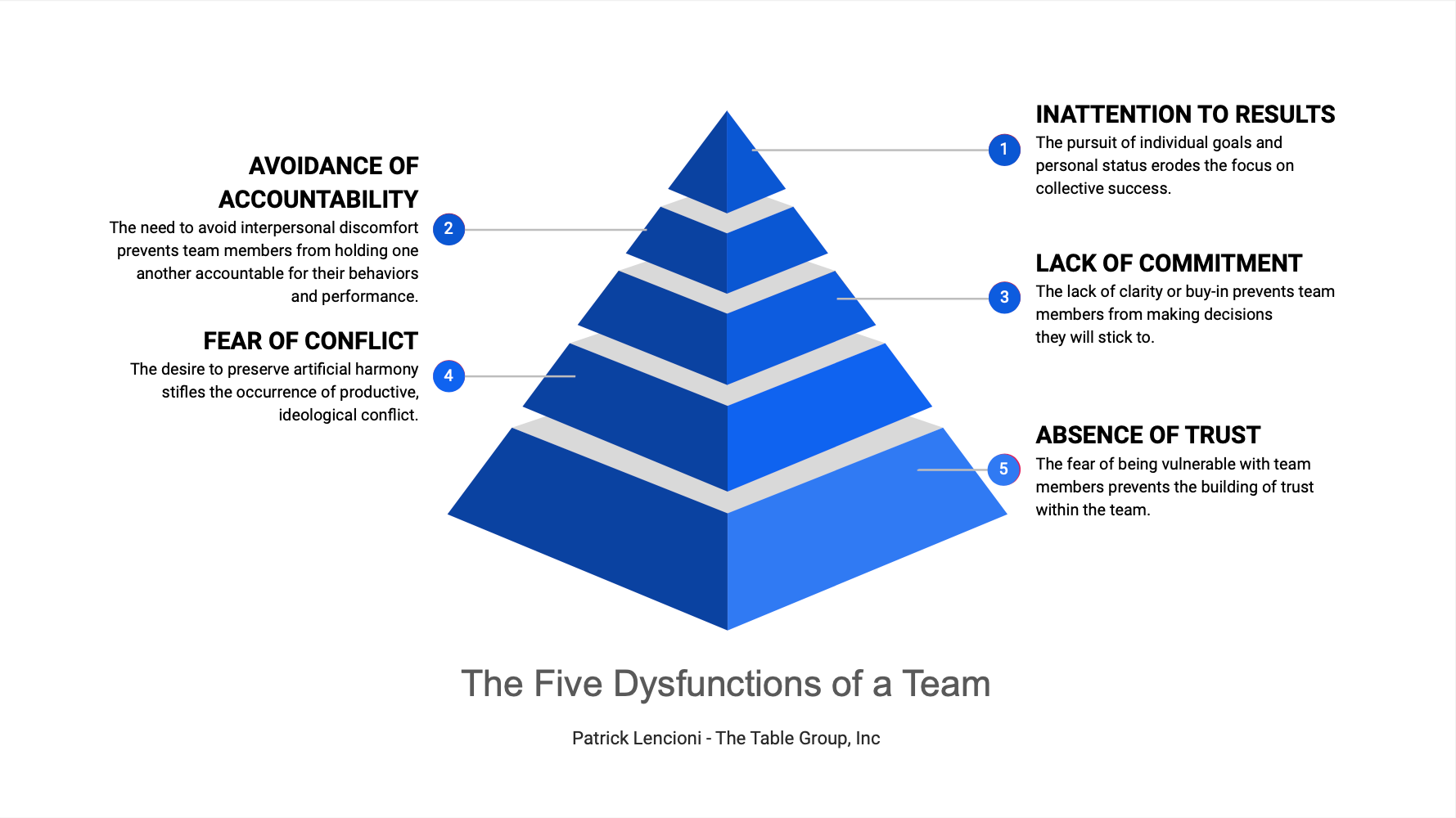
This rings true in the business world, too. It’s not just the smartest people or the standout stars who push a company to the top; it’s teams that work well together. Understanding and fixing team problems can be tricky. Patrick Lencioni’s model of the “Five Dysfunctions of a Team” offers a profound lens through which we can scrutinize and elevate our teams. Here’s how we can stride from dysfunction to high performance.

As a leader, envisioning yourself as the doctor for your team is pivotal. Your primary responsibility is not just to direct but to diagnose and heal the underlying ailments that may hinder your team’s performance. Recognizing the symptoms of dysfunctions early on is crucial to maintaining a healthy, high-performing team. Here’s a summary of what to watch for and how to act as your team’s caretaker:

Symptoms of Dysfunctions

  1. Lack of Trust: If you notice team members hesitating to share ideas, admit mistakes, or seek help, it indicates a foundational crack in trust. This environment stifles open communication and vulnerability, essential ingredients for strong teamwork.
  2. Fear of Conflict: When discussions become superficial or disagreements are avoided to maintain artificial harmony, it’s a sign that your team is not engaging in healthy, constructive debates necessary for innovation and problem-solving.
  3. Lack of Commitment: Watch for ambiguity in decisions and plans. If team members seem disengaged or indifferent towards team goals, it reflects a lack of commitment and clarity.
  4. Avoidance of Accountability: A clear red flag is when poor performance is not addressed, deadlines are consistently missed, and there’s an absence of constructive feedback. This avoidance can create an environment of resentment and lower overall team standards.
  5. Inattention to Results: If team members prioritize their individual goals or departmental targets over the team’s collective objectives, it can derail the team from its primary mission.

Acting as Your Team’s Doctor

Your leadership role extends beyond management to include diagnosis and remedy. By staying vigilant to these symptoms and addressing them with targeted strategies, you can ensure your team not only recovers but thrives.

1. Cultivate Trust: The Foundation of High-Performing Teams

Building a high-performing team is akin to crafting a masterpiece; it requires patience, skill, and a foundation that will stand the test of time. Trust is that foundation. It’s about nurturing an environment where openness is valued over pretense, where team members feel secure enough to reveal their true selves, including their uncertainties and aspirations. When trust is present, a team is not just a collection of individuals working together, but a unified entity with a shared vision.

Trust is the glue that holds a team together through thick and thin. It’s the assurance that everyone has each other’s backs. When you trust your team, and they trust you, magic happens. Here’s how you can lay this crucial groundwork:

Fostering Open Dialogue:

Start by promoting honest and open dialogue. This doesn’t just mean encouraging team members to speak their minds about work issues; it means creating an atmosphere where personal expressions are also welcomed. When people share their thoughts and feelings without fear, they’re not just communicating – they’re connecting.

Know Each Member’s Core Value System:

Understanding and respecting your team members’ core values is crucial. Take the time to discover what drives each person, what they stand for, and start by sharing your own values. This mutual understanding fosters a deeper respect and a stronger bond among team members.

Public Praise, Private Feedback:

Recognition and feedback are two sides of the same coin. When your team does well, shout it from the rooftops. Praise them publicly to show you don’t just notice their hard work, you appreciate it. But when it comes to feedback, especially if it’s constructive, do it privately. This shows respect for their feelings and dignity.

Career Laddering:

Talk about their careers – not just jobs. Invest time in understanding where your team members see themselves in the future and help them map out a path to get there. This shows that you’re not just their leader for the current project, but a mentor for their professional journey.

Get to know their personal goals as well, thats a bonus. What do they aspire to achieve outside of work? When you take interest in their life beyond office walls, you show that you value them as complete individuals, not just as cogs in the machine.

2. Embrace Conflict: The Crucible of Creativity

Conflict isn’t just inevitable; it’s invaluable. Far from being a sign of dysfunction, the clash of differing opinions reveals a team’s dedication to excellence. It’s within these heated exchanges that creativity thrives, transforming potential discord into groundbreaking ideas. This dynamic is not about contention but about the passionate pursuit of innovation, with every team member daring to question the status quo in search of something extraordinary.

Confront Problems:

Procrastination can turn a small spark into a wildfire. This includes engineering problems and people behavior both. Addressing problems promptly shows the team that issues are opportunities for growth, not roadblocks. When you tackle challenges head-on, you set the stage for innovation, turning potential conflicts into catalysts for team development and creative solutions. Let the team know you have their back and not afraid to lead them with example when problems arise.

Practical Solutions Development:

Developing practical solutions in the face of conflict is an exceptional teaching moment for the team. It’s an opportunity to demonstrate that from the crucible of opposing views can emerge the strongest, most innovative outcomes. Use these moments to encourage critical thinking and problem-solving skills within your team.

Inclusion & Minimum Politics:

Make it a point to solicit input from all team members, as groundbreaking ideas can emerge from the most unexpected sources. By valuing each team member’s contribution equally, you ensure a diverse range of perspectives are considered. This inclusivity not only enriches the solution pool but also strengthens team cohesion.

Strive to maintain an environment where team politics are kept to a minimum. Bias and favoritism can stifle open dialogue and hinder the team’s creative potential. By treating everyone’s ideas with equal consideration, you foster a culture of mutual respect and collaboration. In such a setting, team members feel valued and motivated to contribute their best, knowing that their voices will be heard and their ideas given fair consideration.

3. Strengthen Commitment: The Drive of Unwavering Dedication

Commitment isn’t just about agreeing to do something; it’s about truly aligning with the team’s goals, understanding the direction, and dedicating yourself to it. This deep sense of commitment comes when every person on the team understands the why behind what they’re doing and fully buys into it. It’s a powerful force that moves everyone in the same direction with a shared sense of purpose. When there’s clarity around the objectives and a collective agreement on the path forward, the journey isn’t just easier—it’s propelled by a shared drive that can overcome any obstacle.

Clear Buy-In on Objectives:

The journey towards unwavering dedication starts with achieving a unanimous nod on the objectives at hand. Imagine a scenario where each team member feels personally connected to the goals set before them. It’s not merely about dictating these goals from a position of authority but fostering a sense of ownership and participation in crafting them. When individuals understand how their contributions fit into the larger picture, their investment in the outcome deepens. This process of garnering buy-in is more than a procedural step; it’s the cultivation of a collective determination to succeed. It’s about transforming the “I” into “we,” where goals become shared ambitions rather than imposed targets.

Bring Clarity with Open Dialogue:

Achieving this level of commitment requires open dialogue, transparency in decision-making, and a genuine effort to incorporate feedback from across the team. It means laying out the strategy, the why behind it, and the role each person plays in navigating towards success. When team members see their fingerprints on the plan, their commitment to its execution is natural and profound. This approach not only propels the team forward with a shared sense of purpose but also minimizes the friction often encountered when direction feels imposed rather than adopted.

Conclusive One Time Discussions:

To truly foster a spirit of commitment, it’s critical that every discussion, meeting, or brainstorming session concludes with a clear and decisive plan of action. This level of conclusiveness is only achievable when every member of the team is equally committed. It’s about making sure that by the time everyone stands up from the table, there’s a shared understanding of the path forward, and an eagerness to tackle the tasks at hand. Having these conclusive discussions means that the team not only identifies what needs to be done but also leaves no room for ambiguity about who is responsible for what and by when. This clarity and commitment ensure that the team’s energy is directed towards making strides in their shared journey, rather than getting caught in a loop of uncertainty and indecision. It’s this collective dedication to moving forward, with every member pulling in the same direction, that transforms plans into action and visions into reality.

4. Enforce Accountability: The Backbone of Execution

Accountability stands as the unwavering pillar upon which the integrity and success of a team rest. It’s the bold commitment to not just aim for excellence but to consistently uphold it, creating an environment where everyone knows what’s expected of them and strives to meet those expectations without fail. In the realm of high-performing teams, accountability means more than just individual responsibility; it’s about fostering a culture where everyone feels responsible for the collective outcome. It’s where constructive feedback flows freely, and underperformance is tackled head-on, not swept under the rug.

Solidifying Accountability with Clear Roles and Expectations:

The first step toward genuine accountability is ensuring that every team member has a crystal-clear understanding of their role. This clarity is paramount for individuals to function at their peak. When roles are defined, and expectations are set from the outset, it removes ambiguity, allowing team members to channel their efforts effectively. It’s about laying out a roadmap for success for each member, ensuring they know not just their destination but the path to get there.

Maintaining High Standards Across the Board:

Accountability also hinges on the maintenance of uniformly high standards. This means addressing poor performance head-on, without bias. Failing to do so can foster an environment of resentment and hopelessness, eroding the team’s morale. It’s crucial that the same standards apply to everyone, regardless of their position or closeness to leadership. This equality in accountability ensures that all team members are pulling in the same direction, committed to the team’s success.

Deadlines Are Sacred:

In the culture of accountability, missing deadlines should never become the norm. It’s essential to do whatever it takes to adhere to timelines, as consistent delays can undermine the team’s objectives. This may require extra support for some team members or reallocating resources, but the ultimate goal remains clear: meet your deadlines, and keep the team’s momentum going strong.

Addressing Underperformance Without Bias:

When it comes to holding team members accountable, it’s vital to approach the task without bias. This unbiased stance ensures that performance issues are addressed fairly, fostering a sense of justice and respect within the team. When everyone is held to the same standard, and accountability is enforced equitably, it reinforces the team’s foundation, making it stronger and more cohesive.

5. Focus on Results: The Pinnacle of Team Achievement

The true measure of a team’s effectiveness is its ability to deliver results. This means setting aside personal ambitions and focusing on what the team can achieve together. It’s about defining success in tangible outcomes, not just the effort put in. For high-performing teams, the end goal is always in sight, and every action is aimed at reaching that goal.

Clearly Defined Results:

Start by making sure everyone knows exactly what success looks like. This isn’t about vague objectives or feel-good statements; it’s about concrete, measurable outcomes. Numbers speak louder than words, so quantify your goals. Whether it’s hitting a sales target, reducing operational costs by a certain percentage, or achieving a project milestone on time, make it specific. This clarity ensures that every team member understands what they’re working towards and can see the direct impact of their efforts.

Numbers Over Feelings:

It’s crucial to prioritize data and metrics over subjective feelings. While intuition and experience play roles in decision-making, they must be grounded in empirical evidence. If you can’t measure something, you can’t know if you’re truly succeeding. This approach might seem cold to some, but it’s about ensuring accountability and enabling the team to make informed decisions. It’s not about dismissing individual contributions but about aligning those contributions with the team’s overall objectives.

Agility in Course Correction:

Being results-focused means being prepared to pivot when necessary. High-performing teams monitor their progress closely, ready to make adjustments based on what the data tells them. This agility allows them to stay on track towards their goals, even when unexpected challenges arise. It’s about being committed to the outcome, not to a particular path. If the numbers show that a change in strategy is needed, then that change must be made, without hesitation.

Reward Results:

Finally, it’s important to celebrate and reward the results. Recognizing achievements reinforces the importance of focusing on outcomes and motivates the team to continue pushing for excellence. Rewards can take many forms, from public acknowledgment in a team meeting to bonuses or other incentives. What matters is that the reward is tied directly to the achievement of specific results, sending a clear message that high performance is noticed and valued.


References

  1. Patrick Lencioni (2002), The Five Dysfunctions of a Team: A Leadership Fable

TL;DR for Leaders: The Diagnostic Lens for Team Health

As leaders, it’s our prerogative to act as the guardians of our team’s health, much like a doctor would for their patient. Recognizing the symptoms of dysfunction within your team is paramount to maintaining its well-being and steering it back to its optimal state. Be vigilant for signs of eroding trust, such as team members hesitating to share their true thoughts or feelings. Notice when conflict is avoided rather than leveraged as a tool for creativity and innovation. Observe the levels of commitment; a lack of clear direction or wavering dedication can signal misalignment. Accountability, or the lack thereof, often manifests as missed deadlines or subpar performance becoming the norm. Lastly, a shift from collective to individual focus, where team goals are overshadowed by personal achievements, can indicate a loss of result-oriented drive.

Your role as the team’s guide is not just to identify these symptoms but to prescribe and administer the necessary interventions to address them. This involves fostering an environment where trust can flourish, encouraging open and constructive conflict, ensuring commitment through clarity and buy-in, upholding accountability with impartiality, and maintaining a laser focus on results over personal gain.

The journey towards overcoming team dysfunctions is a shared endeavor, one that benefits immensely from the collective wisdom of leaders across various fields. I invite my fellow leaders to share their strategies for identifying and remedying team dysfunctions. How do you foster an environment where trust is the foundation, conflict becomes a source of innovation, commitment is unwavering, accountability is embraced, and a singular focus on results drives your team forward? Your experiences, strategies, and accomplishments in navigating these challenges can serve as invaluable lessons for us all.

I invite you to reflect on these principles and share your insights. How do you navigate these dysfunctions in your teams?