Categories
Articles

Enhancing Engineering Teams with a Competency Matrix

In the ever-evolving field of software engineering, it’s essential to keep teams performing at their best and continuously improving. One effective strategy to achieve this is through the use of a competency matrix. In this article we’ll discuss the challenges of objectively assessing individual skills, the benefits of standardizing roles, and how a competency matrix can help identify and bridge skill gaps through strategic hiring and development programs. Additionally, we’ll discuss how integrating this matrix into Objectives and Key Results (OKRs) for engineering managers can boost overall team performance.

Challenges in Measuring Team Competency
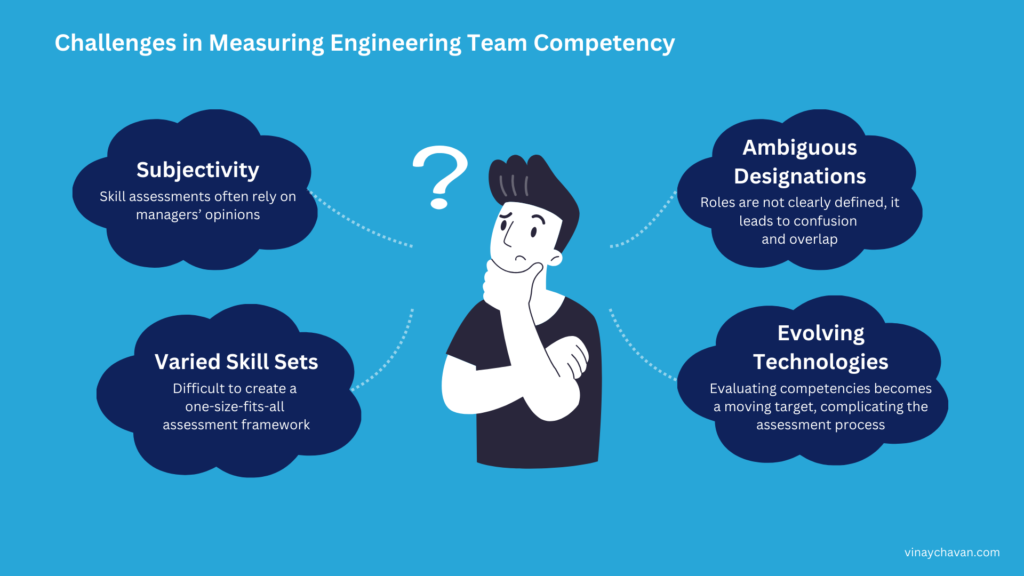
Challenges in Measuring Engineering Team Competency

Measuring individual competency within a diverse engineering team is fraught with challenges. One of the primary issues is subjectivity. Performance reviews and skill assessments often rely on managers’ opinions, which can vary widely. This subjectivity can lead to inconsistencies, as different managers might have different criteria for what constitutes proficiency in a particular skill.

Another significant challenge arises from ambiguous designations given based on age instead of skills. When roles and responsibilities are not clearly defined, it leads to confusion and overlap. For instance, if the distinction between a “software engineer” and a “senior software engineer” is not clear, it becomes difficult to set appropriate expectations and evaluate performance accurately. This ambiguity can cause frustration among team members who are unsure of their specific duties and career progression paths.

The varied skill sets present within a team add another layer of complexity. Engineering teams comprise individuals with different roles and areas of expertise, making it difficult to create a one-size-fits-all assessment framework. For instance, the competencies required for a front-end developer are vastly different from those needed for a back-end engineer or a DevOps specialist. This diversity necessitates a flexible yet standardized approach to competency measurement.

Furthermore, the rapid evolution of technology adds another layer of complexity. Technologies and best practices in software engineering are continually advancing, requiring engineers to engage in continuous learning and adaptation. As new tools and methodologies emerge, evaluating competencies becomes a moving target, complicating the assessment process.

Building Competency Matrix

1. Standardize Designations and Roles

To effectively create a competency matrix, it’s essential to standardize job designations within the team. This begins with defining roles and responsibilities. Clearly outlining what is expected from each role helps in setting precise performance benchmarks. A huge shoutout to Sarah Drasner (@sarah_edo) for her career ladders! This framework is an excellent foundation for standardizing team designations based on roles rather than technology-specific titles as follows,

  1. Engineer I
  2. Engineer II
  3. Senior Engineer
  4. Staff Engineer
  5. Principal Engineer
  6. Distinguished Engineer

2. Identify Key Competencies

Next, it’s crucial to create skill categories. Skills can be broadly divided into technical and non-technical areas. Technical skills might include proficiency in programming languages, familiarity with development tools, and knowledge of specific frameworks. Non-technical skills, on the other hand, encompass abilities like effective communication, problem-solving, and teamwork. By categorizing skills, organizations can ensure a holistic approach to competency evaluation. Example,

General SkillsWeb FrontendBackendMobileQA AutomationTesting Areas
Attention to DetailTypescriptTypescriptTypescriptSeleniumDatabase/SQL
CommunicationReact JSNodeJSReactNativeAppiumAPI Testing
Problem-SolvingReduxExpressExpoCypressPerformance Testing
Time ManagementJest/MochaJest/MochaApp StoreTestCompleteSecurity Testing
QC StandardsSQLPlay StoreKatalon Studio
TeamworkMongoDB
Agile and ScrumDynamoDB
Documentation
Key Competencies

3. Establish Proficiency Levels

Lastly, establishing proficiency levels is key to standardization. Proficiency levels such as novice, intermediate, and expert provide a clear progression path for skill development. For instance, a novice in cloud computing might understand basic concepts, an intermediate might be able to deploy applications, and an expert might design and manage complex cloud architectures. These levels help in setting clear expectations and growth paths for team members.

Skill LevelDescriptionLevel
Not applicable / missing0
NoviceRequires hand holding and supervision1
Intermediatedoes not require hand-holding but requires supervision for complex problems2
Expertno supervision required, can teach others3
Proficiency Levels

Implementing a Competency Matrix

1. Set Up the Excel Sheet

  1. Open Excel: Start by opening a new Excel workbook.
  2. Label Rows and Columns: In the first row, list the key competencies across the columns (e.g., A1: Programming Languages, B1: Database Management, C1: Problem-Solving). In the first column, list the names of the team members down the rows (e.g., A2: John Doe, A3: Jane Smith).
  3. Define Proficiency Levels: Determine the proficiency levels you will use (e.g., 1 for novice, 2 for intermediate, 3 for expert). You can add a legend or key to explain these levels, perhaps in a cell near the top of the sheet.

Here’s a simple example to illustrate how your matrix might look:

Programming
Languages
Database
Management
Problem-SolvingCommunication
John Doe
Jane Smith
Alice Johnson
Bob Brown
Simple Competency Matrix

2. Populate the Matrix

  1. Assess Competencies: Once key competencies are identified, the next step is to assess current skill levels within the team. This can be done through self-assessments, peer reviews, and practical evaluations. Standardized tests or coding challenges can also be used to validate these assessments. For instance, team members might rate their proficiency in different areas, followed by peer reviews to cross-verify these ratings. This multi-faceted approach helps in creating an accurate picture of the team’s current skill set.
  2. Add Team and Employee Versatility: Apply the formula such that the individual team member gets a single score in percentage for the overall competencies defined as well as for each competency column for the team. In the table below those are shown as Individual Versatility and Team Versatility respectively.
Team
Coverage: 100%
Skills ▶︎JavascriptTypescriptReactReact
Native
Node
Team
Versatility ▶︎
100%75%75%75%100%
NameDesignationEmployee
Versatility
John DoeStaff
Engineer
100%33333
Jane SmithSenior Engineer93%32333
Alice JohnsonEngineer II80%32223
Bob BrownEngineer I67%32113
Completed Team Competency Matrix

Leveraging the Competency Matrix

With the establishment of the competency matrix, you now have a clear, objective perspective on the team’s skill levels and proficiencies. This tool allows you to accurately gauge the distribution of competencies across various roles and designations within the team. By utilizing the competency matrix, you can identify existing skill gaps and assess the overall efficiency and utilization of your team’s capabilities. This comprehensive overview offers invaluable insights for targeted skill development and strategic resourcing, ensuring that each team member is positioned to contribute effectively to the organization’s goals.

  1. Analyze Skill Gaps – With the current competencies assessed, the next step is to analyze skill gaps. By comparing current skill levels with the required competencies, organizations can identify areas where team members need improvement or where new skills are necessary. For example, if the team lacks expertise in a new technology that the organization plans to adopt, this gap can be highlighted for targeted development.
  2. Develop Learning and Development Programs – To address identified skill gaps, it’s crucial to develop targeted learning and development programs. These programs might include workshops, online courses, and mentorship initiatives. Encouraging continuous learning is key to keeping the team updated with the latest technological advancements. For instance, organizing regular coding boot camp or subscribing to online learning platforms can help team members enhance their skills.
  3. Hiring to Fill Gaps – When internal development isn’t sufficient to address all skill gaps, it’s essential to hire new team members with the required competencies. The competency matrix can guide the hiring process by pinpointing specific skills that are lacking within the team. For example, if there’s a gap in cybersecurity expertise, the recruitment process can focus on candidates with strong backgrounds in this area, ensuring a balanced and well-rounded skill set within the team.
  4. Cutting the Weeds – A crucial yet often uncomfortable aspect of leveraging a competency matrix is identifying team members who may be slowing down the team’s progress. By objectively assessing each individual’s skills and performance, the matrix can reveal those who consistently fall short of the required competencies. This transparency allows engineering managers to make informed decisions about whether to provide additional support and training to these individuals or, in some cases, to consider more drastic measures such as reassigning roles or even termination. The ultimate goal is to ensure that every team member contributes effectively to the team’s success and that underperformance is addressed promptly to maintain overall productivity and morale.

Integrating Competency Matrix into OKRs

To ensure that the competency matrix makes a tangible impact, it should be integrated into the OKRs for engineering managers. This integration involves several steps:

  1. Setting Clear Objectives – First, define specific objectives related to skill development and competency improvement. These objectives should be clear and measurable. For instance, an objective could be to “Increase the team’s proficiency in cloud technologies by 20% over the next quarter.” Such objectives provide a clear direction for skill enhancement efforts.
  2. Tracking Key Results – Next, measure progress through key results. Key results could include the number of completed training sessions, improvements in competency assessments, or the successful implementation of new technologies. Regularly reviewing and adjusting OKRs based on the team’s evolving needs and achievements helps in maintaining focus and momentum. For example, tracking the number of team members who have completed advanced cloud certification courses can provide tangible evidence of progress.
  3. Continuous Update and Feedback – Finally, it’s important to regularly update the competency matrix to reflect new skills and technologies. Encouraging feedback from team members helps in refining the matrix and training programs continuously. For instance, as new technologies become relevant, the competency matrix should be updated to include these skills. Regular feedback sessions can also help in identifying any gaps or areas for improvement in the training programs.

Benefits of a Competency Matrix to an Organization

Implementing a competency matrix offers several advantages across the organization on how other departments such as HR function because of this:

  1. Objective Measurement – A competency matrix provides a clear and objective framework for evaluating skills and competencies. By standardizing assessments, organizations can minimize subjectivity and ensure consistent evaluations across the team. This objectivity helps in making fair and informed decisions about promotions, role assignments, and development needs.
  2. Targeted Development – With a competency matrix, organizations can implement focused training and development initiatives. By identifying specific skill gaps, resources can be allocated efficiently to areas that need the most attention. This targeted approach ensures that training programs are relevant and impactful, leading to a more skilled and capable team.
  3. Improved Performance – Addressing skill gaps through targeted development leads to improved team performance. Teams become more proficient and capable of handling complex projects, resulting in higher-quality deliverables and increased productivity. For instance, a team with enhanced cloud computing skills can more effectively leverage cloud technologies, leading to better project outcomes.
  4. Enhanced Hiring – A competency matrix guides the hiring process by highlighting specific skills that are lacking within the team. This helps in bringing in new team members with the required competencies, ensuring a balanced and well-rounded skill set. By aligning hiring decisions with the competency matrix, organizations can build a team that is better equipped to meet current and future challenges.

Conclusion

A competency matrix is a powerful tool for enhancing the performance of engineering teams. By standardizing designations, identifying skill gaps, and implementing targeted learning and development programs, organizations can foster a culture of continuous improvement. Integrating this matrix into the OKRs for engineering managers ensures that competency development aligns with overall team performance goals. This alignment leads to a more skilled, adaptable, and successful engineering team, capable of meeting the dynamic demands of the software engineering landscape.

Categories
Articles

You Need a Clear Ownership for Better Project Management

Imagine this (or maybe you don’t need to), a team is sitting in front of their computers, ready for a Zoom meeting. As they look at their screens with a latest numbers in a presentation, figures glaringly short of the set targets. Right away – a room is filled with silence, few cameras turning off and others just frozen. As a minute passes, one brave soul declares, “That part wasn’t my responsibility”, their voice echoing through the speakers, “I was held up because I didn’t get the information I needed from sales” another counters. Soon the virtual space is filled with a excuses and finger-pointing. This back-and-forth blame keeps going, making it hard for anyone to figure out how to fix the problem. No one wants to say it’s their fault. It’s a situation many of us have seen before during online meetings. Have you ever found yourself in a similar situation, wondering how things could have been different with clear ownership?

This scenario underscores a pervasive issue in project management—the lack of clear ownership. When outcomes are murky, and responsibilities blurred, projects often veer off course, culminating in a mire of blame rather than productive resolution. This highlights the necessity of establishing unequivocal ownership in project management, moving away from the blame game towards a culture of accountability and success.

Why Clear Ownership Matters

The cornerstone of any successful project is clarity in ownership. When individuals are designated as directly responsible for specific tasks or outcomes—known as Directly Responsible Individuals (DRIs)—it engenders a sense of accountability and dedication to the project’s success. This clear allocation of ownership ensures that every team member knows precisely what is expected of them, reducing ambiguities that often lead to the blame game.

Apple’s introduction of the DRI model was a game-changer in project management. As detailed in Fortune’s article on Apple’s operational strategies, the DRI is the person with whom “the buck stops” regarding any given project. This clear delineation of responsibility ensures that every project has a singular point of accountability, which simplifies decision-making and problem-solving processes.

At the core of the DRI model is a commitment to results and efficiency. The assignment of a DRI to a project removes ambiguity about decision-making authority, streamlining the project’s progression. Contrary to the belief that a single point of responsibility might hinder collaboration, the DRI model actually fosters a more cooperative environment. DRIs are encouraged to be fully invested in their projects and to seek input and collaboration actively. They hold the final decision-making power but are also expected to leverage the expertise and judgment of their team members.

This approach aligns with the foundational values of accountability and dedication, following are just some of the clear benefits to this approach,

  1. Enhances Accountability: When a DRI is assigned, they become the point person for that task or outcome, fostering a deep sense of responsibility and personal investment in the project’s success.
  2. Streamlines Communication: Clear ownership simplifies communication channels. Team members know whom to approach for updates or to address issues, thereby reducing misunderstandings and inefficiencies.
  3. Improved Collaboration: By knowing who is responsible for what, team members can collaborate more effectively, with a clear understanding of how their contributions fit into the larger project goals.
  4. Facilitates Decision-Making: DRIs have the authority to make decisions related to their areas of responsibility, which accelerates the decision-making process and ensures agile project progression.
  5. Improves Problem-Solving: With clear ownership, DRIs are more attuned to the intricacies of their tasks, enabling them to identify and address problems more swiftly and effectively.
  6. Boosts Team Morale: Assigning DRIs can lead to a more engaged and motivated team. Individuals take pride in ownership, which can enhance overall team morale and productivity.

How to Implement Effective Ownership Allocation

To cultivate an environment where ownership is clearly defined and embraced, organizations must:

  • Define Roles and Responsibilities: From the outset of the project, explicitly outline who is responsible for what.
  • Empower DRIs: Ensure that DRIs have the resources, authority, and support needed to fulfill their responsibilities effectively.
  • Foster a Culture of Accountability: Encourage an organizational culture where accountability is valued and recognized. This includes celebrating successes and constructively addressing challenges.
  • Regular Check-ins: Implement regular status updates and check-ins to monitor progress, address any obstacles DRIs may face, and realign on objectives as necessary.

Implementing effective ownership allocation in project management is essential for ensuring clarity, accountability, and success. Here’s how three distinct frameworks—DACI, RACI, and RAPID—can be effectively employed to delineate responsibilities and empower Directly Responsible Individuals (DRIs) within any organization:

RACI Model: Streamlining Project Responsibilities

https://zapier.com/blog/raci/

RACI is an acronym for Responsible, Accountable, Consulted, and Informed, focusing on task assignment and project roles.

  • Responsible: Individuals or teams tasked with performing the work. There can be multiple people responsible, but tasks are clearer when fewer hands are involved.
  • Accountable: The single DRI who ultimately answers for the task’s completion. This person delegates tasks and ensures they’re completed satisfactorily.
  • Consulted: Those whose opinions are sought typically subject matter experts with two-way communication.
  • Informed: People who are kept updated on progress but do not contribute directly to the task execution.

When to Use:

  • Project Management: Essential for projects that involve multiple tasks and teams, where it’s crucial to define who is responsible for what.
  • Clarifying Roles and Responsibilities: Best used in scenarios where there is confusion about task ownership, and there’s a need to clarify who does what.
  • Cross-Functional Collaboration: Ideal for projects that require cooperation across different departments, ensuring everyone understands their specific roles without overstepping.

RACI is most beneficial in environments where detailed task management and clear communication channels are necessary to prevent overlap and ensure that all aspects of a project are covered without ambiguity. It ensures everyone knows who is doing what, who needs to be consulted, and who should be informed, reducing the risk of miscommunication and overlooked responsibilities.

Further reading:

  1. The RACI matrix: Your blueprint for project success
  2. RACI model: A map for team structure

DACI Framework: Enhancing Decision-Making Clarity

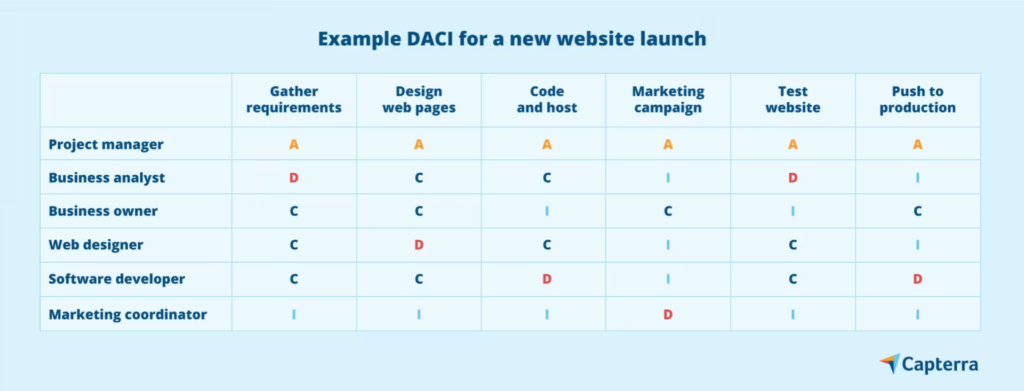
https://www.capterra.com/resources/what-is-a-daci-matrix/

DACI stands for Decision Maker, Accountable, Contributors, and Informed. It is specifically designed to clarify decision-making roles within projects.

  • Decision Maker: Identifies the single individual responsible for making a decision, ensuring decisions are made swiftly and effectively.
  • Accountable: Points to the person who is accountable for the overall success or failure of the decision, ensuring there’s always someone who owns the outcome.
  • Contributors: Are those who provide input or information necessary for the decision. Their role is crucial in supplying the decision-maker with all relevant data.
  • Informed: Consists of stakeholders who need to be kept in the loop about the decision but are not directly involved in making it.

When to Use:

  • Complex Decision-Making: Ideal for projects where decisions require input from various contributors but still need a clear, single decision-maker.
  • High-Level Projects: Useful in situations where strategic decisions impact multiple departments or the entire organization, necessitating a broad range of inputs.
  • Innovation-Driven Initiatives: When projects are highly innovative, requiring creative input and a clear path to decision-making to explore new ideas effectively.

DACI is particularly effective when a project’s success hinges on critical decisions that must be made efficiently, with input from a diverse set of contributors. This framework ensures that every decision has a clear owner (the DRI), supported by a structured team that contributes to and is informed about outcomes. By defining these roles, DACI prevents ambiguity in decision-making processes, ensuring all members know their exact responsibilities.

Further reading:

  1. What is DACI: An Explainer

RAPID Framework: Facilitating Agile Decision-Making

https://www.bain.com/insights/rapid-decision-making

RAPID is a framework aimed at clarifying who is involved in decisions within an organization, consisting of Recommend, Agree, Perform, Input, and Decide roles.

  • Recommend: Individuals who recommend actions or propose decisions based on their knowledge or analysis.
  • Agree: Stakeholders who must agree to a decision before it moves forward, ensuring that all necessary approvals are obtained.
  • Perform: The people who carry out the decision once it’s made, similar to the Responsible role in RACI.
  • Input: Those who provide input based on expertise or stakeholder needs, contributing to the information that leads to a decision.
  • Decide: The single individual, the DRI, who has the final say in the decision, ensuring accountability and clarity in who makes the call.

When to Use:

  • Agile Decision-Making: Suited for dynamic environments where decisions need to be made quickly to adapt to changing conditions.
  • Leadership and Strategic Planning: Useful in settings where leadership needs to make swift, strategic decisions with input from key stakeholders.
  • Streamlining Processes: When the goal is to reduce bottlenecks in decision-making processes, particularly in larger organizations or complex projects.

RAPID excels in scenarios where speed and clarity in decision-making are paramount. It delineates who needs to be involved at each stage of the decision. It streamlines the decision-making process by explicitly defining the roles involved, thereby facilitating faster, more coherent, and accountable project management.

Selecting the right framework—DACI, RACI, or RAPID—depends on the specific challenges and goals of your organization or project. DACI is excellent for complex decision-making with many contributors; RACI shines in projects needing clear task ownership across teams; and RAPID is best for fast-paced environments requiring quick, decisive action. Understanding the strengths and applications of each can help managers and leaders effectively implement the most suitable framework, thereby enhancing project outcomes, team collaboration, and overall organizational efficiency.

Further reading:

  1. RAPID Decision Making

Final Thoughts: Embracing the Power of Defined Ownership

The establishment of clear ownership through the assignment of Directly Responsible Individuals (DRIs) is not just beneficial but essential for the triumphant execution of projects. It instills a profound sense of accountability and dedication, transforming how tasks are approached and completed. This deliberate delineation of duties not only curtails the propensity for finger-pointing but also ensures that every team member is precisely informed of their expected contributions. Through the DRI framework, project management becomes an endeavor marked by precision in decision-making and a collaborative spirit that is both purposeful and results-driven.

What you, as a leader, must do is recognize the transformative potential of implementing the DRI model within your organizational or project framework. It’s about leveraging the power of individual responsibility and collective teamwork to create an environment where ownership is clearly defined, and success is a shared objective. The model is a beacon for navigating the complexities that today’s project management landscapes present, proving itself as an indispensable strategy for achieving outstanding results, optimizing operational efficiency, and nurturing an ethos of mutual respect and collaboration.

Incorporating the DRI model, along with frameworks like DACI, RACI, and RAPID, depending on the specific needs of your project or organization, will not only streamline workflows but also enhance the quality of outcomes achieved. This approach is your stepping stone towards fostering a culture where clarity, accountability, and excellence are not just envisioned but actively realized. As you move forward, let the principles of clear ownership and responsibility guide your strategies, enabling you and your team to reach new heights of project success and organizational growth.

Categories
Articles

Navigating the Path to High Performance

Talent wins games, but teamwork and intelligence win championships.

Michael Jordan

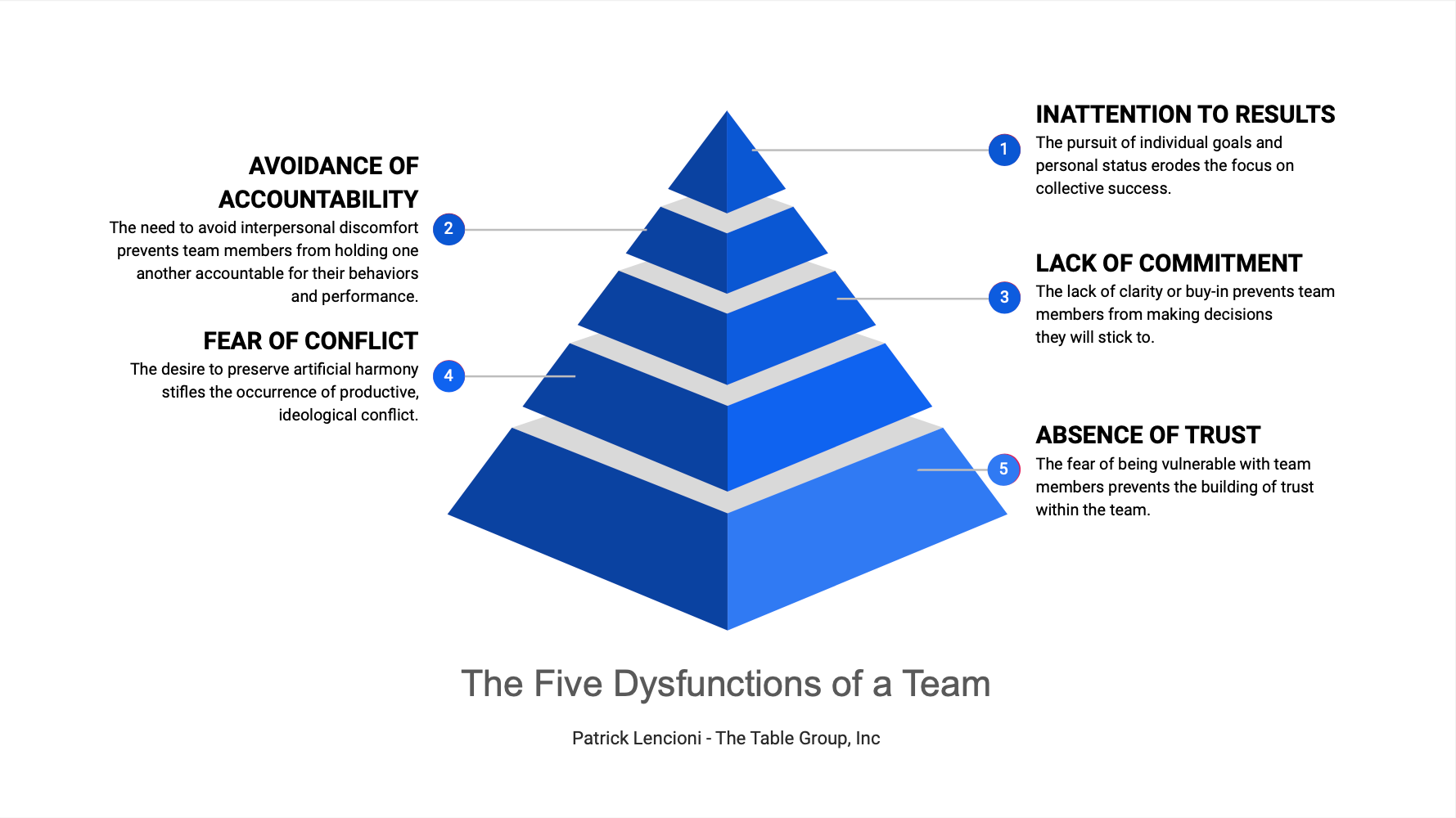
This rings true in the business world, too. It’s not just the smartest people or the standout stars who push a company to the top; it’s teams that work well together. Understanding and fixing team problems can be tricky. Patrick Lencioni’s model of the “Five Dysfunctions of a Team” offers a profound lens through which we can scrutinize and elevate our teams. Here’s how we can stride from dysfunction to high performance.

As a leader, envisioning yourself as the doctor for your team is pivotal. Your primary responsibility is not just to direct but to diagnose and heal the underlying ailments that may hinder your team’s performance. Recognizing the symptoms of dysfunctions early on is crucial to maintaining a healthy, high-performing team. Here’s a summary of what to watch for and how to act as your team’s caretaker:

Symptoms of Dysfunctions

  1. Lack of Trust: If you notice team members hesitating to share ideas, admit mistakes, or seek help, it indicates a foundational crack in trust. This environment stifles open communication and vulnerability, essential ingredients for strong teamwork.
  2. Fear of Conflict: When discussions become superficial or disagreements are avoided to maintain artificial harmony, it’s a sign that your team is not engaging in healthy, constructive debates necessary for innovation and problem-solving.
  3. Lack of Commitment: Watch for ambiguity in decisions and plans. If team members seem disengaged or indifferent towards team goals, it reflects a lack of commitment and clarity.
  4. Avoidance of Accountability: A clear red flag is when poor performance is not addressed, deadlines are consistently missed, and there’s an absence of constructive feedback. This avoidance can create an environment of resentment and lower overall team standards.
  5. Inattention to Results: If team members prioritize their individual goals or departmental targets over the team’s collective objectives, it can derail the team from its primary mission.

Acting as Your Team’s Doctor

Your leadership role extends beyond management to include diagnosis and remedy. By staying vigilant to these symptoms and addressing them with targeted strategies, you can ensure your team not only recovers but thrives.

1. Cultivate Trust: The Foundation of High-Performing Teams

Building a high-performing team is akin to crafting a masterpiece; it requires patience, skill, and a foundation that will stand the test of time. Trust is that foundation. It’s about nurturing an environment where openness is valued over pretense, where team members feel secure enough to reveal their true selves, including their uncertainties and aspirations. When trust is present, a team is not just a collection of individuals working together, but a unified entity with a shared vision.

Trust is the glue that holds a team together through thick and thin. It’s the assurance that everyone has each other’s backs. When you trust your team, and they trust you, magic happens. Here’s how you can lay this crucial groundwork:

Fostering Open Dialogue:

Start by promoting honest and open dialogue. This doesn’t just mean encouraging team members to speak their minds about work issues; it means creating an atmosphere where personal expressions are also welcomed. When people share their thoughts and feelings without fear, they’re not just communicating – they’re connecting.

Know Each Member’s Core Value System:

Understanding and respecting your team members’ core values is crucial. Take the time to discover what drives each person, what they stand for, and start by sharing your own values. This mutual understanding fosters a deeper respect and a stronger bond among team members.

Public Praise, Private Feedback:

Recognition and feedback are two sides of the same coin. When your team does well, shout it from the rooftops. Praise them publicly to show you don’t just notice their hard work, you appreciate it. But when it comes to feedback, especially if it’s constructive, do it privately. This shows respect for their feelings and dignity.

Career Laddering:

Talk about their careers – not just jobs. Invest time in understanding where your team members see themselves in the future and help them map out a path to get there. This shows that you’re not just their leader for the current project, but a mentor for their professional journey.

Get to know their personal goals as well, thats a bonus. What do they aspire to achieve outside of work? When you take interest in their life beyond office walls, you show that you value them as complete individuals, not just as cogs in the machine.

2. Embrace Conflict: The Crucible of Creativity

Conflict isn’t just inevitable; it’s invaluable. Far from being a sign of dysfunction, the clash of differing opinions reveals a team’s dedication to excellence. It’s within these heated exchanges that creativity thrives, transforming potential discord into groundbreaking ideas. This dynamic is not about contention but about the passionate pursuit of innovation, with every team member daring to question the status quo in search of something extraordinary.

Confront Problems:

Procrastination can turn a small spark into a wildfire. This includes engineering problems and people behavior both. Addressing problems promptly shows the team that issues are opportunities for growth, not roadblocks. When you tackle challenges head-on, you set the stage for innovation, turning potential conflicts into catalysts for team development and creative solutions. Let the team know you have their back and not afraid to lead them with example when problems arise.

Practical Solutions Development:

Developing practical solutions in the face of conflict is an exceptional teaching moment for the team. It’s an opportunity to demonstrate that from the crucible of opposing views can emerge the strongest, most innovative outcomes. Use these moments to encourage critical thinking and problem-solving skills within your team.

Inclusion & Minimum Politics:

Make it a point to solicit input from all team members, as groundbreaking ideas can emerge from the most unexpected sources. By valuing each team member’s contribution equally, you ensure a diverse range of perspectives are considered. This inclusivity not only enriches the solution pool but also strengthens team cohesion.

Strive to maintain an environment where team politics are kept to a minimum. Bias and favoritism can stifle open dialogue and hinder the team’s creative potential. By treating everyone’s ideas with equal consideration, you foster a culture of mutual respect and collaboration. In such a setting, team members feel valued and motivated to contribute their best, knowing that their voices will be heard and their ideas given fair consideration.

3. Strengthen Commitment: The Drive of Unwavering Dedication

Commitment isn’t just about agreeing to do something; it’s about truly aligning with the team’s goals, understanding the direction, and dedicating yourself to it. This deep sense of commitment comes when every person on the team understands the why behind what they’re doing and fully buys into it. It’s a powerful force that moves everyone in the same direction with a shared sense of purpose. When there’s clarity around the objectives and a collective agreement on the path forward, the journey isn’t just easier—it’s propelled by a shared drive that can overcome any obstacle.

Clear Buy-In on Objectives:

The journey towards unwavering dedication starts with achieving a unanimous nod on the objectives at hand. Imagine a scenario where each team member feels personally connected to the goals set before them. It’s not merely about dictating these goals from a position of authority but fostering a sense of ownership and participation in crafting them. When individuals understand how their contributions fit into the larger picture, their investment in the outcome deepens. This process of garnering buy-in is more than a procedural step; it’s the cultivation of a collective determination to succeed. It’s about transforming the “I” into “we,” where goals become shared ambitions rather than imposed targets.

Bring Clarity with Open Dialogue:

Achieving this level of commitment requires open dialogue, transparency in decision-making, and a genuine effort to incorporate feedback from across the team. It means laying out the strategy, the why behind it, and the role each person plays in navigating towards success. When team members see their fingerprints on the plan, their commitment to its execution is natural and profound. This approach not only propels the team forward with a shared sense of purpose but also minimizes the friction often encountered when direction feels imposed rather than adopted.

Conclusive One Time Discussions:

To truly foster a spirit of commitment, it’s critical that every discussion, meeting, or brainstorming session concludes with a clear and decisive plan of action. This level of conclusiveness is only achievable when every member of the team is equally committed. It’s about making sure that by the time everyone stands up from the table, there’s a shared understanding of the path forward, and an eagerness to tackle the tasks at hand. Having these conclusive discussions means that the team not only identifies what needs to be done but also leaves no room for ambiguity about who is responsible for what and by when. This clarity and commitment ensure that the team’s energy is directed towards making strides in their shared journey, rather than getting caught in a loop of uncertainty and indecision. It’s this collective dedication to moving forward, with every member pulling in the same direction, that transforms plans into action and visions into reality.

4. Enforce Accountability: The Backbone of Execution

Accountability stands as the unwavering pillar upon which the integrity and success of a team rest. It’s the bold commitment to not just aim for excellence but to consistently uphold it, creating an environment where everyone knows what’s expected of them and strives to meet those expectations without fail. In the realm of high-performing teams, accountability means more than just individual responsibility; it’s about fostering a culture where everyone feels responsible for the collective outcome. It’s where constructive feedback flows freely, and underperformance is tackled head-on, not swept under the rug.

Solidifying Accountability with Clear Roles and Expectations:

The first step toward genuine accountability is ensuring that every team member has a crystal-clear understanding of their role. This clarity is paramount for individuals to function at their peak. When roles are defined, and expectations are set from the outset, it removes ambiguity, allowing team members to channel their efforts effectively. It’s about laying out a roadmap for success for each member, ensuring they know not just their destination but the path to get there.

Maintaining High Standards Across the Board:

Accountability also hinges on the maintenance of uniformly high standards. This means addressing poor performance head-on, without bias. Failing to do so can foster an environment of resentment and hopelessness, eroding the team’s morale. It’s crucial that the same standards apply to everyone, regardless of their position or closeness to leadership. This equality in accountability ensures that all team members are pulling in the same direction, committed to the team’s success.

Deadlines Are Sacred:

In the culture of accountability, missing deadlines should never become the norm. It’s essential to do whatever it takes to adhere to timelines, as consistent delays can undermine the team’s objectives. This may require extra support for some team members or reallocating resources, but the ultimate goal remains clear: meet your deadlines, and keep the team’s momentum going strong.

Addressing Underperformance Without Bias:

When it comes to holding team members accountable, it’s vital to approach the task without bias. This unbiased stance ensures that performance issues are addressed fairly, fostering a sense of justice and respect within the team. When everyone is held to the same standard, and accountability is enforced equitably, it reinforces the team’s foundation, making it stronger and more cohesive.

5. Focus on Results: The Pinnacle of Team Achievement

The true measure of a team’s effectiveness is its ability to deliver results. This means setting aside personal ambitions and focusing on what the team can achieve together. It’s about defining success in tangible outcomes, not just the effort put in. For high-performing teams, the end goal is always in sight, and every action is aimed at reaching that goal.

Clearly Defined Results:

Start by making sure everyone knows exactly what success looks like. This isn’t about vague objectives or feel-good statements; it’s about concrete, measurable outcomes. Numbers speak louder than words, so quantify your goals. Whether it’s hitting a sales target, reducing operational costs by a certain percentage, or achieving a project milestone on time, make it specific. This clarity ensures that every team member understands what they’re working towards and can see the direct impact of their efforts.

Numbers Over Feelings:

It’s crucial to prioritize data and metrics over subjective feelings. While intuition and experience play roles in decision-making, they must be grounded in empirical evidence. If you can’t measure something, you can’t know if you’re truly succeeding. This approach might seem cold to some, but it’s about ensuring accountability and enabling the team to make informed decisions. It’s not about dismissing individual contributions but about aligning those contributions with the team’s overall objectives.

Agility in Course Correction:

Being results-focused means being prepared to pivot when necessary. High-performing teams monitor their progress closely, ready to make adjustments based on what the data tells them. This agility allows them to stay on track towards their goals, even when unexpected challenges arise. It’s about being committed to the outcome, not to a particular path. If the numbers show that a change in strategy is needed, then that change must be made, without hesitation.

Reward Results:

Finally, it’s important to celebrate and reward the results. Recognizing achievements reinforces the importance of focusing on outcomes and motivates the team to continue pushing for excellence. Rewards can take many forms, from public acknowledgment in a team meeting to bonuses or other incentives. What matters is that the reward is tied directly to the achievement of specific results, sending a clear message that high performance is noticed and valued.


References

  1. Patrick Lencioni (2002), The Five Dysfunctions of a Team: A Leadership Fable

TL;DR for Leaders: The Diagnostic Lens for Team Health

As leaders, it’s our prerogative to act as the guardians of our team’s health, much like a doctor would for their patient. Recognizing the symptoms of dysfunction within your team is paramount to maintaining its well-being and steering it back to its optimal state. Be vigilant for signs of eroding trust, such as team members hesitating to share their true thoughts or feelings. Notice when conflict is avoided rather than leveraged as a tool for creativity and innovation. Observe the levels of commitment; a lack of clear direction or wavering dedication can signal misalignment. Accountability, or the lack thereof, often manifests as missed deadlines or subpar performance becoming the norm. Lastly, a shift from collective to individual focus, where team goals are overshadowed by personal achievements, can indicate a loss of result-oriented drive.

Your role as the team’s guide is not just to identify these symptoms but to prescribe and administer the necessary interventions to address them. This involves fostering an environment where trust can flourish, encouraging open and constructive conflict, ensuring commitment through clarity and buy-in, upholding accountability with impartiality, and maintaining a laser focus on results over personal gain.

The journey towards overcoming team dysfunctions is a shared endeavor, one that benefits immensely from the collective wisdom of leaders across various fields. I invite my fellow leaders to share their strategies for identifying and remedying team dysfunctions. How do you foster an environment where trust is the foundation, conflict becomes a source of innovation, commitment is unwavering, accountability is embraced, and a singular focus on results drives your team forward? Your experiences, strategies, and accomplishments in navigating these challenges can serve as invaluable lessons for us all.

I invite you to reflect on these principles and share your insights. How do you navigate these dysfunctions in your teams?

Categories
Articles

Mastering Scrum: Avoiding Common Pitfalls in Agile Project Management

In the dynamic world of project management, embracing agile methodologies like Scrum has become increasingly popular. Scrum, with its focus on collaboration, adaptability, and iterative development, offers a robust framework for achieving project success. However, despite its effectiveness, many project managers make common mistakes in Scrum team implementations that can hinder progress and diminish the framework’s potential.

In this article, we will explore five prevalent mistakes made by project managers when implementing Scrum. Each of these missteps, from prioritizing process over people to neglecting the importance of a well-maintained project backlog, can significantly impact a project’s outcome. By understanding these pitfalls and how to avoid them, project managers can enhance their Scrum practices and lead their teams to greater success.

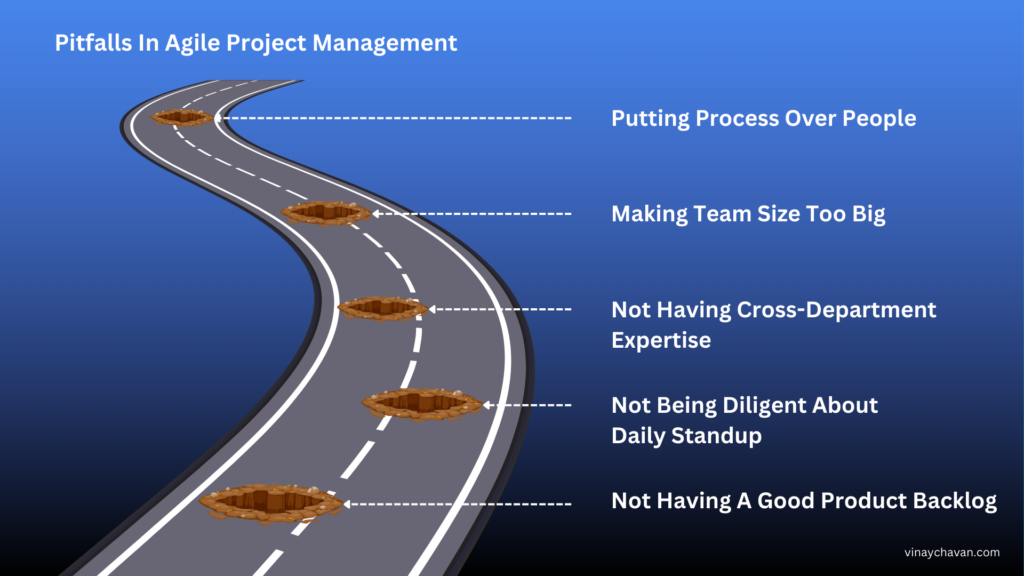
Pitfalls In Agile Project Management

Pitfall 1 – Putting Process Over People

Scrum is often viewed as a set of rules and ceremonies that must be strictly followed. While adherence to the Scrum framework is crucial, it should never come at the expense of the people involved. One common mistake project managers make is placing too much emphasis on process and too little on the individuals who make up the Scrum team.

Scrum is inherently people-centric, promoting collaboration, self-organization, and continuous improvement. Every process is a waste by definition, and Scrum aims to keep waste to a minimum by focusing on what adds value. When project managers become overly rigid in their approach, team members may feel stifled and disengaged. It’s essential to remember that Scrum is a guide, not a rulebook, and it should be adapted to fit the unique needs and dynamics of the team.

To avoid this mistake, project managers should encourage open communication, active participation, and a culture of trust within the team. Everyone in the Scrum team is considered a leader, and there are no designations like team lead. By prioritizing the people over the process and embracing the idea that everyone is a leader, project managers can create a more motivated and productive Scrum team.

Pitfall 2 – Making Team Size Too Big

Scrum advocates for small, cross-functional teams that can work collaboratively to deliver value quickly. However, some project managers make the error of assembling teams that are too large. Large teams can lead to communication challenges, increased complexity, and difficulties in reaching consensus.

The ideal Scrum team size typically ranges from five to nine members, allowing for efficient collaboration and effective decision-making. Larger teams may struggle to coordinate efforts, resulting in delays and reduced productivity. To address this mistake, project managers should carefully consider the skills and expertise needed for the project and aim to keep teams within the recommended size range. Smaller teams tend to be more agile and adaptable, which aligns with the core principles of Scrum.

Pitfall 3 – Not Having Cross-Department Expertise

Scrum teams are expected to be self-sufficient and possess the necessary expertise to complete a project independently. However, some project managers make the mistake of creating teams with a limited skill set, leading to dependencies on other departments or specialists.

This can result in bottlenecks and delays as teams wait for external support or information. To avoid this pitfall, project managers should strive to assemble cross-functional teams with diverse skills and expertise. When team members come from different backgrounds and possess a range of skills, they can tackle challenges more effectively and make informed decisions without relying on external resources.

Encouraging cross-training and knowledge sharing among team members can also help build a more versatile and self-reliant Scrum team, aligning with the agile principles of adaptability and flexibility.

Pitfall 4 – Not Being Diligent About Daily Standup

The daily standup, or daily Scrum meeting, is a vital component of the Scrum framework. It serves as a brief, daily check-in where team members discuss progress, challenges, and plans. Every day standup is like a heartbeat of the team, keeping it synchronized and informed.

When the daily standup is not given proper attention, it can hinder progress tracking, issue identification, and timely problem-solving. To avoid this mistake, project managers should ensure that daily standups are held consistently and follow a structured agenda. During these meetings, team members should share updates, impediments, and their plans for the day.

Creating a culture of transparency and open communication during daily standups can enhance collaboration and keep the team aligned with the project’s goals. Project managers should actively participate in these meetings, facilitating discussions and removing obstacles to keep the team’s progress on track.

Pitfall 5 – Not Having a Good Project Backlog

A well-maintained and prioritized project backlog is the foundation of effective Scrum planning and execution. Unfortunately, some project managers make the mistake of not dedicating enough time and effort to keep the backlog refined and up-to-date.

Without a clear and well-prioritized backlog, teams can lose focus, and it becomes challenging to determine what to work on next. To avoid this mistake, project managers should regularly conduct backlog grooming sessions. During these sessions, the team reviews and prioritizes backlog items, ensuring that they align with the project’s goals and objectives.

Maintaining a good project backlog not only helps the team stay organized but also enables them to deliver value consistently and respond to changing priorities effectively.

In conclusion, Scrum is a powerful framework for agile project management, but its success depends on how well it is implemented. Project managers must be mindful of these common mistakes and take proactive steps to address them. By prioritizing people over process, optimizing team size, fostering cross-departmental expertise, conducting effective daily standups (the heartbeat of the team), and maintaining a well-organized project backlog, project managers can set their Scrum teams up for success and deliver outstanding results. In Scrum, everyone is a leader, and there are no single leaders or team leads, emphasizing the importance of collaboration and shared responsibility.

Categories
Articles

Feeling Committed vs Being Committed to Cause the Result

In our lives and workplaces, the term “commitment” is often used to indicate dedication and loyalty. But have we taken the time to dig deeper into what it means to be committed versus simply feeling committed? Though the distinction might seem minor, it carries significant implications for our ability to generate tangible results.

Feeling committed often refers to a state of aspiration or obligation, typically based on emotional attachment. In contrast, being committed implies an active state of engagement, determination, and readiness to act to achieve a particular goal, regardless of feelings or circumstances.

The Impact of True Commitment

Let’s consider the example of someone who aspires to lose weight and voices their commitment to a healthier lifestyle. If they merely feel committed, they may only stick to their diet and exercise regimen when motivated or when it’s convenient. But if they are truly committed, they adhere to their plan even during holidays, stressful periods, or times when motivation wanes. This illustrates that while feeling committed is a start, being committed is what drives real, sustainable change.

The importance of understanding this distinction extends across every sphere of our lives – personal, professional, health, fitness, and more. Being committed, rather than just feeling committed, significantly influences the outcomes we achieve and the success we experience.

Holding Ourselves Accountable

A crucial aspect of being committed involves holding ourselves accountable. This accountability must be measurable and objectively defined; without a quantifiable standard, commitment can easily fall back into the realm of feeling rather than being.

Consider someone committed to losing weight; they don’t simply rely on subjective feelings of fitness or wellbeing but rather track progress using scales, measurement tapes, or body fat percentages. This measurement offers tangible proof of their commitment, serving as a motivator and a reminder of their progress.

But what about non-physical or intangible commitments, such as love or company culture? Even in these realms, measurement is not only possible but essential. A person committed to their partner might gauge their commitment by tracking the quality time spent together, the frequency of saying ‘I love you,’ or the number of selfless acts performed for their partner.

In a professional setting, if a leader is committed to improving company culture, they could use regular employee surveys to monitor morale, engagement levels, and overall satisfaction. This ongoing evaluation allows them to track progress, address concerns, and make data-driven decisions to improve their organization’s culture.

By giving thought to how we measure our commitments, we can make them tangible and real. This evidence not only reaffirms our commitment but also fuels our motivation to continue on our chosen path, especially when faced with obstacles or adversity.

Navigating the Journey from Feeling Committed to Being Committed

Transitioning from feeling committed to being committed requires a shift in mindset and attitude. It begins with a deep understanding of our values and the alignment of those values with our actions. We need to embrace consistency, resilience, and determination, even in the face of adversity.

However, this transformation doesn’t come without challenges. Obstacles like self-doubt, wavering motivation, societal pressure, or lack of support can hinder progress. Despite these difficulties, it’s these very tests that refine the authenticity of our commitment and catalyze growth.

In the professional sphere, leaders and managers play a vital role in fostering commitment. They can encourage team members to transition from feeling committed to being committed by nurturing a culture of transparency, accountability, and support.

One essential task of a leader is to bring clarity to thoughts and the language that team members use. Leaders must “see” the path that each person would take to fulfill what they’ve promised, breaking down the promise into a series of specific action items that are required to achieve the goal.

When leaders bring such clarity, they can anticipate and manage the potential fallout that might occur as a part of fulfilling promises. These oversights often lead to missed project deadlines and other issues. Therefore, as a leader, it’s crucial to create a space of clarity when working with team members, which in turn empowers them to effectively keep their promises and stay committed to their tasks.

By being committed to each teams members growth, setting clear expectations and providing regular feedback for improvement, sometimes even taking a step back, leaders can help individuals align their actions with their commitments. Through their leadership, they can guide their teams from the realm of feeling committed to truly being committed, resulting in a more engaged, motivated, and productive workforce.

Embracing the Journey

While being committed tends to yield superior results, feeling committed shouldn’t be disregarded entirely. It’s the initial spark that can ignite the flame of dedication. However, to keep that flame alight and translate it into concrete results, we must strive to move beyond feelings and fully embrace commitment.

Being committed surpasses feeling committed in its power to cause results and reach goals. It’s a testament to our resilience, strength, and determination. As we navigate the journey from feeling committed to being committed, we must remember that it’s this very path that shapes us, fuels our growth, and brings our goals within reach. Let’s embrace the challenges, hold ourselves accountable, and rise to the challenge of true commitment – that’s where the magic happens.

Categories
Articles

Unreasonable Leadership – Harnessing the Power of Unconventionality

In the realms of leadership and management, the conventional wisdom has often painted an image of the “ideal” leader as someone who is level-headed, predictable, and reasonable. Although these qualities are undoubtedly important, I wish to champion an often overlooked, yet potentially transformative kind of leader – the ‘unreasonable’ one.

Unreasonable, in this context, does not denote an irrational or tyrannical figure. Instead, it symbolizes a leader who is willing to challenge established norms, push boundaries, and drive their teams towards audacious goals that others might deem impossible. They are the dreamers, the visionaries, and the trailblazers who dare to disrupt the status quo.

The Power of Being Unreasonable

Being unreasonable, in its most productive sense, stems from an unyielding belief in the potential for change and progress. Such leaders often defy the confines of what is considered “possible” or “practical” in favor of bold, innovative approaches. They’re not afraid to question the way things have always been done or to encourage others to do the same. This audacious mindset can inspire teams to push the envelope and reach new heights.

Think of leaders like Steve Jobs or Elon Musk, who were often seen as unreasonable in their time. Their visions for the future were considered outlandish, yet their conviction led to revolutionary products and services that have significantly impacted society.

The Unreasonable Leader’s Toolkit

There are key traits and skills that unreasonable leaders often exhibit, and these can be cultivated with conscious effort:

1. Vision: Unreasonable leaders have a compelling, often unconventional, vision for the future. They can see possibilities where others only see obstacles. This vision provides a roadmap for innovation and motivates their teams to strive for greatness.

2. Resilience: With their bold visions often comes resistance from those who prefer the status quo. Unreasonable leaders possess an unwavering resilience, helping them overcome obstacles and maintain their course, even when faced with adversity.

3. Empathy: While they might push their teams hard, unreasonable leaders also understand the importance of empathy. They recognize that their teams are their most valuable resource, and they work to cultivate an environment where everyone feels valued and heard.

4. Courage: Unreasonable leaders are not afraid to take risks. They understand that breakthroughs often come from daring to venture into the unknown. Their courage can inspire their teams to also take calculated risks.

Creating a Culture of Unreasonableness

Unreasonable leaders create cultures where audacity, innovation, and resilience are celebrated. They foster an environment that encourages questioning, experimentation, and learning from failure. They understand that to innovate, one must be willing to take risks and potentially fail.

This kind of culture can lead to groundbreaking ideas, products, and services. It also tends to attract employees who are creative, ambitious, and resilient – the very people who can help bring the leader’s visionary ideas to life.

In Conclusion

While reasonableness and predictability are valuable traits in many situations, there’s also a place for the unreasonable leader – the one who dares to dream big, push boundaries, and inspire their teams to do the same. This style of leadership might not be for everyone, but in the right context, it can lead to extraordinary results.

In the end, the unreasonable leader is a catalyst for change, pushing us all to rethink what’s possible and strive for a future that’s brighter, bolder, and beyond what we currently perceive as our limits. They remind us that progress often requires a touch of unreasonableness. After all, as George Bernard Shaw famously said, “The reasonable man adapts himself to the world: the unreasonable one persists in trying to adapt the world to himself. Therefore all progress depends on the unreasonable man.”

This quote encapsulates the essence of the unreasonable leader: someone who refuses to accept the world as it is and instead strives to shape it according to a bold, transformative vision. Their unyielding belief in the potential for change, progress, and innovation sets them apart from their more conventional counterparts.

The unreasonable leader’s journey is often fraught with challenges and resistance, but their resilience, empathy, and courage enable them to navigate these obstacles and inspire their teams to do the same. It’s a journey that requires a delicate balance of audacity and understanding, risk-taking and thoughtful deliberation, pushing hard and nurturing carefully.

Being an unreasonable leader isn’t about being difficult or arbitrary; it’s about breaking free from the constraints of convention and daring to envision and pursue a future that’s better than what currently exists. It’s about fostering a culture that values innovation, resilience, and audacity, a culture that’s equipped to turn visionary ideas into reality.

So, here’s to the unreasonable leaders, the visionaries, the trailblazers, and the dreamers. Here’s to those who dare to challenge the status quo, push boundaries, and lead their teams toward audacious goals. Here’s to those who remind us that sometimes, being unreasonable is exactly what’s needed to make extraordinary things happen.

After all, as we navigate an ever-changing, increasingly complex world, perhaps what we need most are leaders who are willing to be unreasonable in their pursuit of a better, more innovative, and more sustainable future.