Categories
Articles

From Microservices to Microteams: Two Pizza Rule in Action

Have you ever looked at the structure of your organization and wondered why some teams seem to work seamlessly while others struggle to get anything done? The answer may lie in a principle you’ve already heard of: the “Two Pizza Rule.” Popularized by Jeff Bezos, it’s the idea that a team should be small enough to be fed by two pizzas. Simple, right? But there’s a profound reason why this works, and it’s tied to something called Conway’s Law.

Let me explain.

Conway’s Law tells us that the systems you build will inevitably reflect the structure of the teams that design them. If your organization is fragmented or overly complex, your software will mirror those flaws. Conversely, if your teams are well-structured, clear, and independent, your systems will thrive. This insight is a game-changer for anyone building software—or, frankly, running any kind of team.

Why Structure Matters More Than You Think

I learned this lesson firsthand while leading the development of integrated event organizers systems suite, an event-driven micro-services architecture. The project was ambitious, with 80+ services working together seamlessly. But as I quickly realized, the success of the system wasn’t just about the technology—it was about the teams building it.

You see, micro-services thrive on autonomy. Each service has a single, clear responsibility, communicates through well-defined APIs, and operates independently. Sound familiar? That’s exactly what the Two Pizza Rule is all about. Small, cross-functional teams mirror the modularity of micro-services. They are independent, agile, and focused—exactly what you need when tackling complex challenges.

The Two Pizza Rule and Conway’s Law

Here’s where it gets really interesting: the Two Pizza Rule is a practical application of Conway’s Law. Think about it. If your organization is made up of small, nimble teams, the systems you design will naturally reflect that structure. They’ll be modular, efficient, and easy to scale.

But the opposite is also true. If your teams are too large or fragmented, your software will end up bloated, full of dependencies, and hard to maintain. I’ve seen it happen more than once—large teams produce systems that look like committee work: disjointed, slow, and overly complicated.

By keeping your teams small, you’re not just setting them up for success—you’re ensuring the systems they build are designed for success, too.

Why Small Teams Work Better

In smaller teams, communication channels are simplified. With fewer people, the number of potential interactions is drastically reduced, making it easier to align on objectives and share ideas. This efficiency accelerates decision-making, eliminates unnecessary noise, and minimizes misunderstandings. Instead of spending time clarifying roles or chasing approvals, team members can focus on meaningful, impactful conversations that drive progress.

1. They Communicate Efficiently

In a small team, every individual’s role is both visible and significant. There’s no room for ambiguity, and contributions—or the lack thereof—are immediately apparent. This clarity fosters a strong sense of ownership among team members, motivating them to deliver their best. When everyone understands their responsibility and its direct impact on the team’s success, it creates a culture of trust and accountability where excellence becomes the norm.

2. They Foster Clear Accountability

In a small team, every individual’s role is both visible and significant. There’s no room for ambiguity, and contributions—or the lack thereof—are immediately apparent. This clarity fosters a strong sense of ownership among team members, motivating them to deliver their best. When everyone understands their responsibility and its direct impact on the team’s success, it creates a culture of trust and accountability where excellence becomes the norm.

3. They Adapt Quickly to Change

Priorities shift—whether it’s due to evolving customer needs, market dynamics, or internal realignments. Small teams are inherently agile. They can pivot quickly without getting bogged down by bureaucracy or lengthy chains of command. This flexibility enables them to seize opportunities, respond to challenges in real-time, and stay ahead in fast-paced environments.

4. They Create Focused, Modular Systems

Small teams naturally align with the principles of modularity. Much like microservices in software design, they focus on specific, well-defined objectives. This reduces overlap, eliminates dependencies, and ensures that every team member is working toward a shared, clear goal. This modular approach not only enhances productivity but also makes it easier to integrate contributions across teams, ensuring seamless collaboration on larger projects.

We embraced these principles wholeheartedly. Each micro-team was given full ownership of a specific service, from initial design to final deployment. This autonomy empowered our teams to take pride in their work and deliver results that exceeded expectations. By clearly defining responsibilities and giving teams the freedom to innovate, we didn’t just improve the quality of our output—we cultivated a culture of commitment, creativity, and accountability.

Small teams aren’t just efficient—they’re transformative. They create an environment where everyone’s voice matters, adaptation is second nature, and excellence is a collective goal. In a world that demands agility and precision, small teams have a unique edge—and we harnessed that to its fullest potential.

How We Build Micro-Teams That Work

Looking back, here are a few key lessons we applied:

1. Defined Clear Roles & Goals

Just as every micro-service had a single responsibility, we ensured every team member knew exactly what they were accountable for. By clearly defining roles, we eliminated overlaps and confusion, which allowed the team to focus entirely on their objectives.

2. Minimized Dependencies

We encouraged our teams to solve problems within their domain before seeking external help. This approach kept projects moving forward without unnecessary delays. When dependencies outside the team arose, we treated them as opportunities to innovate and streamline processes, making teams more self-sufficient over time.

3. Communicated Like APIs

We treated our teams like micro-services, setting up clear communication protocols for how they interacted with one another. Internally, we aimed for communication saturation, ensuring that everyone within the team was fully informed and aligned. Whenever cross-team communication was required, we treated it as a problem statement to solve. This led us to ask questions like, “Why is this dependency here?” and “How can we reduce it in the future?”

4. Encouraged Puzzle-Like Diversity

We deliberately built teams with specific pieces of the puzzle that fit well together. By encouraging diversity in skills and expertise within teams, we reduced external dependencies while fostering autonomy. Each team became a self-contained unit, equipped to make decisions and tackle challenges independently. This diversity also sparked innovation and helped us approach problems from multiple perspectives.

5. Celebrated Autonomy

We gave our teams the freedom to make decisions within their scope. By trusting them, we saw remarkable results. Autonomy not only accelerated decision-making but also boosted morale. Team members took ownership of their work, creating a culture of accountability and pride in the outcomes.

From Micro-services to Micro-Teams

The success of the project wasn’t just about building great software—it was about building great teams. The Two Pizza Rule gave us a framework to align our team structure with the architecture we were designing. By keeping our teams small, we created a system that was agile, scalable, and resilient.

And here’s the best part: this approach doesn’t just apply to software. Whether you’re running a marketing department, managing a product launch, or leading a creative team, the principles are the same. Small, focused teams will always outperform large, unwieldy ones.

Why This Matters to You

If there’s one thing I want you to take away, it’s this: the structure of your teams isn’t just an operational decision—it’s a strategic one. By adopting the Two Pizza Rule, you’re not just making life easier for your teams; you’re setting your entire organization up for long-term success.

So, the next time you’re assembling a team, think like a micro-services architect. Keep it small. Keep it focused. And remember: just like a well-designed system, a well-designed team is one that works seamlessly, scales effortlessly, and delivers consistently.

Because in the end, great teams build great things. And sometimes, all it takes is two pizzas to get started.

Categories
Articles

You Need a Clear Ownership for Better Project Management

Imagine this (or maybe you don’t need to), a team is sitting in front of their computers, ready for a Zoom meeting. As they look at their screens with a latest numbers in a presentation, figures glaringly short of the set targets. Right away – a room is filled with silence, few cameras turning off and others just frozen. As a minute passes, one brave soul declares, “That part wasn’t my responsibility”, their voice echoing through the speakers, “I was held up because I didn’t get the information I needed from sales” another counters. Soon the virtual space is filled with a excuses and finger-pointing. This back-and-forth blame keeps going, making it hard for anyone to figure out how to fix the problem. No one wants to say it’s their fault. It’s a situation many of us have seen before during online meetings. Have you ever found yourself in a similar situation, wondering how things could have been different with clear ownership?

This scenario underscores a pervasive issue in project management—the lack of clear ownership. When outcomes are murky, and responsibilities blurred, projects often veer off course, culminating in a mire of blame rather than productive resolution. This highlights the necessity of establishing unequivocal ownership in project management, moving away from the blame game towards a culture of accountability and success.

Why Clear Ownership Matters

The cornerstone of any successful project is clarity in ownership. When individuals are designated as directly responsible for specific tasks or outcomes—known as Directly Responsible Individuals (DRIs)—it engenders a sense of accountability and dedication to the project’s success. This clear allocation of ownership ensures that every team member knows precisely what is expected of them, reducing ambiguities that often lead to the blame game.

Apple’s introduction of the DRI model was a game-changer in project management. As detailed in Fortune’s article on Apple’s operational strategies, the DRI is the person with whom “the buck stops” regarding any given project. This clear delineation of responsibility ensures that every project has a singular point of accountability, which simplifies decision-making and problem-solving processes.

At the core of the DRI model is a commitment to results and efficiency. The assignment of a DRI to a project removes ambiguity about decision-making authority, streamlining the project’s progression. Contrary to the belief that a single point of responsibility might hinder collaboration, the DRI model actually fosters a more cooperative environment. DRIs are encouraged to be fully invested in their projects and to seek input and collaboration actively. They hold the final decision-making power but are also expected to leverage the expertise and judgment of their team members.

This approach aligns with the foundational values of accountability and dedication, following are just some of the clear benefits to this approach,

  1. Enhances Accountability: When a DRI is assigned, they become the point person for that task or outcome, fostering a deep sense of responsibility and personal investment in the project’s success.
  2. Streamlines Communication: Clear ownership simplifies communication channels. Team members know whom to approach for updates or to address issues, thereby reducing misunderstandings and inefficiencies.
  3. Improved Collaboration: By knowing who is responsible for what, team members can collaborate more effectively, with a clear understanding of how their contributions fit into the larger project goals.
  4. Facilitates Decision-Making: DRIs have the authority to make decisions related to their areas of responsibility, which accelerates the decision-making process and ensures agile project progression.
  5. Improves Problem-Solving: With clear ownership, DRIs are more attuned to the intricacies of their tasks, enabling them to identify and address problems more swiftly and effectively.
  6. Boosts Team Morale: Assigning DRIs can lead to a more engaged and motivated team. Individuals take pride in ownership, which can enhance overall team morale and productivity.

How to Implement Effective Ownership Allocation

To cultivate an environment where ownership is clearly defined and embraced, organizations must:

  • Define Roles and Responsibilities: From the outset of the project, explicitly outline who is responsible for what.
  • Empower DRIs: Ensure that DRIs have the resources, authority, and support needed to fulfill their responsibilities effectively.
  • Foster a Culture of Accountability: Encourage an organizational culture where accountability is valued and recognized. This includes celebrating successes and constructively addressing challenges.
  • Regular Check-ins: Implement regular status updates and check-ins to monitor progress, address any obstacles DRIs may face, and realign on objectives as necessary.

Implementing effective ownership allocation in project management is essential for ensuring clarity, accountability, and success. Here’s how three distinct frameworks—DACI, RACI, and RAPID—can be effectively employed to delineate responsibilities and empower Directly Responsible Individuals (DRIs) within any organization:

RACI Model: Streamlining Project Responsibilities

https://zapier.com/blog/raci/

RACI is an acronym for Responsible, Accountable, Consulted, and Informed, focusing on task assignment and project roles.

  • Responsible: Individuals or teams tasked with performing the work. There can be multiple people responsible, but tasks are clearer when fewer hands are involved.
  • Accountable: The single DRI who ultimately answers for the task’s completion. This person delegates tasks and ensures they’re completed satisfactorily.
  • Consulted: Those whose opinions are sought typically subject matter experts with two-way communication.
  • Informed: People who are kept updated on progress but do not contribute directly to the task execution.

When to Use:

  • Project Management: Essential for projects that involve multiple tasks and teams, where it’s crucial to define who is responsible for what.
  • Clarifying Roles and Responsibilities: Best used in scenarios where there is confusion about task ownership, and there’s a need to clarify who does what.
  • Cross-Functional Collaboration: Ideal for projects that require cooperation across different departments, ensuring everyone understands their specific roles without overstepping.

RACI is most beneficial in environments where detailed task management and clear communication channels are necessary to prevent overlap and ensure that all aspects of a project are covered without ambiguity. It ensures everyone knows who is doing what, who needs to be consulted, and who should be informed, reducing the risk of miscommunication and overlooked responsibilities.

Further reading:

  1. The RACI matrix: Your blueprint for project success
  2. RACI model: A map for team structure

DACI Framework: Enhancing Decision-Making Clarity

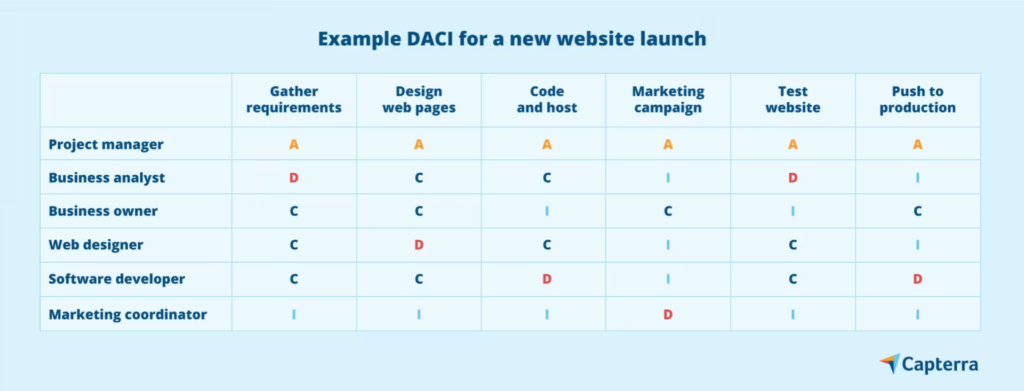
https://www.capterra.com/resources/what-is-a-daci-matrix/

DACI stands for Decision Maker, Accountable, Contributors, and Informed. It is specifically designed to clarify decision-making roles within projects.

  • Decision Maker: Identifies the single individual responsible for making a decision, ensuring decisions are made swiftly and effectively.
  • Accountable: Points to the person who is accountable for the overall success or failure of the decision, ensuring there’s always someone who owns the outcome.
  • Contributors: Are those who provide input or information necessary for the decision. Their role is crucial in supplying the decision-maker with all relevant data.
  • Informed: Consists of stakeholders who need to be kept in the loop about the decision but are not directly involved in making it.

When to Use:

  • Complex Decision-Making: Ideal for projects where decisions require input from various contributors but still need a clear, single decision-maker.
  • High-Level Projects: Useful in situations where strategic decisions impact multiple departments or the entire organization, necessitating a broad range of inputs.
  • Innovation-Driven Initiatives: When projects are highly innovative, requiring creative input and a clear path to decision-making to explore new ideas effectively.

DACI is particularly effective when a project’s success hinges on critical decisions that must be made efficiently, with input from a diverse set of contributors. This framework ensures that every decision has a clear owner (the DRI), supported by a structured team that contributes to and is informed about outcomes. By defining these roles, DACI prevents ambiguity in decision-making processes, ensuring all members know their exact responsibilities.

Further reading:

  1. What is DACI: An Explainer

RAPID Framework: Facilitating Agile Decision-Making

https://www.bain.com/insights/rapid-decision-making

RAPID is a framework aimed at clarifying who is involved in decisions within an organization, consisting of Recommend, Agree, Perform, Input, and Decide roles.

  • Recommend: Individuals who recommend actions or propose decisions based on their knowledge or analysis.
  • Agree: Stakeholders who must agree to a decision before it moves forward, ensuring that all necessary approvals are obtained.
  • Perform: The people who carry out the decision once it’s made, similar to the Responsible role in RACI.
  • Input: Those who provide input based on expertise or stakeholder needs, contributing to the information that leads to a decision.
  • Decide: The single individual, the DRI, who has the final say in the decision, ensuring accountability and clarity in who makes the call.

When to Use:

  • Agile Decision-Making: Suited for dynamic environments where decisions need to be made quickly to adapt to changing conditions.
  • Leadership and Strategic Planning: Useful in settings where leadership needs to make swift, strategic decisions with input from key stakeholders.
  • Streamlining Processes: When the goal is to reduce bottlenecks in decision-making processes, particularly in larger organizations or complex projects.

RAPID excels in scenarios where speed and clarity in decision-making are paramount. It delineates who needs to be involved at each stage of the decision. It streamlines the decision-making process by explicitly defining the roles involved, thereby facilitating faster, more coherent, and accountable project management.

Selecting the right framework—DACI, RACI, or RAPID—depends on the specific challenges and goals of your organization or project. DACI is excellent for complex decision-making with many contributors; RACI shines in projects needing clear task ownership across teams; and RAPID is best for fast-paced environments requiring quick, decisive action. Understanding the strengths and applications of each can help managers and leaders effectively implement the most suitable framework, thereby enhancing project outcomes, team collaboration, and overall organizational efficiency.

Further reading:

  1. RAPID Decision Making

Final Thoughts: Embracing the Power of Defined Ownership

The establishment of clear ownership through the assignment of Directly Responsible Individuals (DRIs) is not just beneficial but essential for the triumphant execution of projects. It instills a profound sense of accountability and dedication, transforming how tasks are approached and completed. This deliberate delineation of duties not only curtails the propensity for finger-pointing but also ensures that every team member is precisely informed of their expected contributions. Through the DRI framework, project management becomes an endeavor marked by precision in decision-making and a collaborative spirit that is both purposeful and results-driven.

What you, as a leader, must do is recognize the transformative potential of implementing the DRI model within your organizational or project framework. It’s about leveraging the power of individual responsibility and collective teamwork to create an environment where ownership is clearly defined, and success is a shared objective. The model is a beacon for navigating the complexities that today’s project management landscapes present, proving itself as an indispensable strategy for achieving outstanding results, optimizing operational efficiency, and nurturing an ethos of mutual respect and collaboration.

Incorporating the DRI model, along with frameworks like DACI, RACI, and RAPID, depending on the specific needs of your project or organization, will not only streamline workflows but also enhance the quality of outcomes achieved. This approach is your stepping stone towards fostering a culture where clarity, accountability, and excellence are not just envisioned but actively realized. As you move forward, let the principles of clear ownership and responsibility guide your strategies, enabling you and your team to reach new heights of project success and organizational growth.

Categories
Articles

Mastering Scrum: Avoiding Common Pitfalls in Agile Project Management

In the dynamic world of project management, embracing agile methodologies like Scrum has become increasingly popular. Scrum, with its focus on collaboration, adaptability, and iterative development, offers a robust framework for achieving project success. However, despite its effectiveness, many project managers make common mistakes in Scrum team implementations that can hinder progress and diminish the framework’s potential.

In this article, we will explore five prevalent mistakes made by project managers when implementing Scrum. Each of these missteps, from prioritizing process over people to neglecting the importance of a well-maintained project backlog, can significantly impact a project’s outcome. By understanding these pitfalls and how to avoid them, project managers can enhance their Scrum practices and lead their teams to greater success.

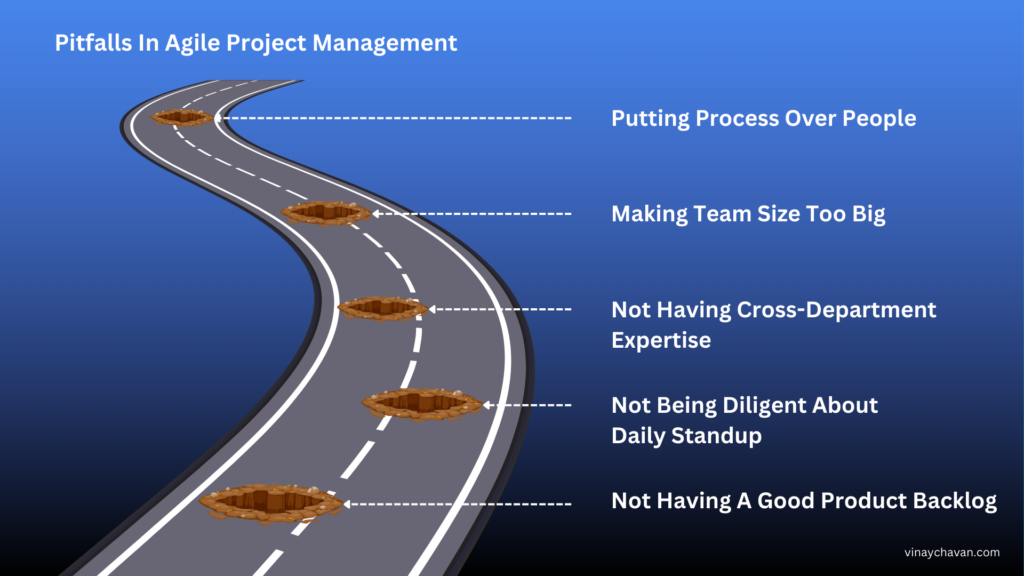
Pitfalls In Agile Project Management

Pitfall 1 – Putting Process Over People

Scrum is often viewed as a set of rules and ceremonies that must be strictly followed. While adherence to the Scrum framework is crucial, it should never come at the expense of the people involved. One common mistake project managers make is placing too much emphasis on process and too little on the individuals who make up the Scrum team.

Scrum is inherently people-centric, promoting collaboration, self-organization, and continuous improvement. Every process is a waste by definition, and Scrum aims to keep waste to a minimum by focusing on what adds value. When project managers become overly rigid in their approach, team members may feel stifled and disengaged. It’s essential to remember that Scrum is a guide, not a rulebook, and it should be adapted to fit the unique needs and dynamics of the team.

To avoid this mistake, project managers should encourage open communication, active participation, and a culture of trust within the team. Everyone in the Scrum team is considered a leader, and there are no designations like team lead. By prioritizing the people over the process and embracing the idea that everyone is a leader, project managers can create a more motivated and productive Scrum team.

Pitfall 2 – Making Team Size Too Big

Scrum advocates for small, cross-functional teams that can work collaboratively to deliver value quickly. However, some project managers make the error of assembling teams that are too large. Large teams can lead to communication challenges, increased complexity, and difficulties in reaching consensus.

The ideal Scrum team size typically ranges from five to nine members, allowing for efficient collaboration and effective decision-making. Larger teams may struggle to coordinate efforts, resulting in delays and reduced productivity. To address this mistake, project managers should carefully consider the skills and expertise needed for the project and aim to keep teams within the recommended size range. Smaller teams tend to be more agile and adaptable, which aligns with the core principles of Scrum.

Pitfall 3 – Not Having Cross-Department Expertise

Scrum teams are expected to be self-sufficient and possess the necessary expertise to complete a project independently. However, some project managers make the mistake of creating teams with a limited skill set, leading to dependencies on other departments or specialists.

This can result in bottlenecks and delays as teams wait for external support or information. To avoid this pitfall, project managers should strive to assemble cross-functional teams with diverse skills and expertise. When team members come from different backgrounds and possess a range of skills, they can tackle challenges more effectively and make informed decisions without relying on external resources.

Encouraging cross-training and knowledge sharing among team members can also help build a more versatile and self-reliant Scrum team, aligning with the agile principles of adaptability and flexibility.

Pitfall 4 – Not Being Diligent About Daily Standup

The daily standup, or daily Scrum meeting, is a vital component of the Scrum framework. It serves as a brief, daily check-in where team members discuss progress, challenges, and plans. Every day standup is like a heartbeat of the team, keeping it synchronized and informed.

When the daily standup is not given proper attention, it can hinder progress tracking, issue identification, and timely problem-solving. To avoid this mistake, project managers should ensure that daily standups are held consistently and follow a structured agenda. During these meetings, team members should share updates, impediments, and their plans for the day.

Creating a culture of transparency and open communication during daily standups can enhance collaboration and keep the team aligned with the project’s goals. Project managers should actively participate in these meetings, facilitating discussions and removing obstacles to keep the team’s progress on track.

Pitfall 5 – Not Having a Good Project Backlog

A well-maintained and prioritized project backlog is the foundation of effective Scrum planning and execution. Unfortunately, some project managers make the mistake of not dedicating enough time and effort to keep the backlog refined and up-to-date.

Without a clear and well-prioritized backlog, teams can lose focus, and it becomes challenging to determine what to work on next. To avoid this mistake, project managers should regularly conduct backlog grooming sessions. During these sessions, the team reviews and prioritizes backlog items, ensuring that they align with the project’s goals and objectives.

Maintaining a good project backlog not only helps the team stay organized but also enables them to deliver value consistently and respond to changing priorities effectively.

In conclusion, Scrum is a powerful framework for agile project management, but its success depends on how well it is implemented. Project managers must be mindful of these common mistakes and take proactive steps to address them. By prioritizing people over process, optimizing team size, fostering cross-departmental expertise, conducting effective daily standups (the heartbeat of the team), and maintaining a well-organized project backlog, project managers can set their Scrum teams up for success and deliver outstanding results. In Scrum, everyone is a leader, and there are no single leaders or team leads, emphasizing the importance of collaboration and shared responsibility.

Categories
Articles

The Power of Language: Shaping Organization, one conversation at a time

I spend much of my time mulling over strategies to cultivate a thriving work culture, one that is conducive to innovation, growth, and shared success. In my quest for creating an effective ecosystem, I have discovered an incredibly powerful tool — one that is often overlooked, yet omnipresent. The tool is language.

Language, by its very nature, is transformative. Beyond the realm of basic communication, it serves as a conduit for ideas, aspirations, and visions. In my experience, I have repeatedly witnessed the magic of language — how the act of verbalizing a thought, a vision, can quite literally speak it into existence. When we dare to voice what seems unreasonable or unattainable, we sow the seeds of extraordinary possibilities.

The Unreasonable Team

It is often said that the strength of a company lies in its team. At Yapsody, we take this a step further. We believe in the concept of an ‘unreasonable team’ — a group of individuals who are driven by their shared vision and unrestrained by conventional thought. We are an unreasonable team because we dare to challenge the status quo, and more importantly, because we dare to voice our challenges.

The act of articulating our aspirations, as audacious as they may be, gives them life. It steers the team toward achieving the extraordinary. By speaking the unreasonable into existence, we generate a transformative force that propels our team and our organization forward.

The Organization as a Network of Conversations

Imagine the organization as a vast spiderweb, its countless strands representing the myriad conversations that crisscross through the office corridors every day. These conversations — be they formal or informal, casual or intense — are the individual threads that weave together the fabric of the organization’s culture, set the course for its direction, and underscore its success.

At Yapsody, we embrace this perspective wholeheartedly. We view each conversation, no matter how seemingly insignificant, as a crucial building block in our organizational structure. That friendly banter by the coffee machine? It’s not just idle chitchat. It helps foster connections, building the bedrock of trust and camaraderie that fuels effective teamwork. The lightbulb moments during a lunchtime discussion? They’re spontaneous sparks of creativity that can ignite the next big idea.

In essence, an organization is not just a collection of individuals but a network of conversations. The power of these conversations, when harnessed effectively, can propel the organization towards new horizons of success and achievement. At Yapsody, we believe in the transformative power of conversation, and we strive to create an environment that fosters open, meaningful, and productive dialogues. Because when we engage in the art of conversation, we’re not just talking — we’re building the future of our organization, one conversation at a time.

People as Conversations

An intriguing perspective to consider is that ‘people themselves are conversations.’ To unpack this statement, we must venture into the realm of human interactions, narratives, and dialogues. We are, in essence, the sum of these aspects, shaped by our internal and external conversations. But what do we mean by internal and external conversations? Let’s dive deeper into this concept.

Our ‘internal conversation’ is the dialogue we maintain with ourselves. It shapes our perceptions, beliefs, and attitudes. Each of us holds an ongoing discussion with our own mind — a discourse that outlines our self-concept and worldview. What we say to ourselves significantly impacts who we are and how we behave. Our internal monologue creates our reality. If we constantly tell ourselves that we are confident, resilient, and capable, we embody these traits in our actions and interactions. In essence, we become the person we speak of in our minds.

Equally as important are our ‘external conversations.’ These are the dialogues we engage in with the world around us — the interactions, narratives, and discourses we share with others. We are not isolated beings but part of a vibrant, dynamic network of conversations. Our exchanges with others, from casual chats to profound discussions, all contribute to shaping our identities. These conversations influence our understanding, attitudes, and behaviours, and even shape how we view others.

Each person we encounter in life — from family members and friends to colleagues and strangers — exists within our minds as a ‘conversation.’ We build a mental narrative about each individual based on our interactions with them. These narratives, shaped by our perception, influence how we view and interact with these individuals.

Moreover, we also exist as ‘conversations’ within the minds of others. The impressions we leave, the words we speak, and the actions we take — these become the threads of the narrative others build about us. We live, in a way, within the conversations happening around us.

This perspective shifts the focus from seeing individuals as mere physical entities to recognising them as vibrant ‘conversations’ — intricate tapestries of thoughts, feelings, and experiences woven through dialogues, both internal and external. This understanding underscores the profound impact that our mental dialogues and interpersonal interactions can have on shaping our identities and our relationships with others.

In essence, we are all participants in a vast, intricate web of conversations, continually evolving, influencing, and being influenced. Recognising this can guide us towards more mindful, intentional, and effective communication — with ourselves and with others.

The Role of Team Leads in Speaking Unreasonable Teams into Existence

Creating an ‘unreasonable’ team isn’t about setting unrealistic expectations or promoting a workaholic culture. It’s about cultivating an environment that embraces challenges, values creativity, and celebrates curiosity. It’s about pushing boundaries, taking risks, and most importantly, believing in the power of ‘what if.’

Team leads can establish this culture by voicing their belief in their team’s potential and abilities. They can foster a sense of trust and confidence within their teams that motivates individuals to step outside their comfort zones and reach for the extraordinary.

One of the most potent tools at a team lead’s disposal is affirmative language. Affirmative language focuses on possibilities, strengths, and solutions, rather than problems or obstacles. It promotes a positive and proactive mindset that can energize a team and propel it towards its goals.

A team lead who regularly uses affirmative language in their conversations can shape their team’s perception of their work and their abilities. This can motivate team members to embrace challenges and strive for excellence, creating a positive cycle of achievement and affirmation that drives the team forward.

The role of team leads in generating ‘unreasonable’ teams is crucial. By leveraging the power of language and communication, they can inspire their teams to embrace challenges, push boundaries, and strive for the extraordinary. The seemingly simple act of ‘speaking’ a team into existence can spark a transformative force that propels the team and the entire organization towards success. Through visionary leadership, the establishment of an ‘unreasonable’ culture, and the use of affirmative language, team leads can turn the unreasonable into reality.

Conclusion: The Transformative Power of Language

In conclusion, language, in all its facets, holds immense power. It’s not just a medium to express and communicate; it’s a catalyst for change, a vehicle for vision. In the seemingly simple act of speaking, we hold the power to create an unreasonable team, to shape our organization, and to transform ourselves.

Let’s harness this power. Let’s dare to voice the unreasonable, to articulate our wildest dreams and aspirations. Let’s embrace the magic of language and reshape our world, one conversation at a time. After all, when we change our words, we change our world.

Categories
Articles

Unreasonable Leadership – Harnessing the Power of Unconventionality

In the realms of leadership and management, the conventional wisdom has often painted an image of the “ideal” leader as someone who is level-headed, predictable, and reasonable. Although these qualities are undoubtedly important, I wish to champion an often overlooked, yet potentially transformative kind of leader – the ‘unreasonable’ one.

Unreasonable, in this context, does not denote an irrational or tyrannical figure. Instead, it symbolizes a leader who is willing to challenge established norms, push boundaries, and drive their teams towards audacious goals that others might deem impossible. They are the dreamers, the visionaries, and the trailblazers who dare to disrupt the status quo.

The Power of Being Unreasonable

Being unreasonable, in its most productive sense, stems from an unyielding belief in the potential for change and progress. Such leaders often defy the confines of what is considered “possible” or “practical” in favor of bold, innovative approaches. They’re not afraid to question the way things have always been done or to encourage others to do the same. This audacious mindset can inspire teams to push the envelope and reach new heights.

Think of leaders like Steve Jobs or Elon Musk, who were often seen as unreasonable in their time. Their visions for the future were considered outlandish, yet their conviction led to revolutionary products and services that have significantly impacted society.

The Unreasonable Leader’s Toolkit

There are key traits and skills that unreasonable leaders often exhibit, and these can be cultivated with conscious effort:

1. Vision: Unreasonable leaders have a compelling, often unconventional, vision for the future. They can see possibilities where others only see obstacles. This vision provides a roadmap for innovation and motivates their teams to strive for greatness.

2. Resilience: With their bold visions often comes resistance from those who prefer the status quo. Unreasonable leaders possess an unwavering resilience, helping them overcome obstacles and maintain their course, even when faced with adversity.

3. Empathy: While they might push their teams hard, unreasonable leaders also understand the importance of empathy. They recognize that their teams are their most valuable resource, and they work to cultivate an environment where everyone feels valued and heard.

4. Courage: Unreasonable leaders are not afraid to take risks. They understand that breakthroughs often come from daring to venture into the unknown. Their courage can inspire their teams to also take calculated risks.

Creating a Culture of Unreasonableness

Unreasonable leaders create cultures where audacity, innovation, and resilience are celebrated. They foster an environment that encourages questioning, experimentation, and learning from failure. They understand that to innovate, one must be willing to take risks and potentially fail.

This kind of culture can lead to groundbreaking ideas, products, and services. It also tends to attract employees who are creative, ambitious, and resilient – the very people who can help bring the leader’s visionary ideas to life.

In Conclusion

While reasonableness and predictability are valuable traits in many situations, there’s also a place for the unreasonable leader – the one who dares to dream big, push boundaries, and inspire their teams to do the same. This style of leadership might not be for everyone, but in the right context, it can lead to extraordinary results.

In the end, the unreasonable leader is a catalyst for change, pushing us all to rethink what’s possible and strive for a future that’s brighter, bolder, and beyond what we currently perceive as our limits. They remind us that progress often requires a touch of unreasonableness. After all, as George Bernard Shaw famously said, “The reasonable man adapts himself to the world: the unreasonable one persists in trying to adapt the world to himself. Therefore all progress depends on the unreasonable man.”

This quote encapsulates the essence of the unreasonable leader: someone who refuses to accept the world as it is and instead strives to shape it according to a bold, transformative vision. Their unyielding belief in the potential for change, progress, and innovation sets them apart from their more conventional counterparts.

The unreasonable leader’s journey is often fraught with challenges and resistance, but their resilience, empathy, and courage enable them to navigate these obstacles and inspire their teams to do the same. It’s a journey that requires a delicate balance of audacity and understanding, risk-taking and thoughtful deliberation, pushing hard and nurturing carefully.

Being an unreasonable leader isn’t about being difficult or arbitrary; it’s about breaking free from the constraints of convention and daring to envision and pursue a future that’s better than what currently exists. It’s about fostering a culture that values innovation, resilience, and audacity, a culture that’s equipped to turn visionary ideas into reality.

So, here’s to the unreasonable leaders, the visionaries, the trailblazers, and the dreamers. Here’s to those who dare to challenge the status quo, push boundaries, and lead their teams toward audacious goals. Here’s to those who remind us that sometimes, being unreasonable is exactly what’s needed to make extraordinary things happen.

After all, as we navigate an ever-changing, increasingly complex world, perhaps what we need most are leaders who are willing to be unreasonable in their pursuit of a better, more innovative, and more sustainable future.