When your engineering team is small, you have visibility into all the nitty-gritty details of your software delivery pipeline. You know which tickets are moving, you know the CI runs, and you probably even know which PRs are pending.
But, as your business and team grow, the challenges you face evolve. And you’re pulled further and further away from those valuable details.
The more you zoom out on the map, the less visibility you have. Fortunately, you can always zoom in when needed.
The trick is to know where to zoom in.
Today we will delve into the challenges you will face as your organization scales from 5 to 250 engineers by focusing on three dimensions of your software development pipeline:
Eiso Kant
Scaling Your Team From 5 to 250 Engineers: A Complete Guide | Athenian
Engineering Leaders have two responsibilities:
👉 Improve the developer experience
👉 Deliver impact to the end-user
These two are infinitely linked, and, when done successfully, will help you create a culture of continuous improvement. We believe this can be done with the right metrics and data.
Managing Humans: Biting and Humorous Tales of a Software Engineering Manager
Read hilarious stories with serious lessons that Michael Lopp extracts from his varied and sometimes bizarre experiences as a manager at Apple, Pinterest, Palantir, Netscape, Symantec, Slack, and Borland. Many of the stories first appeared in primitive form in Lopp’s perennially popular blog, Rands in Repose. The Third Edition of Managing Humans contains a whole new season of episodes from the ongoing saga of Lopp’s adventures in Silicon Valley, together with classic episodes remastered for high fidelity and freshness.
Who This Book Is For
Managers and would-be managers staring at the role of a manager wondering why they would ever leave the safe world of bits and bytes for the messy world of managing humans. The book covers handling conflict, managing wildly differing personality types, infusing innovation into insane product schedules, and figuring out how to build a lasting and useful engineering culture.
Whether you’re an aspiring manager, a current manager, or just wondering what the heck a manager does all day, there is a story in this book that will speak to you―and help you survive and prosper amid the general craziness of dysfunctional bright people caught up in the chase of riches and power. Scattered in repose among these manic misfits are managers, an even stranger breed of people who, through a mystical organizational ritual, have been given power over the futures and the bank accounts of many others.
Lopp’s straight-from-the-hip style is unlike that of any other writer on management and leadership. He pulls no punches and tells stories he probably shouldn’t. But they are magically instructive and yield Lopp’s trenchant insights on leadership that cut to the heart of the matter―whether it’s dealing with your boss, handling a slacker, hiring top guns, or seeing a knotty project through to completion.
It’s a note from DJ Patil, the first US Chief Data Scientist, summarizing his approach to tackling problems:
- Dream in years
- Plan in months
- Evaluate in weeks
- Ship daily
The framework for execution.
- Prototype for 1x
- Build for 10x
- Engineer for 100x
The framework for scale.
- What’s required to cut the timeline in ½?
- What needs to be done to double the impact?
RICE: Simple prioritization for product owners

A good prioritization framework can help you consider each factor about a project idea with clear-eyed discipline and combine those factors in a rigorous, consistent way.
Using a scoring system for prioritization in product management certainly isn’t new. Systems designed to balance costs and benefits abound. But you can have a hard time finding one that allows you to usefully compare different ideas in a consistent way.
RICE is an acronym for the four factors we use to evaluate each project idea: reach, impact, confidence and effort.
Amazon Simple Queue Service (SQS) – 15 Years and Still Queueing! | Amazon Web Services
The first beta of SQS was announced with little fanfare in late 2004. Even though we have added many features since that beta, the original description (“a reliable, highly scalable hosted queue for buffering messages between distributed application components”) still applies.
Unfold the infinity. In 1931, Jaeger-LeCoultre launched a timepiece that was destined to become a classic of 20th-century design: the Reverso. Created to withstand the rigours of polo matches, its sleek, Art Deco lines and unique reversible case make it one of the most immediately recognisable watches of all time. Today, 90 years after the Reverso was born, the Grande Maison celebrates the watchmaking icon by releasing the most complicated timepiece ever presented in this emblematic collection.
(Source: https://www.youtube.com/)
Categories
Automating safe, hands-off deployments
Categories
WAF Security Automations | AWS Solutions
Amazon ECS Service Discovery | Amazon Web Services
Amazon Elastic Container Service (Amazon ECS) now includes integrated service discovery. This makes it possible for an ECS service to automatically register itself with a predictable and friendly DNS name in Amazon Route 53. As your services scale up or down in response to load or container health, the Route 53 hosted zone is kept up to date, allowing other services to lookup where they need to make connections based on the state of each service.
How to destroy user experience with too many choices
I hate those kinds of restaurants, where they have like a hundred different dishes on their menu. Due to the terrifying number of choices, I get decision paralysis and I usually end up ordering a grilled cheese with potato on the side.
Categories
Unboxing Chrome – Hannah Lee
In honor of Chrome’s 10th birthday in September 2018, we launched a complete redesign of our UI which involved an overhaul of our design process. And while Chrome has always been open source, I wanted to share more of our design stories in the hopes that others can learn from it.
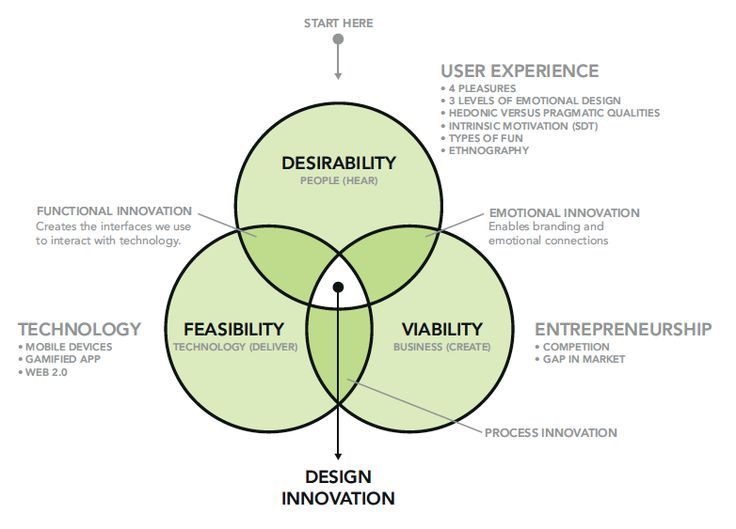
A product should be desirable, feasible and viable. You have to find all of them, but start with desirability.