Categories
Reviews

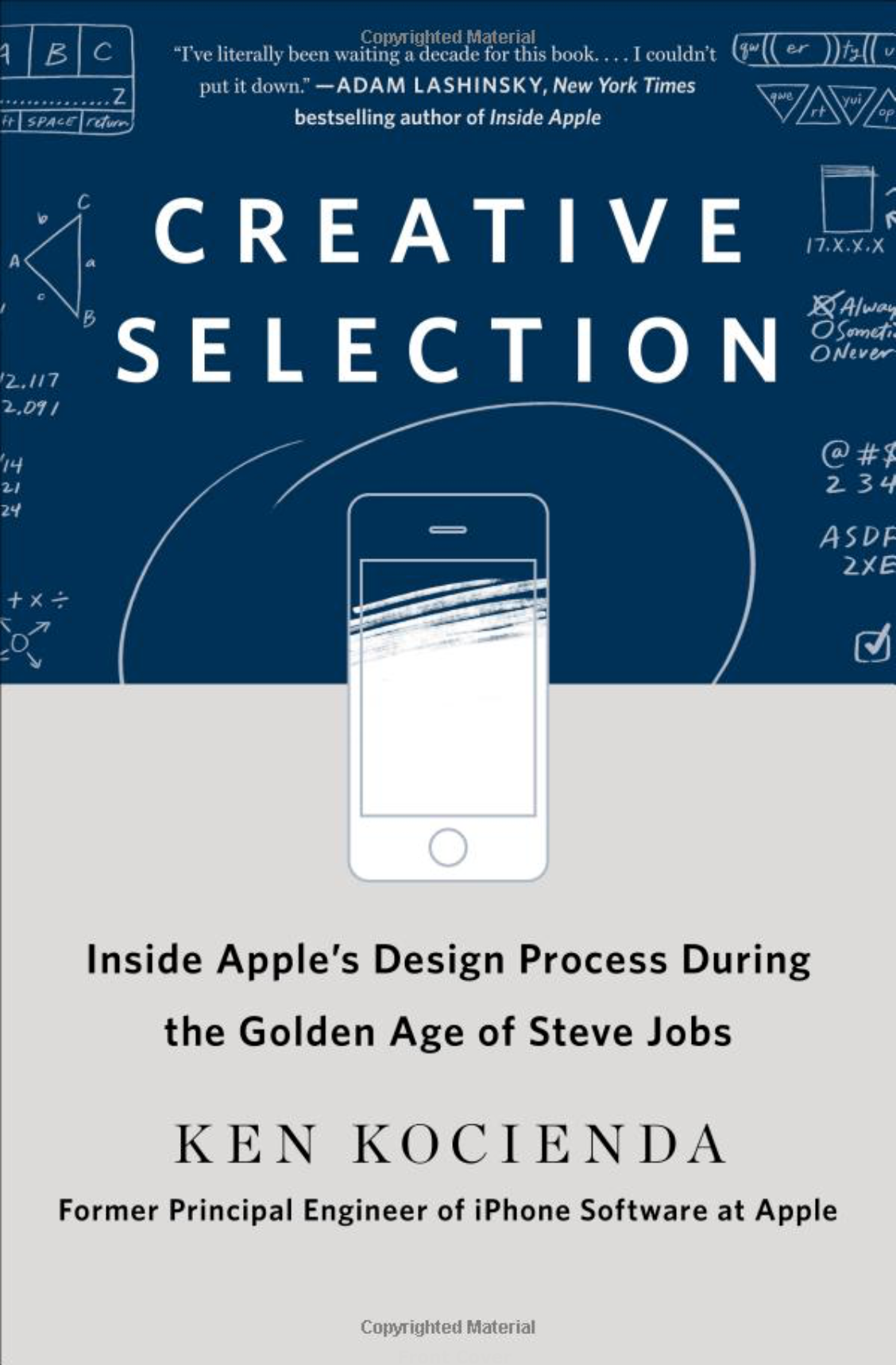
Creative Selection – Inside Apple’s Design Process During the Golden Age of Steve Jobs

Creative Selection – Inside Apple’s Design Process During the Golden Age of Steve Jobs

Hundreds of millions of people use Apple products every day; several thousand work on Apple’s campus in Cupertino, California; but only a handful sit at the drawing board. Creative Selection recounts the life of one of the few who worked behind the scenes, a highly-respected software engineer who worked in the final years of the Steve Jobs era―the Golden Age of Apple.

Ken Kocienda offers an inside look at Apple’s creative process. For fifteen years, he was on the ground floor of the company as a specialist, directly responsible for experimenting with novel user interface concepts and writing powerful, easy-to-use software for products including the iPhone, the iPad, and the Safari web browser. His stories explain the symbiotic relationship between software and product development for those who have never dreamed of programming a computer, and reveal what it was like to work on the cutting edge of technology at one of the world’s most admired companies.

Kocienda shares moments of struggle and success, crisis and collaboration, illuminating each with lessons learned over his Apple career. He introduces the essential elements of innovation―inspiration, collaboration, craft, diligence, decisiveness, taste, and empathy―and uses these as a lens through which to understand productive work culture.

An insider’s tale of creativity and innovation at Apple, Creative Selection shows readers how a small group of people developed an evolutionary design model, and how they used this methodology to make groundbreaking and intuitive software which countless millions use every day.


Amazon Link

Categories
Reposts

DevOps: Principles, Practices, and DevOps Engineer Role

DevOps: Principles, Practices, and DevOps Engineer Role

Categories
Reposts

A taste of MVVM and Reactive paradigm

A taste of MVVM and Reactive paradigm

Categories
Reposts

How UX Designers Make Developers More Efficient

How UX Designers Make Developers More Efficient

At my company, we have been developing web and mobile apps for almost 13 years. For the first 10 of those years our team was completely made up of developers: we did not have any UI or UX designers on our team. When we began our first project with our newly hired design director, we found something that we were not expecting, but very pleasantly surprised by. In addition to developers creating better-looking applications, they were also significantly more productive. This article will explore what we learned in that process and outline how great designers can make development teams more productive.

Categories
Reposts

Build, Test , Deliver — A complete guideline for iOS CI/CD

Build, Test , Deliver — A complete guideline for iOS CI/CD

Categories
Reposts

Jony Ive on Simplicity

Why do we assume that simple is good? Because with physical products, we have to feel we can dominate them. As you bring order to complexity, you find a way to make the product defer to you. Simplicity isn’t just a visual style. It’s not just minimalism or the absence of clutter. It involves digging through the depth of the complexity. To be truly simple, you have to go really deep. For example, to have no screws on something, you can end up having a product that is so convoluted and so complex. The better way is to go deeper with the simplicity, to understand everything about it and how it’s manufactured. You have to deeply understand the essence of a product in order to be able to get rid of the parts that are not essential.

(From Steve Jobs, by Walter Isaacson)

Categories
Reviews

Managing Humans: Biting and Humorous Tales of a Software Engineering Manager

Managing Humans: Biting and Humorous Tales of a Software Engineering Manager

Read hilarious stories with serious lessons that Michael Lopp extracts from his varied and sometimes bizarre experiences as a manager at Apple, Pinterest, Palantir, Netscape, Symantec, Slack, and Borland. Many of the stories first appeared in primitive form in Lopp’s perennially popular blog, Rands in Repose. The Third Edition of Managing Humans contains a whole new season of episodes from the ongoing saga of Lopp’s adventures in Silicon Valley, together with classic episodes remastered for high fidelity and freshness. Whether you’re an aspiring manager, a current manager, or just wondering what the heck a manager does all day, there is a story in this book that will speak to you-and help you survive and prosper amid the general craziness of dysfunctional bright people caught up in the chase of riches and power. Scattered in repose among these manic misfits are managers, an even stranger breed of people who, through a mystical organizational ritual, have been given power over the futures and the bank accounts of many others. Lopp’s straight-from-the-hip style is unlike that of any other writer on management and leadership. He pulls no punches and tells stories he probably shouldn’t. But they are magically instructive and yield Lopp’s trenchant insights on leadership that cut to the heart of the matter-whether it’s dealing with your boss, handling a slacker, hiring top guns, or seeing a knotty project through to completion. Writing code is easy. Managing humans is not. You need a book to help you do it, and this is it. What You’ll Learn Lead engineers Handle conflict Hire well Motivate employees Manage your boss Discover how to say no Understand different engineering personalities Build effective teams Run a meeting well Scale teams

Amazon Link

Categories
Reposts

Is this my interface or yours?

Is this my interface or yours?

As you tap around from app to app, you’ll see that there’s no standard way to refer to the things that belong to you within an interface. Some say it’s mystuff. Some say it’s your stuff.

If you’re designing an interface, does it matter whether the words are written from the user’s point of view or the product’s point of view? I think there’s a subtle difference, and it all depends on how you want your users to feel while using your product.

John Saito
Categories
Reviews

The Laws of Simplicity (Design, Technology, Business, Life)

The Laws of Simplicity (Design, Technology, Business, Life)

The basic objective of the book, the Laws of Simplicity (Simplicity: Design, Technology, Business, Life) is to promote simplicity. The book has been authored by John Maeda and it equates simplicity with sanity.

We are living in an era which is heavily dependent on technology, which can be complicated. for example, DVD players come with many menus and options and softwares which are bundled with voluminous manuals which are often too tedious to go through. However, despite the technological advancements, we want things that are easy and simple to use and, at the same, time should be able to perform all the complex tasks according to our desire.

In this book, the author explains ten laws to balance the elements of complexity and simplicity in the business, design and technology. These principles are guidelines for getting more then what is needed. The book tries to give an answer to the question on how the notion of ‘improved’ can be redefined so that it doesn’t always refer to something additional.

The Laws of Simplicity (Simplicity: Design, Technology, Business, Life) has been published by MIT Press in 2006. The book is available in hardcover edition. The author’s guide to simplicity is relevant in the digital age as it can drive both technology and business.

Amazon Link

Categories
Reposts

How to Write a Brand Story That Sells – Brandlitic

How to Write a Brand Story That Sells – Brandlitic

Categories
Reposts

Effective Remote Communication | Inside PSPDFKit

Effective Remote Communication | Inside PSPDFKit

Categories
Reposts

How to Use Smart Defaults to Reduce Cognitive Load – Shopify

How to Use Smart Defaults to Reduce Cognitive Load – Shopify

Categories
Quotes

The life of a designer is a life of fight

The life of a designer is a life of fight. Fight against the ugliness. Just like a doctor fights against disease. For us, the visual disease is what we have around, and what we try to do is cure it somehow with design.

Massimo Vignelli
Categories
Reposts

Mobile Internet Statistics and Facts 2016

digital-marketing-engineer:

  1. There are more mobile internet users than desktop internet users; 52.7% of global internet users access the internet via mobile, and 75.1% of U.S. internet users access the internet via mobile.
  2. Mobile media time in the U.S. has exceeded desktop, with mobile media time estimated to be 51% while desktop media time is estimated to be 42%.
  3. While there are more mobile users than desktop users, mobile advertising spend is still slightly lower than desktop advertising spend; mobile advertising spend currently represents 49% of digital advertising spend, compared to desktop at 51%.
  4. Mobile advertising spend is projected to account for 60.4% of all digital advertising spend by 2016 and 72.2% of all digital advertising spend by 2019.
  5. In 2015, mobile influenced retail sales to the tune of over $1 trillion.
  6. Search engines are the starting point for mobile research, with an estimated 48% of mobile internet users starting their search on search engines.
  7. Consequently, the #1 search engine, Google started to significantly use mobile compatibility as a factor when ranking websites.
  8. B2C mobile commerce sales in the U.S. is valued at an estimated $83.93 billion.
  9. 4 out of 5 consumers use a Smartphone to shop.
  10. 70% of mobile searches result in an online action within an hour of the search being conducted.
  11. 50% of mobile users will abandon of web page if it takes more than 10 seconds to load, and 60% won’t return to the site.

(via Internet Statistics & Facts (Including Mobile) for 2016 – HostingFacts.com)

Categories
Reposts

The Natural Balance

mindher:

The Natural Balance

self-watering flowerpot by Studio Lorier

http://studiolorier.com/natural-balance/

Categories
Reposts

The Right Way to Do Collaborative Design: How to Avoid Designing by Committee

The Right Way to Do Collaborative Design: How to Avoid Designing by Committee

Categories
Reposts

How Google Ventures Uses Design Sprints to Ship Great Products

How Google Ventures Uses Design Sprints to Ship Great Products

Categories
Reposts

What I Saw Inside Apple’s Top-Secret Input Lab — Backchannel

What I Saw Inside Apple’s Top-Secret Input Lab — Backchannel

Categories
Reposts

Configuring App Transport Security Exceptions in iOS 9 and OSX 10.11

Configuring App Transport Security Exceptions in iOS 9 and OSX 10.11

Categories
Reposts

Mathematical Web Typography

Mathematical Web Typography