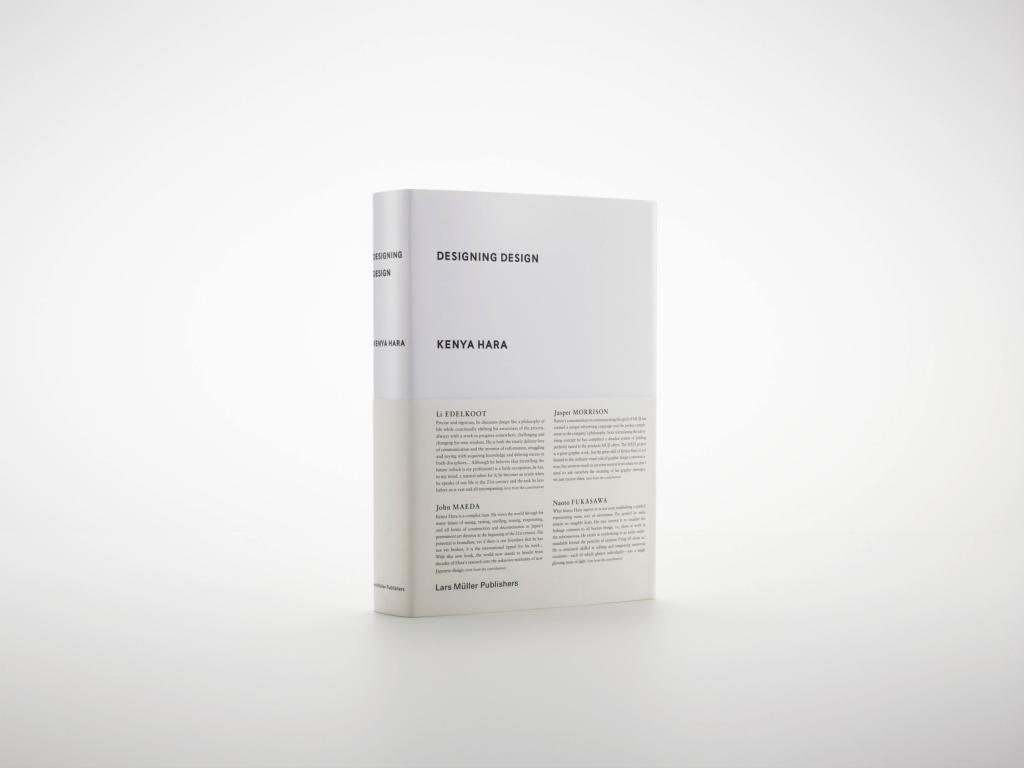
Finally ordered Designing Design by Kenya Hara. Cant wait to read it!
Finally ordered Designing Design by Kenya Hara. Cant wait to read it!
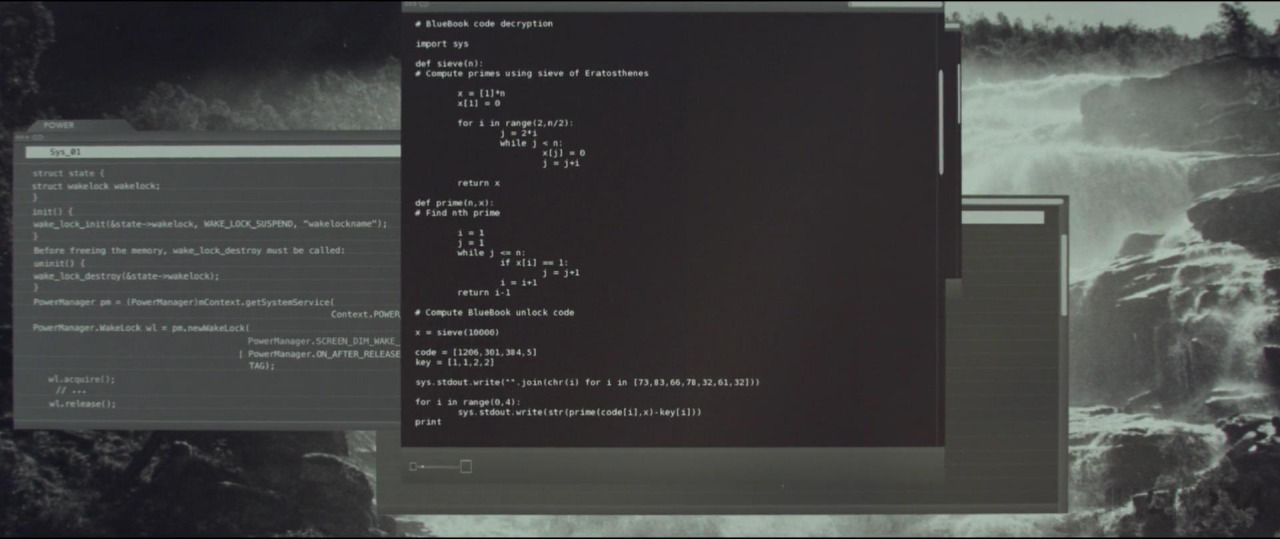
In the movie “Ex Machina” (which is really great BTW) this code can briefly be seen:
#BlueBook code decryption
import sys
def sieve(n):
x = [1] * n
x[1] = 0
for i in range(2,n/2):
j = 2 * i
while j < n:
x[j]=0
j = j+i
return x def prime(n,x):
i = 1
j = 1
while j <= n:
if x[i] == 1:
j = j + 1
i = i + 1
return i – 1
x=sieve(10000)
code = [1206,301,384,5]
key =[1,1,2,2,] sys.stdout.write(“”.join(chr(i) for i in [73,83,66,78,32,61,32]))
for i in range (0,4):
sys.stdout.write(str(prime(code[i],x)-key[i]))
Which when you run with python2.7 you get the following:
ISBN = 9780199226559
Which is Embodiment and the inner life: Cognition and Consciousness in the Space of Possible Minds
Pretty neat easter egg!
jgc says: “There’s a related thread on reddit about this.”
There’s no doubt that animating user interfaces is a rising trend. Risen enough that the emphasis is often put on the animation itself, rather than on improving the user experience through subtle and functional animation. Pasquale D’Silva gave some good advice in his talk at Web Direction South in 2013, including:
Good animation is invisible.
You shouldn’t notice that you’re looking at animation.
It’s great advice that we — the team behind Campaign Monitor’s email builder — have been trying to apply with a few principles in mind: animation must improve the usability, feel natural and subtle, and give feedback to the user.
Having spent the last year working on the email builder, I’ve learned that animation on the web — as opposed to native apps — comes with many challenges that go beyond finding the right timing, spacing, poses or easing. Animations just don’t render the same on all devices and browsers, and that rendering inconsistency has led us to compromise things to create a good user experience. In fact, some beautiful and useful interactions on our powerful 27" iMacs didn’t make it to the final product, because they felt jerky and slow on a device some of our users were more likely to use.
The Science of Good UX on E-commerce – eWebDesign
In this article, we will be discussing what Good UX qualities should be present in Ecommerce websites. We will be talking about how these qualities should be applied. Let’s take a look!
Design the user, not the experience | Userbrain

Following Apple’s advice and sticking with Model-View-Controller (MVC) design pattern seemed like a good idea at first, but as the app continued to grow, logic that drove some parts of it started to became complex to the point where making changes was accompanied with the feeling of unease and fixing issues in one part of the code with the fear of causing new bugs in some other parts. It would not be fair to blame only MVC for that – of course that some problems are caused by bad programming, lack of experience and the pressure of hard deadlines – but MVC is not well-wisher either. Thinking only in the terms of model, view and controller, one can miss some useful possibilities of how responsibilities can be further separated and dependency graph simplified. In following paragraphs I’ll present a situation where MVC can be improved by expanding it to MVVM
Good Design is About Process, not Product
This is some good shit right here:
“A designer’s process determines the difference between mediocre and great work. Natural talent and training aren’t substitutes for good design habits. The right process can cover many shortcomings of talent and skill — but the opposite is never true. A good process will bring out your best and most unique work. A bad process will leave you with tired, unsurprising clichés.”
The linked article is exactly how I think about design, articulated better than I have ever said it. In my opinion every designer should read this.
Amen.
Three important points about listening to your customers
I’ve known lots of business owners who want to “get some design in here” by hiring a designer. This almost never works because that owner isn’t thinking about design in the right way. Being a design-first company means to actually change the process of product design to one that starts with users actual goals or a known problem and working outward. If you are hitting a wall and hoping a designer can get you out of it, it’s probably not going to work without a fundamental change to your product development process.
Wells Rilley talks about how we have lost some of the crucial affordances while shifting our focus on to flat design too fast. Its time to hold on for a while and improve the flat design. Design has a purpose and if that purpose is lost, well its not a design anymore… its a decoration.
The flat movement was born out of a need to get as far away from skeuomorphism as possible. Shadows and metallic sheen were replaced with solid hues and typography-driven design. It was a harken back to the Swiss ‘international style’ of design where strong typography and blocks of color reigned supreme in print.
But perhaps the pendulum swung too far in the flat direction. In the transition to flat we lost some of the helpful affordances – especially on buttons and forms – that more traditional aesthetics used to make our products easy to use. When everything became flat, creating a clear visual hierarchy became a constant challenge.
Can you tell which Shift key is enabled?
Flat has been the predominant visual style for over a year, and some brilliant work has come out of it. But it’s clear that now it’s time to let the pendulum swing back – if even only a little bit.
Query!
Time for Programmers to Grow a Spine
Build something. Build something great. Make it so great that it makes money. Then bring on other people who believe in you and what you’ve built so much that they’re willing to risk for it. Don’t do it only because it makes money, but let money be a reward for bringing more value to your customers. Risk, lose, learn, and then win. It takes guts. It takes a spine. If you haven’t already, grow one.
Mistakes You Should Never Make
Seth Bannon talks about the mistakes he made as a CEO that he shouldn’t have,
The Why and The How of Organizations that Deliver Great Experiences
As companies embrace the need to take user experience seriously, often their first step is to build out a “UX department.” However, the reality is that user experience is a phenomenon that emerges from an entire organization’s activities, not just the efforts of one team. There are (at least) six components that need to be aligned throughout the organisation,
In Objective-C, selectors, methods, and implementations refer to particular aspects of the runtime, although in normal conversation, these terms are often used interchangeably to generally refer to the process of message sending.
Here is how each is described in Apple’s Objective-C Runtime Reference:
typedef struct objc_selector *SEL): Selectors are used to represent the name of a method at runtime. A method selector is a C string that has been registered (or “mapped”) with the Objective-C runtime. Selectors generated by the compiler are automatically mapped by the runtime when the class is loaded .typedef struct objc_method *Method): An opaque type that represents a method in a class definition.typedef id (*IMP)(id, SEL, ...)): This data type is a pointer to the start of the function that implements the method. This function uses standard C calling conventions as implemented for the current CPU architecture. The first argument is a pointer to self (that is, the memory for the particular instance of this class, or, for a class method, a pointer to the metaclass). The second argument is the method selector. The method arguments follow.The best way to understand the relationship between these concepts is as follows: a class (Class) maintains a dispatch table to resolve messages sent at runtime; each entry in the table is a method (Method), which keys a particular name, the selector (SEL), to an implementation (IMP), which is a pointer to an underlying C function.
To swizzle a method is to change a class’s dispatch table in order to resolve messages from an existing selector to a different implementation, while aliasing the original method implementation to a new selector.
Read More : http://nshipster.com/method-swizzling
I have never laughed so much while reading programming related stuff.
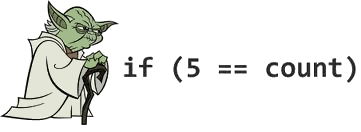
Yoda Conditions
Using
if(constant == variable)instead ofif(variable == constant), likeif(4 == foo). Because it’s like saying “if blue is the sky” or “if tall is the man”.
Interface Moss – The Usability Post
The recent minimalist trends in software design — Metro, flat, iOS7, Material — are attempts to scrape away the moss without a radical alteration in the underlying function. It is a reaction to the friction felt between the old stratum of software that has cemented its implementation and thus could afford to wear a rich visual coat, and a new stratum of software that yearns for a radically different approach to interface design.
It’s OK not to use tools by Jonas Downey of Basecamp
Remember when the web was damn simple? It still can be. It’s up to us to make it that way.