A few years back, I had two engineering teams stalled on the same platform migration. On paper, both wanted the same outcome – get off the legacy system before it started costing us reliability. But one team was arguing about sequencing, and the other was quietly convinced the whole migration was the wrong call to begin with. I made the mistake most leaders make in that moment: I gave both rooms the same pep talk. It worked for one team. It did nothing for the other.
That sent me back to a framework I’d come across years earlier – Clayton Christensen, Matt Marx, and Howard Stevenson’s Tools of Cooperation and Change. The idea is simple but easy to forget in the moment: before you reach for a leadership tool, diagnose what people actually agree on. A technique that works brilliantly in one situation can fail completely in another, and more often than not, the problem isn’t the tool – it’s the diagnosis.
Picture it like planning a climb with your team. Some people are excited about the summit but can’t agree on the route. Others know exactly how to make the climb but aren’t convinced the summit is worth it. A few disagree about both. And every so often, you get a team that shares the same ambition and trusts the same way of getting there.
From a distance, all four situations look identical: the team isn’t moving. But each one calls for a different response from you as the leader. Do you explain the vision? Introduce a process? Offer an incentive? Set a firm boundary? Or step back and let the culture carry the team forward? The answer depends entirely on the kind of agreement that already exists.
Why Good Leadership Tools Often Fail
Leaders have a lot of tools available to them: vision, storytelling, incentives, training, standard operating procedures, measurement, role modeling, negotiation, and formal authority. The common mistake and I’ve made this one myself is picking a favorite tool and reaching for it every time.
A visionary leader assumes a more inspiring presentation will resolve every disagreement. A process-oriented manager responds to uncertainty by adding another checklist. A decisive leader imposes a solution before understanding the resistance. A team with a strong culture keeps repeating familiar rituals even when the environment demands something different.
The problem usually isn’t the tool. It’s the diagnosis.
The Tools of Cooperation framework asks you to assess the situation along two dimensions:
- Agreement on goals: Do people agree on what they want to achieve?
- Agreement on cause and effect: Do people agree on which actions are likely to produce that result?
That second question goes deeper than agreeing on a plan. Two people can sign off on the same project plan while holding very different beliefs about why it will actually work. Cooperation holds together a lot better when the team shares an understanding of how the action leads to the outcome.
Together, these two dimensions give you four leadership situations.
The Four Tools of Cooperation
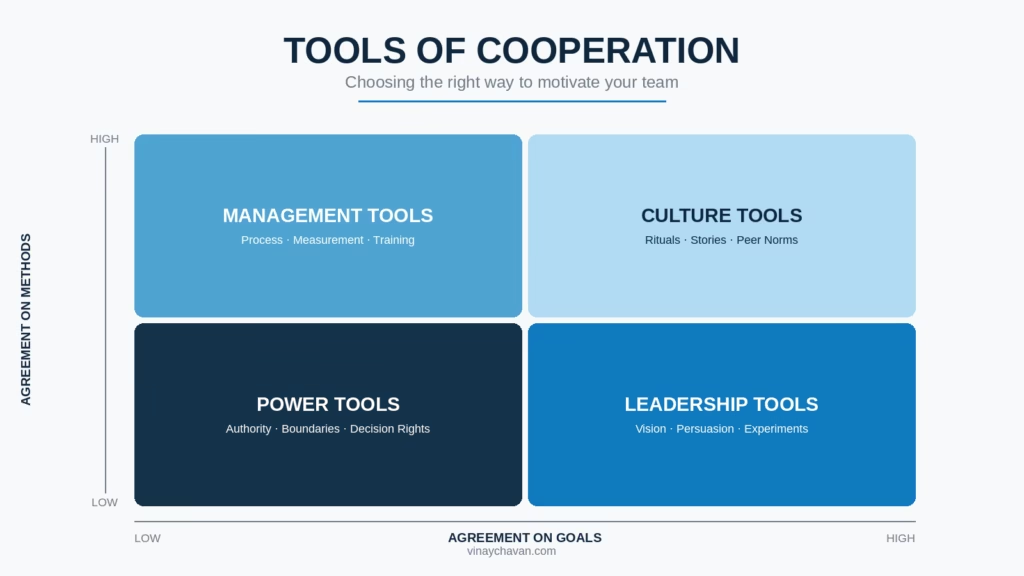
1. Power Tools: Little Agreement on Either Goals or Methods
When people disagree about both the destination and the way to get there, inspiration and process alone won’t create movement. This is where you need power tools: formal authority, role definition, control systems, firm boundaries.
That doesn’t have to mean authoritarian leadership. In practice, it usually means making a clear executive call, defining a non-negotiable standard, assigning decision ownership, or stopping behavior that’s creating unacceptable risk.
Example: I’ve seen this play out almost exactly in an engineering org dealing with repeated security incidents. Some teams didn’t believe security work should interrupt feature delivery, and there was no shared agreement on which controls actually mattered. The only way through was leadership setting a mandatory security baseline, assigning accountable owners, and blocking releases that failed critical checks.
The point of authority here is to break dangerous gridlock, not to replace leadership indefinitely. Power creates compliance quickly, but it rarely creates commitment on its own. Lean on it too long and you get silence, dependency, and resistance that just moves underground. Once the immediate risk is under control, the real work is building understanding and moving the team toward genuine agreement.
2. Leadership Tools: Goals Are Shared, Methods Are Disputed
This is the situation I run into most with ambitious teams. Everyone wants the same outcome better reliability, faster delivery, a stronger customer experience — but people disagree about how to get there.
This is where leadership tools do the work: vision, storytelling, persuasion, role modeling, strategic framing, visible experimentation.
Example: Product and engineering agree that releases need to get faster and safer. One group is pushing for trunk-based development, another wants longer stabilization cycles, a third thinks better automated testing is the real fix. Rather than prescribing every step up front, the job is to reconnect the debate to the shared outcome, make room for a controlled pilot, and model genuine curiosity about what the evidence shows.
Your job isn’t to pretend there’s no disagreement. It’s to keep disagreement about methods from destroying commitment to the goal. When people already care about the destination, a credible vision gives them a reason to try a new path and a small experiment turns competing opinions into shared evidence.
3. Management Tools: Methods Are Understood, Goals Differ
Sometimes people broadly agree on how the work gets done but show up for different reasons or optimize for different outcomes. This is where management tools earn their keep: standard operating procedures, measurement systems, training, resource allocation, incentives, clear responsibilities.
Example: Engineering, compliance, and customer support can all value a release-readiness review, just for different reasons. Engineering wants fewer rollbacks, compliance wants traceability, support wants fewer escalations. They don’t share an identical definition of success, but they agree the review reduces preventable failures. A documented process, a shared dashboard, and clear ownership can coordinate all three groups even before their motivations fully line up.
Management tools only work when people trust the relationship between the process and its outcome. If that trust is missing, adding more process just feels like bureaucracy. A checklist can’t fix a disagreement about whether the checklist actually works.
4. Culture Tools: Agreement on Both Goals and Methods
When a team shares both its priorities and its understanding of how to get there, cooperation becomes almost automatic. People make similar calls even when a manager isn’t in the room. This is culture tools: rituals, stories, traditions, peer recognition, shared language, consensus-based decisions.
Example: A mature team that genuinely believes in learning from failure doesn’t need to be told to run a blameless incident review after an outage, it just happens. The ritual is baked into how the team works. Stories from past incidents reinforce the norm, and the senior folks model it for anyone new.
That’s the strength of culture: it scales judgment. It’s also its limitation. A strong culture is excellent at protecting an established direction, but it can resist change that challenges the very beliefs that made it successful in the first place. A ritual that once drove excellence can quietly become an obstacle once circumstances shift. It’s worth asking regularly whether you have a strong culture or a culture suited to the next challenge those aren’t always the same thing.
Quick Reference
| Situation | Agreement on Goals | Agreement on Methods | Reach For |
|---|---|---|---|
| Power Tools | Low | Low | Authority, boundaries, decision rights |
| Leadership Tools | High | Low | Vision, persuasion, experiments |
| Management Tools | Low | High | Process, measurement, training, incentives |
| Culture Tools | High | High | Rituals, stories, peer norms |
The Team Isn’t Permanently in One Quadrant
This matrix is a snapshot, not a personality test for your organization.
The same team can sit in different quadrants depending on the decision. I’ve had teams with deep agreement on product quality, partial agreement on architecture, and almost no agreement on returning to the office all at the same time. Different stakeholder groups can land in different places too.
Which means the first question isn’t “what kind of team do I have?” It’s:
“For this specific change, where does agreement exist and where does it break down?”
Agreement also shifts over time. Dialogue builds agreement on goals. Experiments and evidence build agreement on cause and effect. Training makes a proven method easier to adopt. Repeated success eventually turns a new behavior into culture. Your job isn’t just picking the right tool for today, it’s helping the team build the shared understanding it’ll need tomorrow.
A Practical Diagnostic
Before you announce the next transformation, roll out a new process, or try to motivate a struggling team, pause and run a short diagnosis first.
Step 1: Define the change clearly. Finish this sentence in plain language: “We want the team to ______ because ______.” If you can’t state the change cleanly, you can’t honestly assess agreement on it.
Step 2: Test agreement on the goal.
- Do people agree this problem is worth solving?
- Do they define success the same way?
- Who benefits from the change, and who carries the cost?
- Is the agreement real, or are people just quiet in front of authority?
Step 3: Test agreement on cause and effect.
- Do people believe the proposed actions will actually produce the outcome?
- Which assumptions are backed by evidence, and which aren’t?
- Where are we leaning on habit, hierarchy, or opinion instead?
- What small experiment would reduce the uncertainty?
Step 4: Choose the tool that fits.
- Low agreement on both: set boundaries, decision rights, and immediate controls.
- Shared goal, disputed methods: lead with vision, persuasion, role modeling, experiments.
- Disputed goal, shared methods: coordinate through process, measurement, training.
- Agreement on both: reinforce it through rituals, stories, recognition, peer norms.
Choose the least forceful tool that will still produce responsible action. Authority may be necessary in an emergency, but it shouldn’t become a shortcut around actually listening.
Step 5: Reassess after you act. Don’t assume one intervention permanently resolves anything. Look for real evidence has behavior changed, has understanding improved, are people complying or genuinely committed, has the team moved toward more agreement? Cooperation is dynamic. Your diagnosis has to keep up with it.
Psychological Safety Makes the Diagnosis Honest
There’s a condition underneath all of this: people have to feel safe revealing disagreement.
If your team fears embarrassment, punishment, or being frozen out, you’ll see false consensus. Everyone nods along in the meeting while the real resistance moves into side conversations and quiet non-compliance. This is exactly the dynamic Google’s Project Aristotle research pointed to when it named psychological safety as the strongest predictor of team effectiveness and it matters here because the whole framework only works if people will tell you what they actually believe.
Before you try to measure alignment, make disagreement safe first. Ask for the counter-evidence. Invite the quietest people to speak before you share your own conclusion. Separate debating the idea from judging the person who raised it. A team that can disagree openly gives you better information and gives itself a real shot at genuine cooperation, not just the appearance of it.
Mistakes I See Leaders Make With This
Treating silence as agreement. People often go quiet because the decision already feels made. Test alignment privately, invite written input, and ask people to explain the goal and the logic back to you in their own words.
Using vision to solve a goal conflict. An inspiring speech doesn’t land when people fundamentally want different outcomes. Surface the competing interests before you try to rally everyone around a slogan.
Adding process to solve a belief conflict. If people don’t believe a method will work, a detailed procedure just formalizes the disagreement. Use evidence, pilots, and small wins to build confidence in cause and effect instead.
Overusing authority. Power moves fast, especially in a crisis, but leaning on it too often erodes ownership. Use it to protect clear boundaries or break urgent gridlock, then build a path back toward participation.
Assuming a strong culture is automatically an adaptive one. Deep agreement makes execution efficient, but it can also make old assumptions invisible. Every so often, ask which rituals still serve the mission and which ones are just preserving the past.
Diagnosing the whole org as one group. Executives, managers, front-line engineers, customers, and partners can all hold different goals and different beliefs about cause and effect. Map the important stakeholder groups separately before you pick an intervention.
Final Thoughts
Motivating a team was never really about becoming more charismatic, more forceful, or more process-driven. It’s about understanding the situation well enough to know which response it actually calls for.
The Tools of Cooperation framework gives you a disciplined way to make that call. When a team disagrees about both goals and methods, establish clarity and boundaries first. When the goal is shared but the path is uncertain, lead with vision and learning. When the method is trusted but the motivations differ, coordinate through management systems. When both are shared, let culture carry the work and stay alert to the moment it starts protecting the past instead of the mission.
The mountain was never really the problem. The real question is whether people want the same summit, believe in the same route, and trust each other enough to say when they don’t.
So before asking “how do I motivate this team,” ask two better questions: what do we genuinely agree on, and which tool does this specific situation actually call for? The quality of that diagnosis will tell you almost everything about the quality of your leadership.
